
Science fiction has long imagined alien landscapes, apocalyptic disasters, and monstrous ecosystems. Yet some of the strangest scenarios ever conceived didn’t originate in a writer’s imagination. They actually happened here on Earth.
Buried beneath the crust and preserved throughout the fossil record is evidence of a planetary history far stranger than the world we know today. Natural nuclear reactors operated underground, oxygen poisoned much of the existing life, and mysterious organisms towered over landscapes with almost no trees. These ten ancient events sound like sci-fi plot devices, but each is grounded in scientific evidence.
Related: Planet Earth’s 10 Most Hardcore Natural Creations
10 The Asteroid’s Underground Oasis
Scientists Finally Solved the Mystery Of The Missing Chicxulub Meteor
When the roughly 6-mile-wide (10 km) Chicxulub asteroid struck Mexico’s Yucatán Peninsula 66 million years ago, it triggered a global catastrophe. The impact vaporized rock, hurled debris into the atmosphere, and contributed to an extinction that eliminated about 75%of Earth’s species, including all non-avian dinosaurs.
Yet the destruction above ground created an unexpected sanctuary beneath it. When scientists drilled into the crater’s peak ring in 2016, they discovered that the impact had fractured the crust into an enormous network of porous rock. Seawater poured into those fractures and encountered intensely heated material deep below the crater.
The result was a vast hydrothermal system filled with circulating, mineral-rich water. It may have remained active for at least 100,000 years, supplying sulfur, iron, and other chemicals that could support microorganisms in the absence of sunlight. While the surface endured a prolonged impact winter, life may have flourished inside a warm subterranean refuge created by the very disaster devastating the planet above.[1]
9 Snowball Earth
How Volcanoes Froze the Earth (Twice)
During the Cryogenian Period, Earth experienced two extraordinary deep freezes, the Sturtian and Marinoan glaciations. Ice sheets expanded from the poles toward the tropics, leaving much—or perhaps nearly all—of the planet encased in ice.
The freeze became self-reinforcing. As more bright ice covered the darker land and ocean, Earth reflected increasing amounts of sunlight back into space. Temperatures fell further, allowing the ice to spread until glaciers reached areas near the equator. Thick ice restricted contact between the atmosphere and ocean, severely challenging the single-celled organisms then inhabiting the planet.
Volcanoes eventually provided an escape. With rainfall and rock weathering greatly reduced, carbon dioxide released by volcanic activity accumulated in the atmosphere for millions of years. The resulting greenhouse effect eventually overwhelmed the ice’s reflectivity, triggering a dramatic global thaw. Life survived the frozen interval in scattered refuges, emerging into a radically transformed world that would later support increasingly complex organisms.[2]
8 When Oxygen Became Poison
How a single-celled organism almost wiped out life on Earth – Anusuya Willis
Today, oxygen sustains most complex life on Earth. Around 2.4 billion years ago, however, it was an environmental poison capable of destroying the organisms that dominated the planet.
The trouble began when cyanobacteria evolved oxygen-producing photosynthesis. Their new metabolism used sunlight to generate energy, releasing oxygen as a byproduct. Most organisms alive at the time were anaerobic microbes adapted to an oxygen-free world, and the highly reactive gas could damage their cellular machinery.
At first, the oxygen combined with dissolved iron in the oceans, producing the vast rust-colored deposits now known as banded iron formations. Once those chemical sinks became saturated, oxygen began accumulating in the atmosphere. It also reacted with methane, a powerful greenhouse gas, helping drive the planet into the prolonged Huronian glaciation.
The Great Oxidation Event likely devastated many anaerobic ecosystems while opening entirely new evolutionary possibilities. The gas that nearly transformed early Earth into a biological wasteland ultimately made complex animals—and humans—possible.[3]
7 Earth’s Natural Nuclear Reactors
Earth’s Two-Billion-Year-Old Nuclear Reactor
In 1972, scientists examining uranium from Gabon noticed something nearly impossible: some of its uranium-235 appeared to have already been consumed in a nuclear chain reaction. The explanation was even stranger. Earth had created its own nuclear reactors roughly two billion years before humans learned how.
At that time, naturally occurring uranium contained a much higher proportion of fissile uranium-235 than it does today. At Oklo, groundwater flowed through rich uranium deposits buried in sandstone. The water slowed neutrons released during radioactive decay, allowing them to split nearby uranium atoms and sustain nuclear fission.
The reactors even regulated themselves. As fission heated the groundwater, the water boiled away, removing the moderator and stopping the reaction. Once the rock cooled, water returned, restarting the cycle. This process may have generated roughly 100 kilowatts of thermal power intermittently for hundreds of thousands of years.
Long before engineers built the first nuclear power station, geology, water, and radioactive ore had already assembled functioning reactors beneath ancient Africa.[4]
6 The Giant That Defies Classification
Science Has Found a Whole New Kingdom of Life
Between roughly 420 and 370 million years ago, Earth’s landscapes looked almost alien. Early land plants remained low to the ground, lacking the deep roots and woody structures needed to grow tall. Rising above them were enormous pillar-like organisms called Prototaxites, some reaching approximately 26 feet (8 m) in height and more than 3 feet (0.9 m) across.
Since the first fossils were described in 1859, scientists have struggled to determine what these giants actually were. Researchers initially classified them as ancient conifers, then as giant algae. Later analysis showed that they did not obtain their carbon through photosynthesis, as ordinary plants do, leading many scientists to interpret them as colossal fungi that absorbed nutrients from decaying organic matter.
Recent research has complicated that explanation again. Some specimens possess chemical and structural features that don’t match known fungi, plants, or algae, raising the possibility that Prototaxites belonged to an entirely extinct branch of complex life.
Whatever they were, these towering organisms dominated terrestrial landscapes for millions of years before true trees evolved. Earth once supported a forest of giants unlike anything alive today—and scientists still aren’t certain where they belong on the tree of life.[5]
5 The Mediterranean Sea Evaporated and Refilled
That Time the Mediterranean Sea Disappeared
Nearly 6 million years ago, tectonic shifts narrowed and eventually closed the ocean channels connecting the Mediterranean Sea to the Atlantic Ocean. Cut off from its main water supply, the enclosed basin lost far more water to evaporation than it received from rainfall and rivers. The result was the Messinian Salinity Crisis.
As the Mediterranean’s water level fell, much of the sea became a vast desert basin lying thousands of feet below the surrounding continents. Enormous salt deposits accumulated on its floor, while rivers such as the ancient Nile and Rhône carved deep canyons as they descended toward the shrinking water.
Around 5.33 million years ago, Atlantic water breached the barrier near the Strait of Gibraltar and began pouring into the empty basin during the Zanclean Flood. The water carved a channel roughly 125 miles (200 km) long, with peak flow rates estimated at about 1,000 times that of the modern Amazon River.
Although the flood may have begun slowly, researchers estimate that 90%of the Mediterranean’s water returned within several months to two years. At its peak, the sea level may have risen by more than 33 feet (10 m) per day, refilling an entire ocean basin with the speed of a planetary disaster film.[6]
4 Earth Was Once Inhabited by Giant Insects
What Was Earth Like in the Age of Giant Insects?
During the Carboniferous Period, vast tropical swamps covered large portions of Earth’s continents. Their forests contained towering lycopsids such as Lepidodendron, giant horsetails, and tree ferns rather than the flowering plants and hardwood trees familiar today.
When this vegetation died, much of it fell into oxygen-poor swamps, where decay proceeded slowly. Layer after layer of buried plant matter eventually formed many of Earth’s major coal deposits. Because so much carbon remained trapped underground, atmospheric oxygen rose to perhaps 30–35 percent, compared with about 21%today.
That oxygen-rich atmosphere allowed insects and other arthropods to reach extraordinary sizes. Insects breathe through small openings called spiracles, which connect to branching tubes that deliver oxygen directly to their tissues. Higher oxygen concentrations made that system far more efficient and helped remove one of the limitations on insect size.
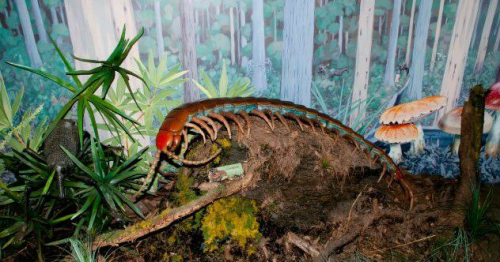
Dragonfly relatives such as Meganeura developed wingspans of approximately 2.5 feet (0.75 m). Meanwhile, the millipede-like Arthropleura could grow to about 8.5 feet (2.6 m), making it the largest known land-dwelling arthropod. For a time, Earth really did resemble a monster movie populated by insects the size of birds and invertebrates longer than most humans are tall.[7]
3 A Two-Million-Year Climate Shift
The Time It Rained for 2 Million Years – The Carnian Pluvial Event
During much of the Late Triassic Period, the supercontinent Pangaea was dominated by harsh inland deserts. Because its enormous interior lay far from the oceans, little moisture reached many regions. Then volcanic eruptions associated with the Wrangellia terrane, now found in parts of Alaska and British Columbia, helped transform the planet’s climate.
Over hundreds of thousands of years, the eruptions released vast quantities of carbon dioxide and other gases. Rising temperatures accelerated evaporation and strengthened the global water cycle, helping trigger the Carnian Pluvial Episode around 234 million years ago.
Despite its popular description as a rainstorm lasting 2 million years, the event did not produce uninterrupted rain everywhere. Instead, it was a prolonged interval of recurring monsoons, intensified rainfall, and unusually humid conditions that repeatedly swept across regions normally dominated by deserts. Geological layers around the world preserve river sediments, coal beds, and other evidence of this dramatic transition.
The shift disrupted existing ecosystems and contributed to widespread changes among plants and animals. As older groups declined, dinosaurs began diversifying into newly available ecological roles. Earth had transformed from an arid supercontinent into a world of powerful monsoons—and that climate upheaval helped set the stage for the dinosaurs’ eventual rise.[8]
2 Bipedal Crocodile Relatives Ruled Triassic Earth
When Dinosaur Look-Alikes Ruled the Earth
Dinosaurs did not immediately dominate the planet after they evolved. During much of the Triassic Period, they shared the landscape with a far more diverse and often more imposing group of reptiles: the pseudosuchians, or crocodile-line archosaurs.
Modern crocodiles and alligators provide only a limited glimpse of what their ancient relatives looked like. Triassic pseudosuchians included armored herbivores, enormous four-legged predators, and surprisingly agile hunters that walked upright with their legs positioned beneath their bodies.
Among the strangest were poposauroids such as Poposaurus. Unlike today’s sprawling crocodilians, Poposaurus traveled on two powerful hind legs and used its long tail for balance. Its narrow skull, sharp teeth, and lightweight build made it look remarkably like a theropod dinosaur, even though it belonged to the crocodilian branch of the archosaur family tree.
This resemblance developed independently through convergent evolution. Faced with similar environmental pressures, two separate reptilian lineages evolved nearly identical body plans millions of years apart. Before dinosaurs claimed the starring role, Triassic Earth was already populated by bipedal crocodile relatives that looked like convincing dinosaur impersonators.[9]
1 The Sunless Antarctic Rainforest
What If Antarctica Were a Rainforest?
Today, Antarctica is the coldest and driest continent on Earth, buried beneath an ice sheet that reaches several miles thick in places. During the mid-Cretaceous Period, however, extreme greenhouse conditions transformed the region into something almost unimaginable: a temperate forest near the South Pole.
During a 2017 expedition aboard the research vessel Polarstern, scientists drilled into the seabed near West Antarctica’s Pine Island Glacier. Almost 100 feet (30 m) beneath the ocean floor, they recovered a layer of 90-million-year-old soil that had formed on land.
CT scans revealed an intricate network of fossilized plant roots. Researchers also found pollen and spores from flowering plants, ferns, and conifers, proving that a dense temperate swamp forest once covered the Antarctic coast. The landscape may have resembled parts of modern New Zealand rather than the frozen desert that exists there today.
The forest grew at roughly 82 degrees south latitude, where it endured about four months of complete darkness every winter. Climate models suggest the region’s average annual temperature may have been around 54°F (12°C), with atmospheric carbon dioxide concentrations far higher than today’s.
Long before Antarctica became a world of glaciers, plants flourished beneath months of darkness in a warm polar rainforest. It sounds like an alien biome designed for science fiction, but it once existed at the bottom of our own planet.[10]
fact checked by Darci Heikkinen
Estelle is a regular writer for Listverse.