
More than half of the vehicles on Indian roads continue to operate without mandatory third-party insurance despite it being a legal requirement. The Supreme Court’s latest move to extend the compulsory insurance period for new vehicles is aimed at addressing this long-standing problem, but industry experts say the real challenge lies elsewhere. The apex court has increased the mandatory third-party insurance tenure for new vehicles by one year — from five years to six years for two-wheelers and from three years to four years for cars. Third-party motor insurance covers compensation payable to people injured or killed, or whose property is damaged in an accident involving the insured vehicle. Unlike comprehensive motor insurance, it does not cover damage to the owner’s own vehicle.
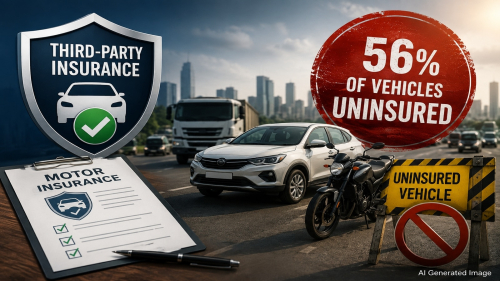
It is mandatory under Indian law because it ensures accident victims have access to compensation. The Supreme Court noted that nearly 56% of vehicles continue to operate without valid third-party insurance, leaving victims and their families to “run from pillar to post” to seek compensation. When an uninsured vehicle is involved in an accident, victims often face a longer and more complicated process to recover compensation because there is no insurer available to settle valid third-party claims. However, experts told CNBC-TV18 that extending policy tenure alone is unlikely to solve the problem unless the broader system of vehicle registration, tracking and enforcement is strengthened.
Why hasn’t mandatory insurance solved the problem? According to Thomas Devasia, Former Member (Non-Life) of IRDAI, India’s uninsured vehicle problem has little to do with the initial purchase of insurance and much more to do with renewals. “What the Supreme Court is suggesting… is based on a common understanding that if I extend the tenure by multiple years applicable for a TP policy, things will become okay.
But that has not been so,” he said. Devasia argued that increasing the compulsory insurance period merely postpones the problem because many vehicles drop out of the insurance system once the initial mandatory policy expires. “The issue is with renewals. The issue is more systemic with regard to how vehicles are being tracked at the time of registration and from the time of registration,” he said. He pointed out that nearly two crore new vehicles are registered every year.
Once their initial third-party insurance expires after four or six years, many owners simply do not renew their policies. Why do renewals remain the biggest challenge? The experts agreed that the problem begins after the mandatory insurance period ends. Udayan Joshi, Chief Operating Officer at SBI General Insurance, said renewals have historically been difficult because of a combination of distribution challenges, affordability, convenience and consumer perception.
More Read

“Renewal has always been a challenge for insurance companies for several reasons, right from distribution capability to the value perceived by consumers and their actual ability to transact,” he said. According to him, extending policy tenure should be viewed as only one element of a broader strategy rather than a complete solution. Why does the Supreme Court want longer insurance periods? Joshi said the court’s objective is to ensure more vehicles remain insured for longer while regulators and enforcement agencies strengthen compliance. He described the order as a “multi-dimensional approach” involving three elements:
Longer-tenure insurance products. Better enforcement by authorities. Improved use of vehicle and insurance data.
Beyond extending insurance tenure, the Supreme Court has also suggested measures such as automated number plate recognition, linking enforcement with fuel refills, mandatory accident reporting by police and greater use of data maintained by the Insurance Information Bureau (IIB). “If we are able to reduce the proportion of uninsured vehicles by 5% over the next couple of years, I think this will be a big feat,” Joshi said. Is better enforcement the real solution? Both experts believe enforcement will play a much larger role than simply increasing policy tenure. Devasia said India already has extensive digital infrastructure through the Vahan vehicle database and the Insurance Information Bureau, making it possible to identify uninsured vehicles. He argued that authorities should focus on cleaning up vehicle registration records rather than creating additional policing mechanisms.
More Read

“Enforcement should happen with regard to cleaning up the system. Enforcement should not happen by creating new policing mechanisms because they only postpone the problem,” he said.
He also suggested that private vehicles should be required to update their registration details more frequently, similar to commercial vehicles that undergo periodic fitness tests. Should uninsured vehicles be denied fuel? Among the Supreme Court’s suggestions is denying fuel to vehicles that do not carry valid insurance.
While Devasia acknowledged the need for stronger enforcement, he cautioned that creating multiple checkpoints could encourage workarounds rather than genuine compliance. Instead, he favoured stricter penalties linked directly to vehicle registration. “In fact, I would recommend that…
the vehicle registration itself should be cancelled if insurance is found to be missing,” he said. According to him, severe penalties would encourage vehicle owners to renew their insurance instead of waiting until they are caught. Can technology improve compliance? Joshi believes technology could significantly improve renewal rates without requiring major physical infrastructure.
He suggested automated number plate recognition, handheld devices for police officers and proactive alerts to uninsured vehicle owners could encourage timely renewals. “In my personal experience, the moment I know somebody is watching me, my behaviour tends to change,” he said. He added that most insurers already offer digital purchase options through websites, mobile apps and point-of-sale channels, including at fuel stations. “So it’s not about cost. It’s more about intent, and it’s about pinpointing who needs to be nudged,” Joshi said. Will insurance become cheaper if more people buy it?
Joshi argued that bringing uninsured vehicles into the insurance pool could eventually benefit policyholders. Insurance works by pooling risk across millions of customers. As more vehicle owners participate, insurers are better placed to spread claims costs across a larger base, which could improve pricing efficiency over time.

“Imagine if all these 50% of people who currently do not have insurance joined this pool. Probably the average premium, over a period of time, has a strong possibility of coming down for consumers,” he said. What happens next? The Supreme Court’s order will keep new vehicles covered by mandatory third-party insurance for an additional year. But both experts believe that is only the first step. Lasting improvement will depend on stronger renewal tracking, cleaner vehicle registration databases, better use of technology and closer coordination between insurers, regulators, transport authorities and police. The court’s decision may improve compliance in the short term, but unless authorities can ensure vehicle owners continue renewing their policies after the mandatory period ends, experts say India’s uninsured vehicle problem is unlikely to change materially.