

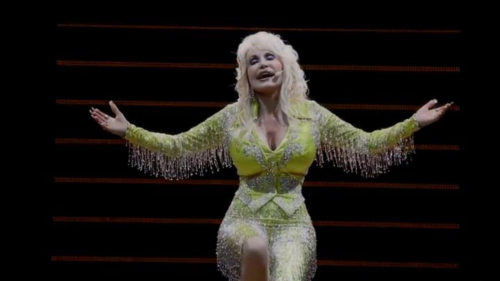
Dolly Parton, the rhinestone-clad singer-songwriter-actor who rose from a one-room cabin in the Great Smoky Mountains to become the best-selling female country artist of all time, died Tuesday, August 25, in Nashville. She was 80. Her family did not disclose a cause of death, saying only that she “died peacefully today in Nashville.” News of her passing came in a video posted to her official Instagram by her nephew, Bryan Seaver, who for more than two decades served as her head of security, a role his own father, Larry, had held before him. In the video, Seaver described Parton by the names her family used for her: “Sister, Sis and Granny to one generation and Gigi to the next”. He said the sorrow over her death belonged to those left behind, not to Dolly herself. He recalled that she had asked him years earlier to be the one to deliver the news when the time came, and said she wanted to be laid to rest “in a beautiful bed of plush cotton” after a lifetime spent in heavy rhinestones. The death comes just days after Parton addressed her declining health directly.
In an interview published August 21, she told PEOPLE that she had been managing health issues she’d let slide while caring for her husband, Carl Dean, before his death in March 2025, but stressed she had weathered hard stretches before, including a period sidelined by illness and weight struggles in the early 1980s. She added that despite the toll of nonstop scrutiny in the social-media era, she intended to keep working, saying she still had “so many things” she wanted to accomplish.
Parton’s decline had played out publicly for nearly a year. Health concerns forced her to postpone, and later scrap entirely, a long-awaited December 2025 residency at Caesars Palace in Las Vegas — her first extended Vegas run in three decades — as well as her planned appearance to accept the Motion Picture Academy’s Jean Hersholt Humanitarian Award. She had described the ailments as including kidney stones and issues affecting her immune and digestive systems, and, in a virtual appearance tied to a new Dollywood ride earlier this year, spoke of bouts of dizziness and dehydration that led her Nashville doctor to ground her from travel. Even so, she remained active behind the scenes into 2026: overseeing the opening of her Nashville hotel, SongTeller, and its attached Life of Many Colors Museum; appearing in person to open her own truck stop in Tennessee in June; and helping shepherd ‘Dolly: An Original Musical,’ a stage adaptation of her life, through its pre-Broadway run in Nashville over the summer, with hopes of a New York transfer in 2026. Born January 19, 1946, Dolly Rebecca Parton was the fourth of 12 children of Robert Lee and Avie Lee Owens Parton, in a cabin on the banks of the Little Pigeon River near Sevierville, Tennessee.
The family had no plumbing or electricity, and her mother sewed the children’s clothes from scraps and feed sacks, an experience Parton later transformed into ‘Coat of Many Colors,’ one of her most enduring songs. She grew up singing in the Pentecostal Church of God and began writing songs as a child, later saying she used to wander graveyards making up stories about the people buried there. She cut her first single, ‘Puppy Love,’ at 13, and performed on the Grand Ole Opry as a teenager, introduced there by Johnny Cash. The day after becoming the first in her family to graduate high school, in June 1964, she boarded a bus for Nashville. Parton spent her early Nashville years writing for other artists before landing her breakout role as Porter Wagoner’s duet partner on his syndicated television show, beginning in 1967.
The pairing produced 11 top-10 singles and a shared 1974 No. 1, but Parton’s own ambitions eventually outgrew the act. She left Wagoner’s show in 1974, marking the split with ‘I Will Always Love You’, a farewell song she said she wrote to ease the tension of the breakup.
More Read

Parton racked up 25 No. 1 country singles over her career, many self-written, and was among the first major female country stars — after Loretta Lynn — to build her catalogue largely on her own songwriting. ‘Jolene,’ released in 1973, became one of her signature hits; she later said the song, along with ‘I Will Always Love You,’ came from the same emotionally fraught period, inspired in part by a bank teller’s flirtation with her husband.
Her pop crossover began in earnest with 1977’s ‘Here You Come Again,’ and accelerated with 1980’s ‘9 to 5,’ written for the film of the same name, which paired her with Jane Fonda and Lily Tomlin and earned her a Golden Globe nomination and an Oscar nod for the title song. She went on to star in The Best Little Whorehouse in Texas (1982), Rhinestone (1984) opposite Sylvester Stallone, and Steel Magnolias (1989), and later produced television projects including, with her former manager Sandy Gallin, Buffy the Vampire Slayer and the Father of the Bride films. The 1983 duet ‘Islands in the Stream,’ written by the Bee Gees and performed with Kenny Rogers, became one of the biggest hits of her career, while her roots-leaning 1987 album ‘Trio,’ with Emmylou Harris and Linda Ronstadt, became a personal touchstone; Parton would later call it one of the finest things she’d ever been part of. A bluegrass resurgence in the early 2000s — ‘The Grass Is Blue,’ ‘Little Sparrow’ and ‘Halos & Horns’ — won fresh Grammys and critical acclaim, including a striking cover of Led Zeppelin’s ‘Stairway to Heaven.’
She was godmother to Miley Cyrus, whose father, Billy Ray Cyrus, was a longtime friend, and played the recurring role of “Aunt Dolly” on Disney Channel’s ‘Hannah Montana’ between 2006 and 2010. Later career highlights included her 2016 album ‘Pure & Simple,’ her first country No. 1 in 25 years, a Sunday “Legends” slot set at England’s Glastonbury Festival that drew one of the biggest crowds in the festival’s history, and 2023’s ‘Rockstar,’ a covers-and-collaborations album with artists including Paul McCartney, Ringo Starr, Miley Cyrus and Joan Jett that accompanied her induction into the Rock & Roll Hall of Fame, an honour she initially tried to turn down, saying she didn’t feel she’d earned it as “a true rocker,” before relenting. Beyond music, Parton built Dollywood, her theme park in Pigeon Forge, into an economic engine for East Tennessee, and became known for philanthropic work including disaster relief for 2017 wildfire victims, funding for Covid-19 vaccine research, and her Imagination Library, which mails free books to children from birth through kindergarten — a project she has said was inspired by her father, who never learned to read.

Her honours accumulated across decades: induction into the Country Music Hall of Fame in 1999, the Songwriters Hall of Fame in 2001, the National Medal of Arts in 2005, Kennedy Center Honors in 2006, and 11 Grammy Awards over her career, along with an Emmy for the TV movie ‘Dolly Parton’s Christmas on the Square.’
Parton married Carl Dean in May 1966; the couple had no children but remained together until his death in March 2025, days after which she released a tribute song, ‘If You Hadn’t Been There.’ Of their six-decade marriage, largely kept out of the public eye at Dean’s preference, she once said her time on the road was part of what made the relationship last, joking that her secret was simply to “stay gone.”
Reflecting on her life in a November 2025 interview, Parton said she didn’t dwell on turning 80, adding that she still felt like she was “just getting started.” She is survived by her extended family, including the nieces and nephews who called her “Aunt Granny.”