


The hardest remaining barrier to rapid Starship reuse is no longer engines, tanks, or even catching the vehicle. It is the heat shield.
Three specific problems still dominate:
Mechanical loads during ascent (vibration combined with higher dynamic pressure)
Coefficient of thermal expansion mismatch — stainless steel expands far more than the silica-based tiles
Plasma intrusion into the seams between tiles
SpaceX is attacking all three at once with improved mechanical attachments, better gap sealing, refined edge geometry, and load-sensing tiles that report their own health.
Note: Even if the heat shield needed complete replacement, returning intact and reusable engines would still increase the total volume of flights.
Why Tile Work Is Actually Getting Faster
Unlike the Space Shuttle, Starship tiles are not bonded. They are mechanically attached with studs and pins. Most are standardized hexagonal shapes, so spares are interchangeable. This design was intentional. Swapping a tile was always meant to be relatively quick.
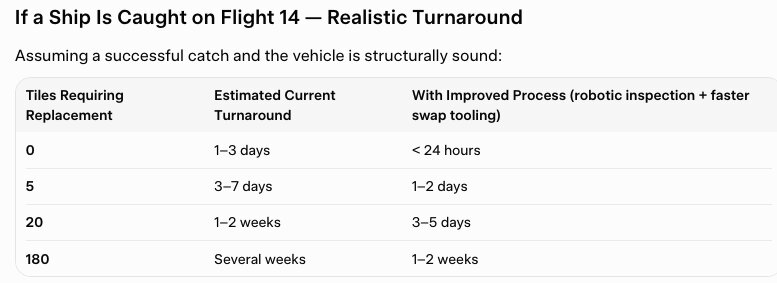
Today the bottlenecks are detailed inspection (especially cracks that reach the attachment points) and the manual labor required for replacement. The steel structure itself has enough thermal margin that imperfect tiles can often be left in place if sensors and visual inspection clear them.
The Trajectory to Rapid Reuse
SpaceX’s current progress points to a clear sequence:
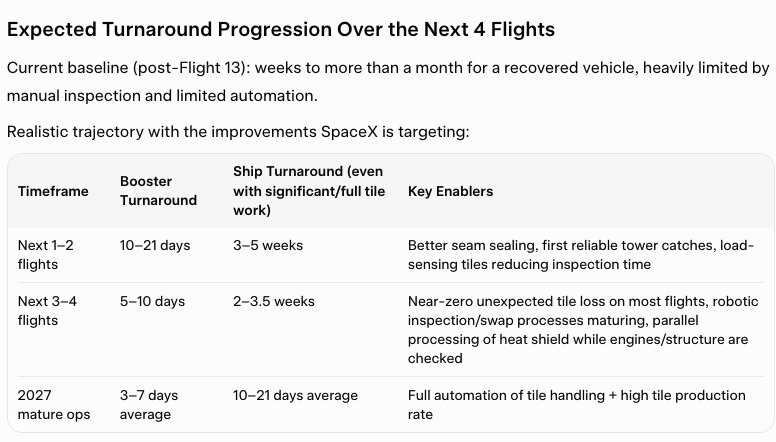
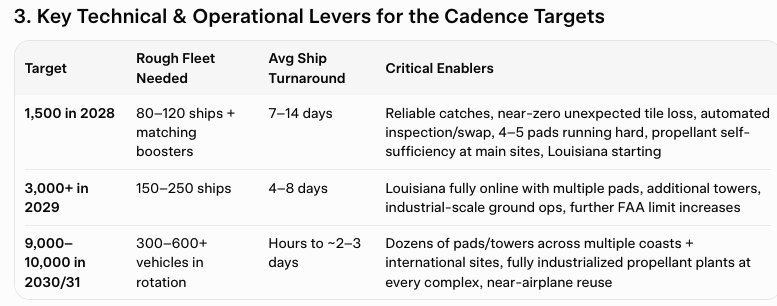
Near-zero tile replacement (or only a handful of tiles) within the next 2–4 flights — if seam sealing and edge robustness keep improving at the present rate.
Multi-day turnaround once robotic/automated inspection and tile-swap processes mature.
True rapid reuse (same-day or next-day) further out. This will require both near-perfect tile retention and highly automated ground operations.
The ultimate target remains the one Elon has stated for years. Booster reuse measured in hours, with the ship following on a longer but still operational cadence. The heat shield is the last major piece that has to stop being a multi-week repair job and become a routine check-and-go item.
Every successful flight that returns with fewer damaged tiles and cleaner seams moves that timeline forward. The mechanical attachment system, standardized hex tiles, and steel’s thermal margin were all chosen precisely so this progression could happen. The remaining work is execution — sealing the seams, hardening the edges, and automating the inspection and swap process.
That is the actual path from today’s turnaround times to the one-month → one-week → one-day → hours progression that makes Starship the vehicle SpaceX has always intended it to be.

Brian Wang is a Futurist Thought Leader and a popular Science blogger with 1 million readers per month. His blog Nextbigfuture.com is ranked #1 Science News Blog. It covers many disruptive technology and trends including Space, Robotics, Artificial Intelligence, Medicine, Anti-aging Biotechnology, and Nanotechnology.
Known for identifying cutting edge technologies, he is currently a Co-Founder of a startup and fundraiser for high potential early-stage companies. He is the Head of Research for Allocations for deep technology investments and an Angel Investor at Space Angels.
A frequent speaker at corporations, he has been a TEDx speaker, a Singularity University speaker and guest at numerous interviews for radio and podcasts. He is open to public speaking and advising engagements.