

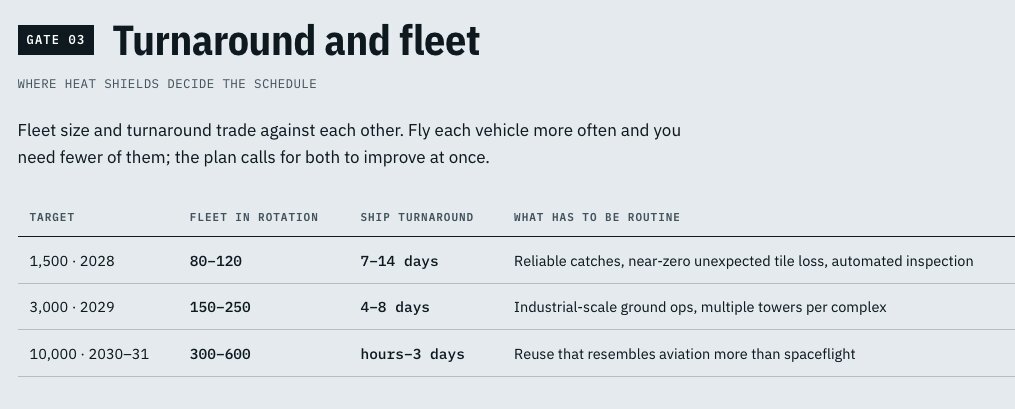
SpaceX says it is targeting thousands of Starship flights a year. We are seeing progress to recovery and reuse of Starship. The booster has been recovered 3 times and reused twice. The new booster needs engine software improvements and the upper stage starship catch will be attempted in the next flight (14). If booster and starship are both being recovered then getting them back in better condition for fast turnaround will be key. However it seems 1-3 week turnarounds will be achievable in 2027 based on rocket operations.
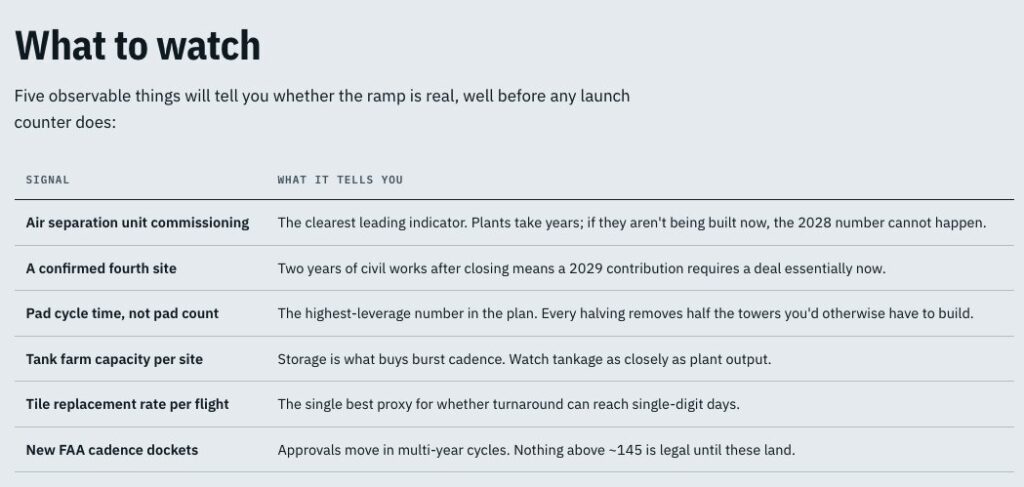
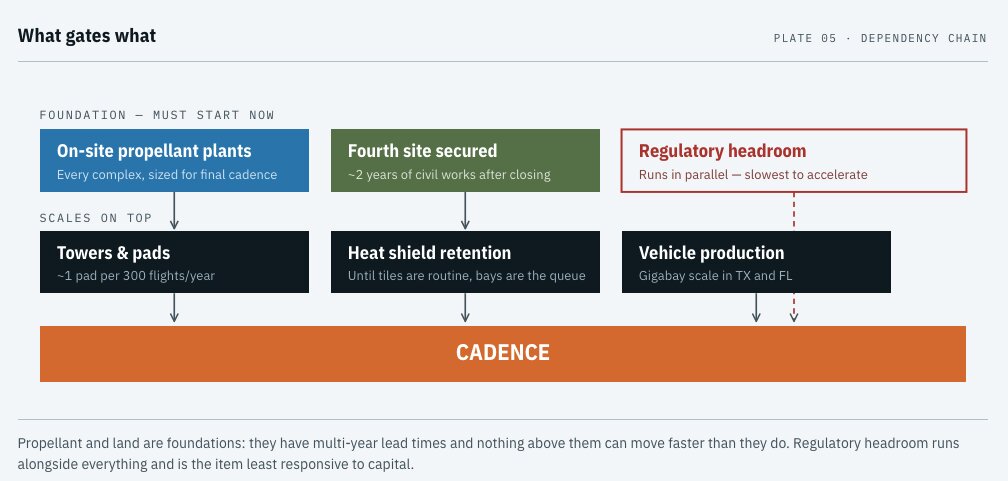
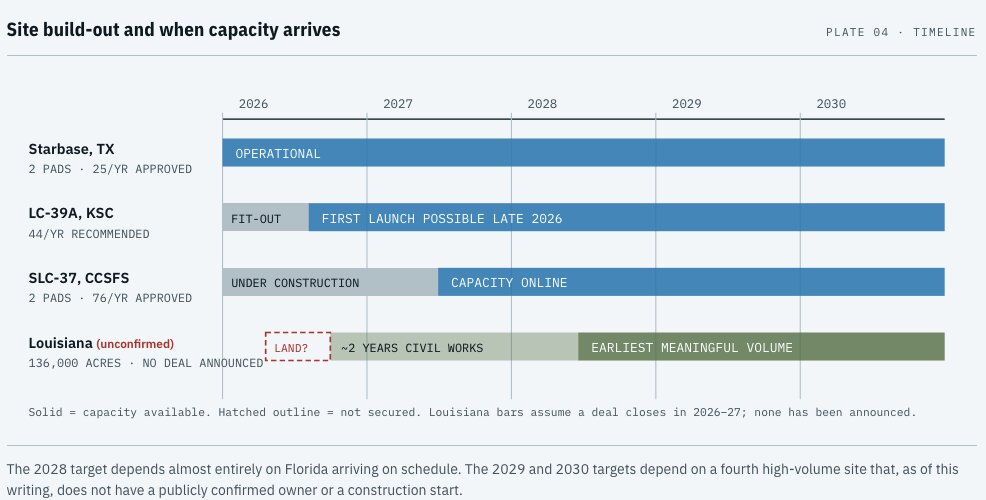
There is more to high launch cadence. There is the need to build cryogenic plants, launch towers, and regulatory headroom fast enough to feed them — and today’s approved ceiling is about 145 flights.
SpaceX has said – It’s no secret that we intend to launch Starship a lot, targeting thousands of flights per year. That cadence will require the ability to launch from many” sites.
That is a genuinely staggering number, and the instinct is to treat it as a rocket-engineering question — can the vehicle be made reliable and reusable enough? But rocket reusability is the part SpaceX has already demonstrated in principle. The things that will actually decide whether 2028 looks like 1,500 flights or 150 are industrial and bureaucratic. How much liquid oxygen you can make on site, how many towers you have, how fast a pad can cycle, and what the FAA has signed.
Propellant
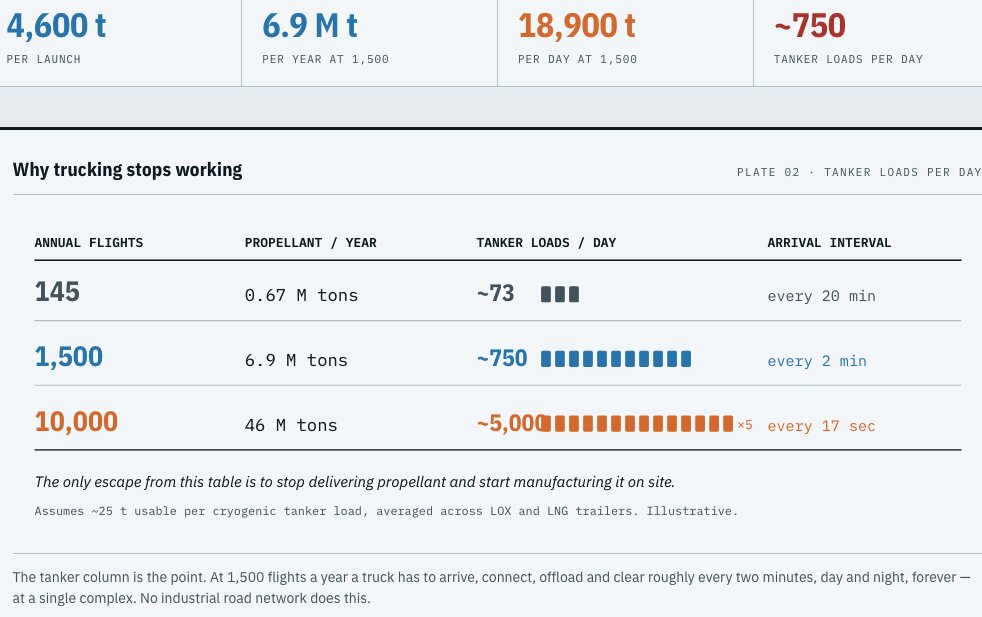
Every Starship stack swallows roughly 4,600 tons of propellant — about 1,000 tons of liquid methane and 3,600 tons of liquid oxygen. That number is fixed by physics and doesn’t improve with practice. Multiply it by the cadence targets and the logistics stop being logistics and become heavy industry.
Starbase is being upgraded with air separation units that pull oxygen and nitrogen straight out of the atmosphere, methane liquefaction plants, and an eight-mile natural gas pipeline feeding the site. Florida’s LC‑39A work reportedly includes propellant generation systems among roughly 800,000 square feet of improvements.
The rule of thumb worth carrying. A launch complex that cannot make its own propellant cannot exceed a few hundred flights a year, regardless of how many pads it has. Every major site needs its own plant, sized on day one for the cadence the site is eventually meant to carry — because you cannot retrofit an air separation unit in a quarter.
Pads and towers
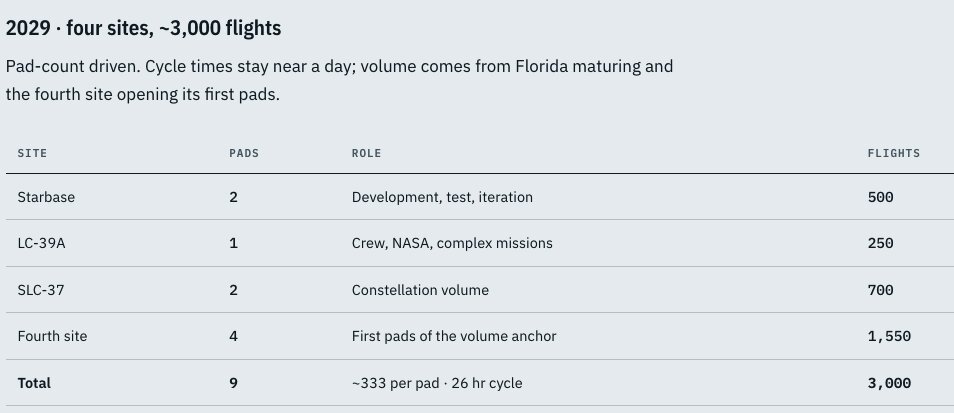
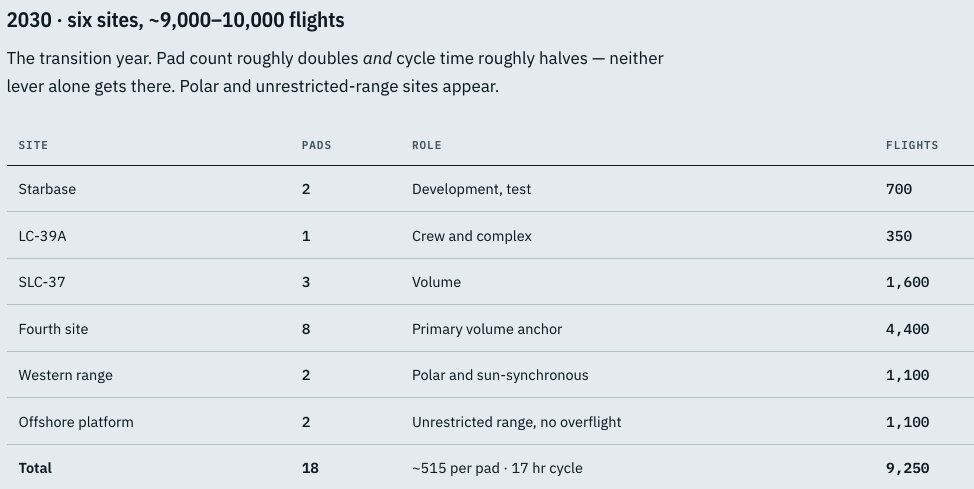
Cadence is a product of two numbers. How many pads you have and how fast each one cycles. Almost every published estimate fixes the second and solves for the first, which makes the plan look like a construction problem. Fix it the other way and it becomes an operations problem — a much cheaper one.
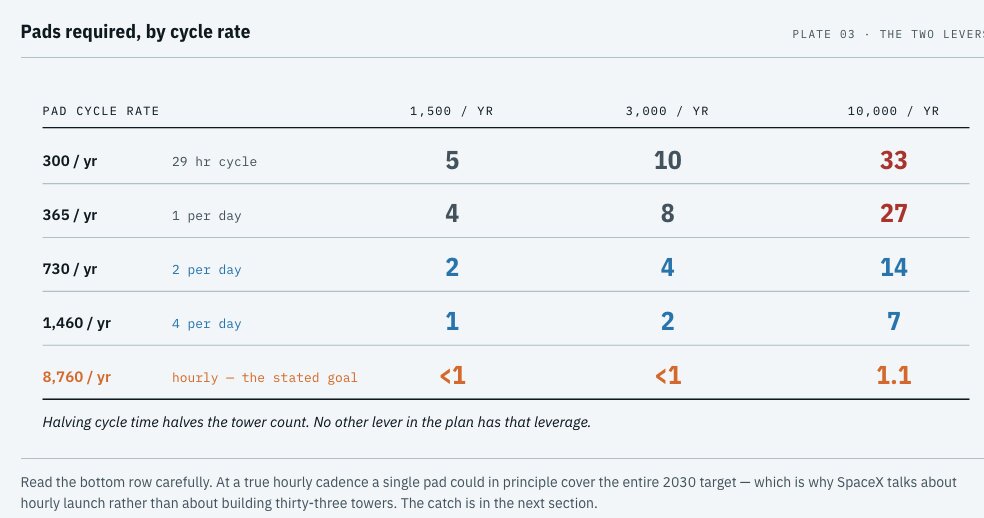
A tower is a nine-figure structure with multi-year lead time. Cycle time is an engineering and operations problem you can iterate on weekly. Any rational build-out spends aggressively on the second before committing to thirty of the first.
Run the propellant arithmetic on an hourly pad and it breaks immediately. One flight per hour means 4,600 tons per hour — about 110,000 tons a day from a single pad, some 86,000 tons of it liquid oxygen. The largest single-train air separation units in industry produce on the order of 4,000–7,000 tons of oxygen per day. Sustaining hourly launch from one pad would need something like fifteen world-scale oxygen plants feeding that pad alone.
So hourly cadence is not a plant-capacity problem you solve with money. It is a storage problem you solve with tank farms. A site that produces propellant continuously and stores it can discharge inventory far faster than it makes it — launching hourly for a day or two, then refilling over a week. Peak rate is set by tankage and pumps. Average rate is set by the plant.
Mars transfer windows open roughly every 26 months and last weeks, and each Mars-bound ship needs many tanker flights to refuel in orbit. That is precisely a burst requirement: enormous cadence for a short window, idle capacity between. Designing for hourly burst and a far lower annual average is the rational architecture — and it explains why the same program can talk about hourly launch and about thousands, rather than tens of thousands, of flights per year without contradiction.
Constraint Order Changes With More than One Flight Per Day
Below roughly one flight per pad per day, the binding constraint is towers — there aren’t enough places to launch from.
Above it, the binding constraint becomes propellant storage and plant output — towers stand idle waiting for tanks to refill. Past that crossover the right capital allocation stops being “build another tower” and becomes “build another air separation train and more tankage beside the tower you already have.”
How you actually run it
Concentrate, don’t distribute. One site carries roughly half of all flights in every year above. Pads are far cheaper to add beside an existing propellant plant than to bootstrap at a new location — each new site needs its own air separation units, tankage, barge access and environmental approvals before its first flight.
Additional sites exist for reasons other than throughput like trajectory access, redundancy, and political diversification.
Specialize by mission type. Crew and complex missions want a low-cadence pad with long, careful flows. Constellation deployment wants a high-cadence pad running one standard profile over and over. Mixing them on the same pad forces the fast work to inherit the slow work’s procedures.
Size propellant for the site’s final cadence on day one. A volume anchor at 5,000 flights a year needs roughly 23 million tons annually — about 63,000 tons a day, of which some 49,000 tons is liquid oxygen. That is on the order of eight to twelve world-scale ASU trains at a single location. It cannot be retrofitted; it has to be in the site plan before the first pad pours concrete.
Use the waterway as the fleet-balancing mechanism. A Gulf site sitting between Texas and Florida on the Intracoastal Waterway lets boosters and ships be barged between complexes, so the fleet can be pooled rather than stranded wherever it was built. That single logistical fact is worth more than an extra pad.
Brian Wang is a Futurist Thought Leader and a popular Science blogger with 1 million readers per month. His blog Nextbigfuture.com is ranked #1 Science News Blog. It covers many disruptive technology and trends including Space, Robotics, Artificial Intelligence, Medicine, Anti-aging Biotechnology, and Nanotechnology.
Known for identifying cutting edge technologies, he is currently a Co-Founder of a startup and fundraiser for high potential early-stage companies. He is the Head of Research for Allocations for deep technology investments and an Angel Investor at Space Angels.
A frequent speaker at corporations, he has been a TEDx speaker, a Singularity University speaker and guest at numerous interviews for radio and podcasts. He is open to public speaking and advising engagements.