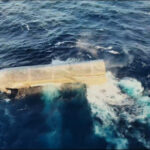


SpaceX deliberately flew a more energetic / higher-dynamic-pressure reentry profile on this flight to stress the system harder than a normal return would. The vehicle survived, executed the flip and landing burn, soft-splashed, and remained intact and transmitting. Dan Huot called it “a dream scenario for the team that’s trying to get this heat shield data,” and Elon said they got “all the heat shield data we needed and then some.”
Visible tile loss was low. Multiple independent views (onboard cameras, recovery drones, and the Starlink V3 sats that imaged the ship) show the great majority of the ~18,000 hexagonal tiles still attached. Commentators noted you could count the missing ones on one hand in the best angles. Where tiles did come off, the underlying ablative layer appears to have done its job — the structure stayed intact and there was no cascading burn-through.
The widely distributed damage pattern some people worry about is real in the sense that erosion and small losses weren’t confined to one or two obvious hot spots. However, the absolute rate looks manageable with the current generation of tiles + attachment methods (robotic adhesive application, stronger mechanical features, better gap fillers). This is iterative progress from earlier flights that lost far more tiles. The leading-point erosion on hex tiles is a consistent observation. Tapering or re-orienting those edges is an obvious, low-cost adjustment SpaceX can make.
Can it handle multiple reentries with reasonable maintenance?
The current data supports “yes, with continued iteration.” One high-stress reentry with only sparse tile loss and intact underlayment is a strong positive signal. The remaining work is reducing the loss rate further so that post-flight inspection and tile replacement stay quick and cheap enough for rapid reuse. Nothing in the Flight 13 imagery suggests the tiles are fundamentally inadequate for repeated use once the attachment and edge details are refined.
Ryan Hansen Space saus The white streaks are deposits from an ablative material that is placed under the tiles. The deposits indicate that there are broken tiles where the streaks originate from. Plasma heats up the exposed ablative in that area area causing the ablative to burn off and deposit material on the nearby tiles. We can see the broken tiles a lot clearer later on in the drone video after splashdown where corners of tiles are missing. It’s possible this damage may be due to the increased stresses on ascent for this flight.
The white streaks are deposits from an ablative material that is placed under the tiles. The deposits indicate that there are broken tiles where the streaks originate from. Plasma heats up the exposed ablative in that area area causing the ablative to burn off and deposit…
— Ryan Hansen Space (@RyanHansenSpace) July 25, 2026
Not going to get more heat shield data than this. Big win https://t.co/BayWMaQyMD
— Aaron Burnett (@aaronburnett) July 25, 2026
Recovery of the physical ship / tiles
No. SpaceX has no plans to recover this vehicle from the Indian Ocean. It is a test article. Recovery teams are on site with drones getting high-resolution imagery and telemetry continues, but they are not attempting to approach or salvage the ship itself because of residual propellant hazards.
The forensic value is coming from the combination of
Live and post-splashdown video from the ship
Drone close-ups
Pre-reentry imaging from the six Starlink V3 satellites that carried cameras specifically for this purpose
Telemetry and load sensors on selected tiles
Physical tiles would be ideal, but the volume and quality of remote data from an intact vehicle is already far better than previous flights that exploded or broke up. Full physical recovery and reuse of ships is planned for later flights once they start catching them with the tower arms.
What happened on the booster (B20)
Ascent + boostback was strong. All 33 Raptor 3 engines worked for ascent. For the first time on a V3 booster, the high-thrust portion of the boostback burn used all 33 engines.
Landing burn: Partial failure. Only ~8 engines relit (instead of the planned number, roughly a 13-engine landing burn configuration).
Result was a Harder-than-intended splashdown in the Gulf of Mexico.
This is a continuation of the same class of problem seen on Flight 12 (incomplete engine relights during the landing phase).
The pre-launch July 16 abort (four engines failed to start due to LOX turbopump moisture/freezing) is related but separate — SpaceX replaced engines and improved procedures before the successful July 24 flight.
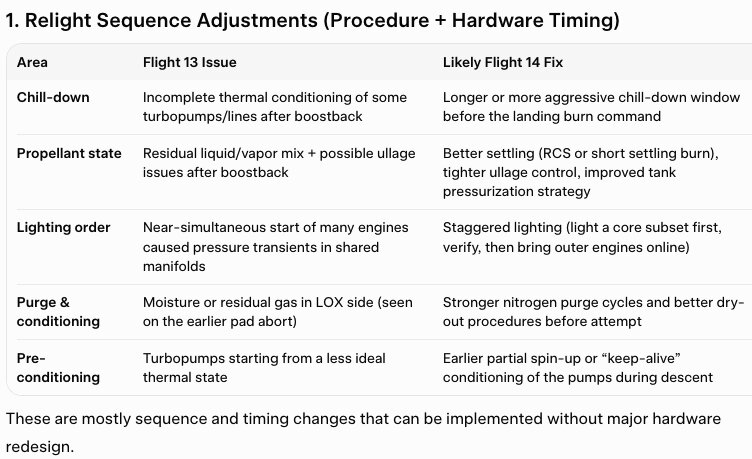
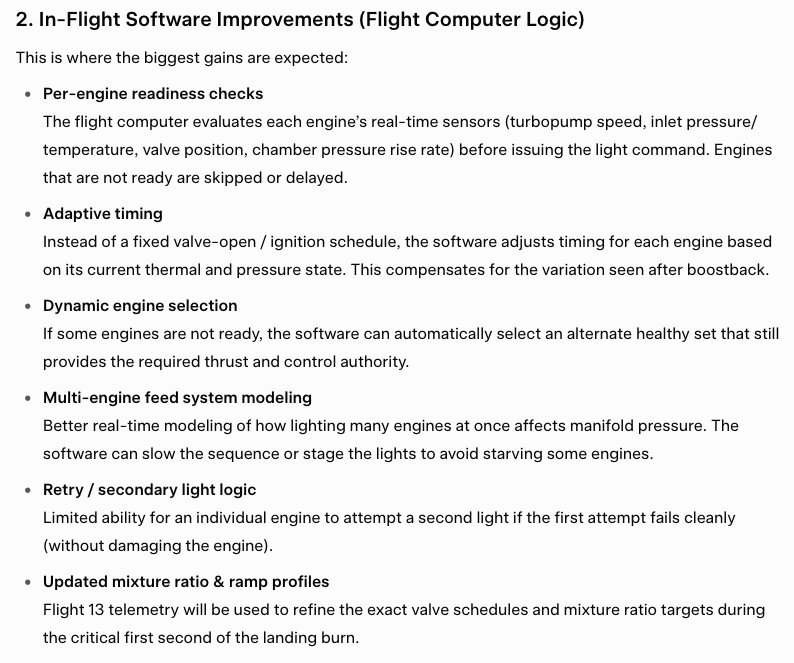
How SpaceX is expected to fix it for Flight 14
The core problem is Raptor 3 relight reliability under the specific conditions after boostback (propellant residual state, thermal environment, vehicle attitude, and multi-engine interactions).
Likely fixes already in work or expected
Further startup sequence and timing robustness
Flight 13 already carried modified startup sequencing to handle timing variability better (a direct lesson from Flight 12’s 90° flip error). More refinement is expected.
Hardware and conditioning improvements on the LOX side
The July 16 pad abort was traced to moisture collecting in the LOX turbopumps and freezing. Better drying/purging procedures and possible hardware changes (seals, heaters, or pump design tweaks) are high-probability items.
Updated engine alarm / abort logic and propellant management
SpaceX has already been tuning alarms and abort criteria for multi-engine flight environments. Additional changes to how residual propellant is managed and conditioned before the landing burn are expected.
Booster 21 as the Flight 14 vehicle
B21 has already rolled out for cryogenic testing. It will incorporate the latest hardware and software iterations from the Flight 13 data.
Raptor 3 engine relight mechanics
Raptor 3 is a full-flow staged combustion (FFSC) methalox engine. This is the most complex operational rocket cycle currently flying. Understanding relight requires understanding how the engine starts from a cold or partially conditioned state.
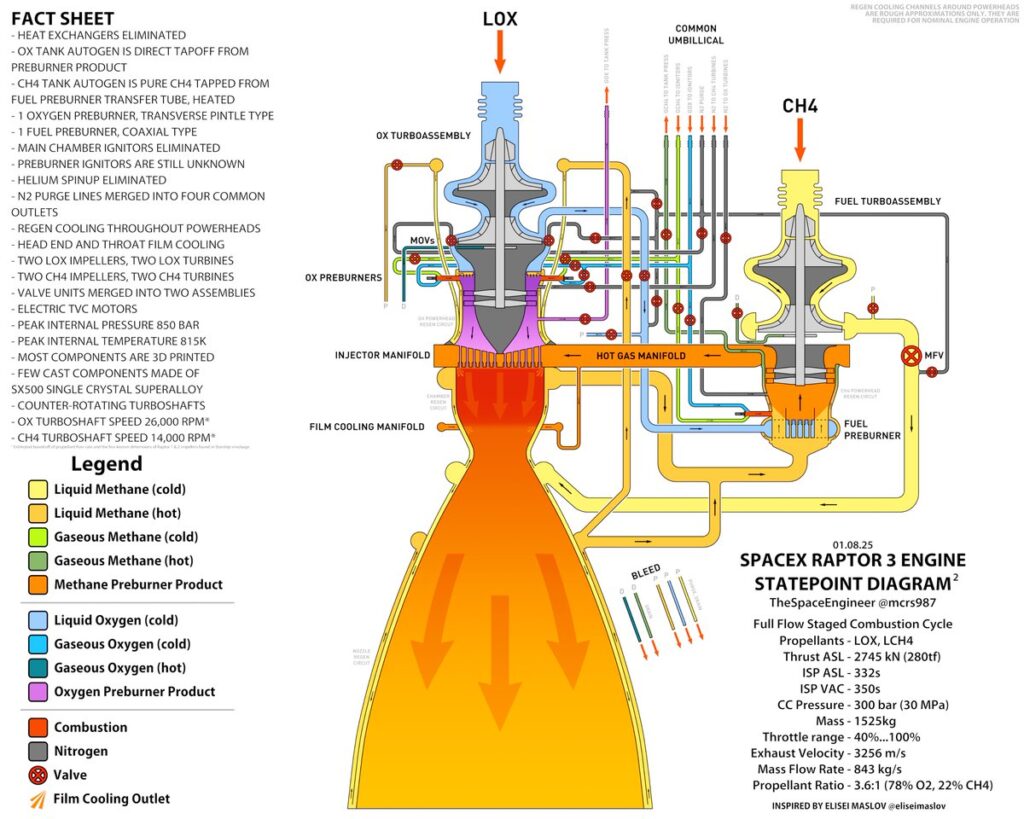
Core architecture Two separate preburners
Fuel-rich preburner (mostly methane + a little oxygen) drives the methane turbopump.
Oxidizer-rich preburner (mostly oxygen + a little methane) drives the LOX turbopump.
All of the propellant passes through these preburners before reaching the main combustion chamber.
There is no separate main-chamber igniter on Raptor 2/3. The superheated preburner exhaust gases themselves light the main chamber when they mix.
This design allows extremely high chamber pressure (~300–350 bar) and high efficiency, but it makes the startup sequence precise and sensitive to thermal and propellant conditions.
Typical relight / startup sequence
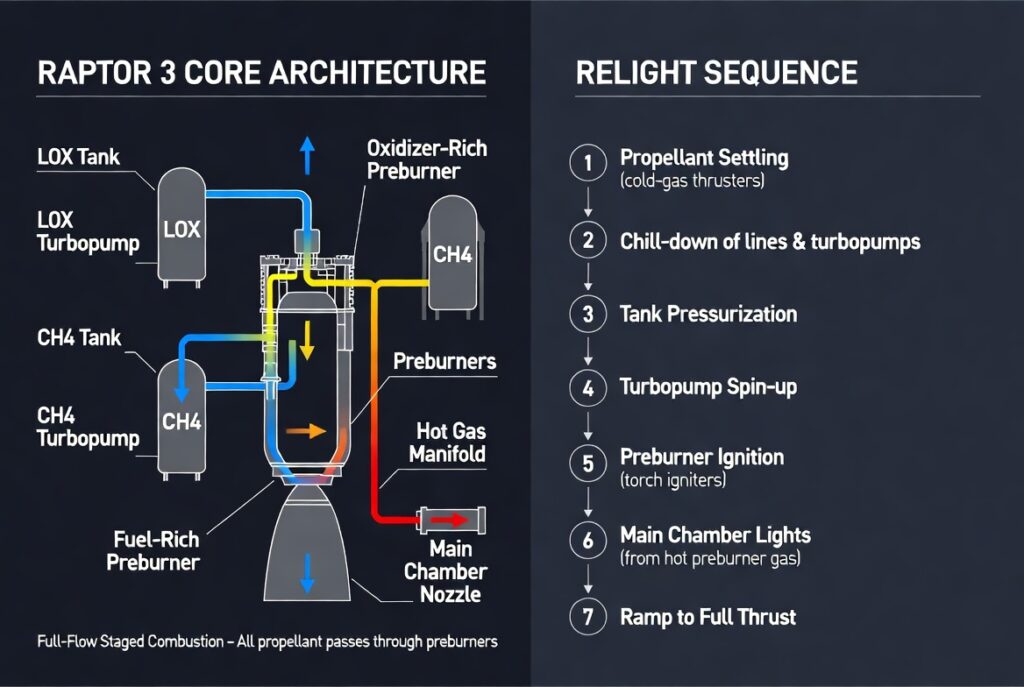
1. Propellant settling & tank pressurization
In flight (especially after a coast or boostback), cold-gas thrusters settle the liquid propellants. Tanks are pressurized (initially often with helium or residual gases; later autogenous pressurization takes over using gaseous propellant from the engine).
2. Chill-down
Cryogenic LOX and liquid methane are flowed through the lines and turbopumps to bring them to the correct temperature. Incomplete chill-down is a common cause of ignition problems (cavitation, vapor lock, or slow turbopump spin-up).
3. Turbopump spin-up
Initial rotation of the turbopumps is driven by tank pressure forcing propellant through the pumps, sometimes assisted by a gas spin-start system. Once the preburners light, the hot gas provides the power.
4. Preburner ignition
Each preburner has its own torch igniter (spark-ignited gaseous oxygen + gaseous methane torch).
The two preburners are lit in a carefully timed sequence. One must lead slightly so that regenerative cooling circuits are properly filled and thermal conditions are correct.
5. Main chamber light
Once both preburners are producing hot, high-pressure gas, that gas flows into the main combustion chamber through swirl injectors. The two streams (fuel-rich and oxidizer-rich) mix and ignite spontaneously from their high temperature and pressure. No spark plug is needed in the main chamber.
6. Ramp to full thrust
Valves and mixture ratio are controlled very precisely as the engine accelerates to operating chamber pressure and thrust. The whole sequence from first valve motion to full thrust is extremely rapid (typically well under one second once the process is committed).
Why in-flight relights (especially booster landing burns) are difficult
The engine may be thermally soaked from previous operation or cold from a long coast.
Residual propellant in the lines can be a mix of liquid and vapor.
After boostback, the propellant state, vehicle attitude, and residual ullage conditions are less ideal than a clean pad start.
Tiny timing differences or moisture/contamination in the LOX turbopumps (as seen on the Flight 13 pad abort) can prevent one or both preburners from lighting cleanly.
On a 33-engine booster, interactions between engines and shared propellant manifolds add complexity.
Raptor 3 simplified the external plumbing and eliminated the engine heat shield compared with earlier versions, which improves mass and reduces some failure modes, but the fundamental FFSC ignition physics remain demanding. SpaceX has been iterating heavily on valve timing, chill procedures, purge systems, and alarm logic specifically to improve multi-engine relight reliability under flight conditions.
Most observers believe Flight 14 (likely Booster 21) will fly with
Updated flight software incorporating Flight 13 landing-burn data
Refined chill-down and lighting sequence
Tighter engine health monitoring
The combination should meaningfully increase the probability of lighting the full planned set of engines (the classic 13 → 5 → 3 down-select profile) and produce a controlled soft splashdown. A successful soft splashdown is the gate before SpaceX attempts another booster catch.

Brian Wang is a Futurist Thought Leader and a popular Science blogger with 1 million readers per month. His blog Nextbigfuture.com is ranked #1 Science News Blog. It covers many disruptive technology and trends including Space, Robotics, Artificial Intelligence, Medicine, Anti-aging Biotechnology, and Nanotechnology.
Known for identifying cutting edge technologies, he is currently a Co-Founder of a startup and fundraiser for high potential early-stage companies. He is the Head of Research for Allocations for deep technology investments and an Angel Investor at Space Angels.
A frequent speaker at corporations, he has been a TEDx speaker, a Singularity University speaker and guest at numerous interviews for radio and podcasts. He is open to public speaking and advising engagements.