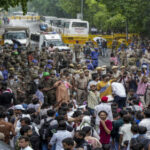

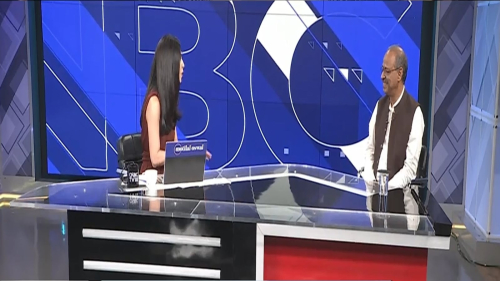
Former Education Secretary Anil Swarup has said accountability for examination leaks must go beyond transferring officials, arguing that officers found guilty of wrongdoing should face strict action while those not responsible should not be made scapegoats. “If they are at fault, if any civil servant is at fault, he should be nailed. But mere transferring doesn’t work,” Swarup said in an exclusive interview with CNBC-TV18. His comments come as the government seeks to rebuild confidence in India’s examination system following month-long Gen Z-led protests that culminated in Education Minister Dharmendra Pradhan’s resignation. The government has introduced a Bill in Parliament proposing tougher penalties for examination fraud, including higher fines, a two-month deadline for investigations and fast-track courts. Prime Minister Narendra Modi has also announced a high-powered task force led by Infosys co-founder Nandan Nilekani to examine the use of technology to make examinations more transparent. Swarup said the government’s response must focus on identifying the actual cause of failures rather than simply moving officials out of their posts.
“What is the signal that you are sending? That irrespective of whether you are culpable or not, I am going to find a scapegoat in you and I’ll transfer you? It doesn’t work that way,” he said. He cited the 2018 CBSE paper leak as an example, saying the administration had conducted a quick inquiry to establish where the fault lay. Once it was found that CBSE was not responsible, he said, transferring officials would have only demoralised the organisation.
Swarup said the same principle should apply to the wider examination system. “If an officer does something wrong, he should be nailed. He should not merely be transferred. He should be terminated. But if he has not done anything wrong, by transferring him, you will demoralise the entire organisation.”
The need for stronger accountability is underscored by the limited conviction rate in examination fraud cases. An Indian Express investigation found 45 paper leak cases between 2002 and 2025 involving exams attended by over one lakh people, with only two resulting in convictions. This is an edited transcript of the interview.
Q: As I said, you’re the right man to talk to us about an issue that has really captured not just the headlines, but also the emotions of the youth of this country. And the question now is, where do we begin to start the process of repair? Let’s start with the Nandan Nilekani task force that the Prime Minister has set up. You know, headed by Nandan Nilekani, with the impeccable credentials of the people who are going to be part of this task force.

We don’t have the exact terms of reference yet, but where should the Nilekani panel start? What should they prioritise? Anil Swarup: First of all, let me compliment the government for having chosen such a panel.
The name that did not find mention in your opening remarks was that of Anita Karwal. She is the one who set the CBSE examination right. Q: When they were asking for her head. Anil Swarup: Absolutely, and that’s the point that I’d like to make. The problem today in this country is not policies or prescriptions; there are too many of them. The problem is execution.
I have absolutely no doubt that Mr Nilekani and his entire team are going to come out with a fabulous report, but then we have so many fabulous reports. I am told there is another report by Mr Radhakrishnan after the 2024 paper leak. What’s happening to that report? So, I don’t think reports will solve the problem.

The problem lies elsewhere. Okay, let’s first look at what this committee can possibly look at.
I think the first thing that they should do is look at the entire process of examination. It’s not merely the ultimate writing of the examination or where the paper leak actually happens. The examination has a full process: how the papers are prepared, where they are kept. Very important are the centres that are selected for examination. I distinctly recall when I had just begun my service way back in 1985. I had gone to a centre where board examinations were happening, and suddenly people started jumping out of that hall. I was wondering, what’s happening?
So my driver told me, “Sir, ye nakal karane aaye the, gaadi dekhkar bhaag gaye,” and I was told that, at least at that point in time, these centres were auctioned for copying. So that was the culture that prevailed. I’m not aware of what’s happening now, but I’m sure in a very high-profile examination where too many people are appearing and there are too few seats, the stakes are very high. Hence, it is important to look at the entire process and also see what should or should not be outsourced. If you look at the recent leaks, I think outsourcing is a major issue. You look at what is happening in UPSC.
There’s never been a leak. Why? Because nothing is outsourced there.
I am not saying you should not outsource. For example, you are preparing a question bank running into hundreds or thousands of questions. Outsource it, get those banks.
But thereafter, it has to be an internal exercise. You can’t outsource the setting of a paper, no matter how good a person is.
More Read

You can’t do that. So this committee should look at the entire process, right from the beginning till the end, and try and plug those loopholes. With Anita Karwal sitting there, she did that in the CBSE examination, and after 2018, there has been no leak. So that’s what they should look at. But as I said earlier, I’m sure they will come up with a great prescription.
But if things don’t happen on the ground, what is the big deal in having a prescription? Q: You talked about the Radhakrishnan report. The former ISRO chairman was entrusted with putting together recommendations on the reformation of the NTA, and he put together 101 recommendations.
And this is as far back as October 2024, so it’s barely two years old. But many points that he’s mentioned there — 46 action points specifically — and I want to pick up on what you talked about because he’s also bringing up the issue of outsourcing. He says, outsource if you have to, but preferably to government agencies and government bodies, not necessarily to the private sector. And I want to link that to something that one of the members of the Nandan Nilekani panel, Mr Kamakoti, was just telling my colleague. He said perhaps we should look at a national registry of blacklisted companies.
And I want to get your thoughts on both those issues. Anil Swarup: You can do all that. Let’s look at more fundamental issues, and I hope this committee looks into it. Why does the Central Government feel that everything should be done by them? Why can’t this be decentralised? Why can’t it be done at the state level? Why are we taking the entire responsibility?
Earlier, at some point in time, it was done. Fair enough, in some of the states there would still be problems, but I think the rest of it would be fine.
You are centralising it for no rhyme or reason. So my first suggestion to this committee would be to look at why do you want to centralise everything here? For the central universities and the central medical colleges, do it. But trust these states. What the Centre should do — and I did that when I was in the government — is lay down broad guidelines, assist the states, treat states as partners, trust them and help them to do it. They can learn from each other.
It’s a facilitator role that the Central Government has to play. Don’t get down to doing everything. I mean, when the NTA was established at that point in time, the Secretary of School Education was taking people from CBSE there.
At that point in time, I also said, “What are you trying to do here? Because earlier, if you remember, CBSE used to conduct the NEET examination fairly well. You created a special body without sufficient staff, so they had no option but to outsource.”
So, as I keep saying, you can keep coming up with recommendations. The question should be: you should look at it from a practical point of view — how is it actually going to work?
You mentioned also the law that has been brought into Parliament. Now, I jokingly say, when the British left this country, they took justice — whatever that was here in India — with them, and left behind laws, in-laws, outlaws and above-laws.
And we think laws will solve a problem. We have a reasonably good law, and what happens under that law? The principal culprit of 2024 goes scot-free because the CBI doesn’t find evidence. Now, you may still have a law, but if my investigating agency is unable to nail the guy, what do you do? The world knows that a police officer slapped a woman in front of everybody during this agitation. What do we do to him?
We just shift him. He should have been suspended immediately.
An FIR should have been lodged. It would have sent a signal to everyone: please don’t behave in this manner. Why am I saying that? You have to signal that nonsense shall not be tolerated. I’ll now bring this to the examination system.
What do we do? We transfer the DG, we transfer the Higher Education Secretary, we transfer 48 people from NTA.
Do you think it will solve the problem? No. CBSE was fixed because I, as Secretary of Education, resisted the transfer of the Chairman of CBSE. Why? Because my view is very clear. If an officer does something wrong, he should be nailed. He should not merely be transferred.
He should be terminated. But if he has not done anything wrong, by transferring him, you will demoralise the entire organisation. Please bear with me.
Things happen through bureaucracy – good, bad or ugly. So you have to send them the signal that if you are in the wrong, I will not spare you.
If you are right, I will go to town and defend you. Come what may. That’s what had to be done in CBSE. Imagine a new person joining an organisation, trying to understand the organisation to correct it. As against that, you have a person like Anita Karwal who has seen the organisation, within a couple of months, comes up with the system.
But to do that, you have to have a summary inquiry, which we did. Inquire quickly and see where the fault lay.
And we discovered that CBSE had nothing to do with it. Once we said that, then we said, if we transfer anybody from here, it will demoralise the organisation.
So, in order to make things happen on the ground, first understand the whole process and correct it. And second, that itself will not work because on-the-ground activities are conducted by civil servants. Select the right person, support him. Don’t unnecessarily transfer him. Look at the difference between 2018 and 2024. You transfer the DG, and I am told he is presently Principal Secretary to the Chief Minister. Now, if he was a useless guy — which he wasn’t; he is one of the most outstanding officers — why did you shift him?
You shouldn’t have shifted him. What is the signal that you are sending? That irrespective of whether you are culpable or not, I am going to find a scapegoat in you and I’ll transfer you? It doesn’t work that way. I saw that in coal. In coal also, when I joined, there was a crisis of confidence. So the first thing that you do is build the confidence of the team that I am there to protect you if you don’t have a malfeasant intention or anything.
That is the problem here. The first thing, at the drop of a hat, we shift people. That is not done.
I keep saying, if they are at fault, if any civil servant is at fault, he should be nailed. But mere transferring doesn’t work.
Q: So if we were to draw up an execution roadmap from where we are today, on the back of the experience that we’ve had previously with instances, as you pointed out in 2018 with CBSE, and all the recommendations and good recommendations that have been put forward by many committees, including the last one headed by Mr Radhakrishnan, what should the top three priorities be? Anil Swarup: Not three. Post Anita Karwal as Chairman of NTA. That’s how it works in India.
We must understand that she executed here in CBSE. So, make her the Chairman of NTA, and I tell you, she will find people who will do it. See, the question here is: if you have the right person sitting there. I’m not sure whether the present person is the right person. With the right person sitting as Chairman of NTA, she will get hold of Nandan Nilekani. She will find people.
As Coal Secretary, I didn’t do anything. I found people. You have to find the right people. It is the approach that matters. It is the vision that matters, and that lady has it. I’m so glad she’s there in the committee because she’s going to give the right recommendation.
But my fear is, like many other reports, I give you another parallel example. You know, one of the biggest problems this country faces is unemployment, and the solution is MSMEs. Former Cabinet Secretary Mr Prabhat Kumar was set up as a committee member or a chairperson to give his recommendations. He gave his recommendations seven or eight years ago. What is happening to those recommendations? So the point is not the committee.
The point is how do you go about making it happen on the ground? Q: Speaking about making it happen on the ground, let’s just go back and revisit what happened at CBSE in 2018. And if we were to draw parallels from the execution roadmap that you took forward there, of course with Anita Karwal at the helm of things, what did you do differently to ensure that we didn’t see a repeat? And, you know, so far, we haven’t seen a repeat. What happened at CBSE this year is a different matter. It wasn’t a leak that happened at CBSE. What did you do then that can perhaps be replicated?
Anil Swarup: I’ll touch upon both the leak this year at CBSE and what happened then. First, Anita looked at the entire process and looked at different loopholes that could possibly exist, and then there was intensive use of technology. Let me give you an example. Things may have changed now, and there could be better technology available.
Let us assume that I prepare 10 sets of question papers. These are digital question papers. I appropriately select the centres which have the facility to print them. I don’t know which paper is going to come.
No one knows which paper is going to come. On the day of the examination, at five or six o’clock, you send a key and say, “Paper number seven to be distributed.” It gets printed and goes. How will that paper leak? And let us assume that all 10 papers leak.
He would have, in any case, to study the entire course and all those papers. I am giving a very simple example. You can actually go further into it and refine it further. But today, technology allows you not to allow anybody to interfere in the entire process. Now let me come to the problem that CBSE faced now. That had nothing to do with the examination.
There again, the outsourcing problem. You outsourced checking to an agency which, I am told, was blacklisted. I am not sure, but that’s what I am told. Now, if you play with the process, I mean, this committee will give a recommendation, and you give execution to a third-rate agency. No matter how good the recommendations are, it won’t work.
So both are important. One is understanding the process, and second, having the right people to execute them. If you don’t have the right people to — I keep repeating this.
You look at any organisation. Take, for example, UPSC.
UPSC has the credentials because of the right people sitting there, except for one exception who now chairs the NTA. So, outstanding people with absolutely above-board credentials — you have to have that. You have to be clear in your mind that you may have your politics or whatever you have, but for educational institutions, keep it as much away from politics as possible. Because the moment you get into that, you run into problems.
You go into the details of it, you’ll find in the CBSE case also. Had it not been outsourced in the manner it was done, that thing would not have happened. It’s as simple as that. So one, the process should be understood clearly, and I have no doubt that Nandan Nilekani and his team will understand the process and provide the right prescription. But I have my doubts whether they will be the right people to execute them. They are most critical.
If you don’t select the right people to do it, no matter how good a process you put in place, as was done in CBSE, you outsource something and it goes wrong for sure. Q: Yeah, you know, there is a difference between putting things on paper and actually making things happen on the ground, and that’s what a lot of your work, your writing work, has been about. Anil Swarup: Let me tell you, I keep talking about this. This country has tremendous ideas. There is no dearth of ideas, but for any idea to fructify and sustain — and I’ll just take a couple of minutes to explain this to you — it has to be politically acceptable, socially desirable, technologically feasible, financially viable, administratively doable, judicially tenable, emotionally relatable and environmentally sustainable.
Just two aspects are relevant for examinations because the idea would be politically acceptable and socially, all will be there. But whether it is administratively doable, that will be determined by the personnel that you put there. That is one. Number two, emotionally relatable.
That applies everywhere. That is, you must take stakeholders into confidence. If you don’t discuss with the stakeholders, probably some aspects will get ignored. I’m so glad Nandan is there and his team is there. They are going to talk to all the stakeholders, get their opinions, and I have absolutely no doubt they will come up with a fantastic report. But I have doubts whether such a report will be implemented because that has to be implemented by men and women.
Q: Mr Swarup, I want to understand from you. One, of course, what we’re discussing now is a result of what has happened over the last 40 days. But is there a need to also review the overall process? Do we need as many entrance examinations to start with? I mean, that’s a whole other discussion and a whole debate, but I would imagine that we now need to start looking at this issue in its entirety, holistically. Otherwise, we’re going to be going after symptoms, and we won’t really get to the heart of the problem.
Anil Swarup: Yes, there are two parts to it: one, which examinations should be conducted, and who should conduct those exams. It’s very important because it comes as a huge burden on the Central Government if it takes upon itself to do everything. So you will have to have the NEET exam, you will have to have the Joint Entrance Examination for the IITs or engineering colleges. You can’t do without them. The question is whether we are following the right process. One is the process.
The other is which agency should do it. That is something which I hope this team also debates and suggests, as the Radhakrishnan Committee has also recommended. The Centre should do only what it should do or can do. Why should we believe that we are the best people around and the states are not capable of doing it?
Develop their capacities and capabilities if they have to do it. So this agency sitting here, instead of doing everything itself, should set standards. Like, for example, again, I keep going back to UPSC. UPSC conducts examinations for the Central Services and All India Services. There are State Public Service Commissions, and there is a lot wrong with some of these State Public Service Commissions. Imagine a scenario if the Central Government decides, no, for even a Group C employee, we are going to do the recruitment. There will be chaos.
Why are we doing that? So let there be selection based on what we should be doing. It should be very clear, and get the states to do it and build capacities there instead of doubting them. A lot of effort should go into building the capacities of state governments to conduct examinations, and they can learn from each other.
There are so many things that you can learn from other states. That is the job which the central agency should play: set standards and, operationally, try and learn from each other. Otherwise, you put everything on yourself. Stakes go high. Somewhere, someone is going to leak it. Why should you do that? Decentralise it.
Q: But, Mr Swarup, before I let you go now, on the back of what has happened — and this is, in your words, an emotive issue. It is something that has got the youth of this country united in a way that we haven’t seen before. Confidence. There is a crisis of confidence as well. Do you believe that the measures that are being taken now, with the announcement of this committee, with the amendment to the Bill being moved in Parliament today, with the process of some dialogue at least starting with this constituency, with this cohort, do you believe that the process of rebuilding confidence has started?
Anil Swarup: Yes, it has, and it’s not so much the Bill in Parliament because people have huge doubts, but the dialogue is important. I’ve always believed: have a conversation.
You are the decision-maker. You have to take a decision. Why should you deprive yourself of some of the wisdom that may come from the other side? So the dialogue should continue. The communication channel should be open. You must still disagree, but the situation will not be as bad as it is today.
Continue to have conversations with people, especially the affected party, and that’s what is a part of emotional relatability. You have to make your idea acceptable to the person. It’s like marketing a product. You market an idea. You package it in a manner that the other person understands that it is beneficial to him.
Maybe not as much as he would want it to be, but it’s your art of communication that you convey to him that this is useful to you. But even if that doesn’t happen, conversations help. If you don’t have conversations, if you have only people around you telling you everything is hunky-dory and these people are lackeys of the US or China or Pakistan, whatever, it doesn’t work that way. Even if they are, I’ll still have a conversation with them. What do I lose by talking to people?
I should talk to people.