

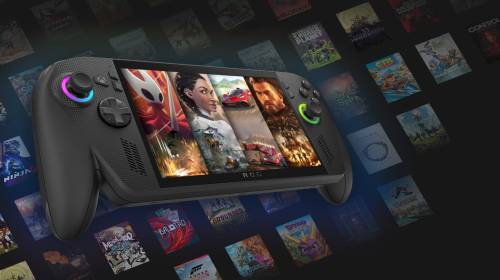
The handheld gaming world is no longer about making great, addicting games to play on the go. Now we need as much horsepower as possible in tiny form factors to play full console games, as is the case with the Xbox Ally X. Backed by a Z2 Extreme and 24 GB of LPDDR5 RAM, the Xbox Ally X has nonetheless been rapidly overtaken in performance and price. If you thought the $1,000 price tag was eye-popping, wait until you meet these more powerful gaming PC handhelds.
It’s currently a rat race for efficiency and performance. Intel introduced the G3 line, its next-generation chips especially targeted at gaming, bringing some genuine power to the party. Meanwhile, AMD has been the ruler of the handheld world for the longest time. From its custom chip in the Steam Deck to the 7840U and Z1 Extreme in devices like the Ayaneo 2S and Asus ROG Ally, it’s been a real generational run. However, the Z2 Extreme has been outpaced not only by Intel, but by other offerings as well.
These devices are ludicrously expensive, and we cannot recommend that you purchase them under the current conditions caused by AI data centers. Prices on these before the RAM crisis were already bad, like the $1,200 Legion Go 2 price point — or the Xbox Ally X’s price — and if you’re considering a gaming device at these price points, it might be better to go look for a prebuilt gaming PC or the various gaming laptops available, which will provide more power still.
MSI Claw 8 EX AI+
Intel’s push into providing a true alternative to AMD or Nvidia for graphics has been a real boon to PC gaming. Now, with the third MSI Claw to feature an Intel chip, the 8 EX AI+ is showing just how far Intel has come. The first two generations were a mixed bag, with weird support issues or just a general lack of performance. The G3 Extreme inside the Claw 8 EX AI+ puts the Xbox Ally X to shame when it comes to performance.
In tests from PC Mag, the MSI Claw bested the Xbox Ally X by quite a margin. Using “Cyberpunk 2077” as a baseline, thanks to its impressive scalability across different systems, we can see that it reached 68 frames per second (FPS) using the Steam Deck presets. The Xbox handheld only managed 51. Meanwhile, at Ultra settings using each device’s native resolution (1,920 by 1,080 for Xbox and 1,920 by 1,200 for MSI), despite the higher resolution, the Claw scored 35 FPS and the Ally X 28 FPS.
Of course, handheld performance wouldn’t be any good without some discussion about upscaling. PC Mag also found that using XESS 3, with the newest frame generation tech set to 4X, the MSI produced 153 FPS on average. Other benchmarks using Cyberpunk at 800p to compare against the Steam Deck LCD saw 102 FPS versus 80 FPS for the Claw and Ally, respectively. For reference, the Steam Deck scored 36 FPS. Where the Xbox Ally X weirdly wins is that it’s $800 dollars cheaper than the MSI Claw 8 EX AI+.
OneXPlayer 3
One of OneXPlayer’s latest, the OneXPlayer 3 is another Intel G3 Extreme-powered handheld, bringing either 24 GB of RAM or 32 GB. These handheld chips work better as you feed them more RAM since they split it between the integrated GPU and CPU that make up the overall APU. So the 32 GB will leave more headroom for heavier games. That said, with these devices, once you’ve seen how one runs, you’ll notice it’s quite often the same story elsewhere.
The device has yet to ship to consumers as of this writing, but reviews have touted the impressive performance from the system’s chip. In synthetic benchmarks from ETA Prime, 3DMark’s Time Spy scored the OXP3 at 4,956 while it was running at 17-watt TDP (thermal design power) out of the max of 35 watts. This was well ahead of 2,917 score achieved by the Legion Go 2, which shares the same Ryzen Z2 Extreme chip as the Xbox Ally X, but has 32 GB of RAM compared to the Xbox’s 24 GB. If a device with more resources couldn’t beat it, you can imagine the Xbox Ally X’s performance.
The OneXPlayer 3 is more expensive than the Xbox Ally X, but with that price increase comes a performance boost over its AMD-based counterpart. It’s also a three-in-one system, similar to the Nintendo Switch, with detachable controllers for a tablet mode or keyboard mode. It even features a nicer screen than the Xbox Ally X, which has an IPS panel, whereas OneXPlayer has fitted the 3 with an AMOLED panel.
Ayaneo Next 2
Another victim of the RAM apocalypse, the Ayaneo Next 2 sports AMD’s Ryzen AI Max+ 395, its current top-of-the-line APU. It combines extreme processing power with an incredibly performant graphics unit, the 8060S, which can perform about as well as a laptop version of Nvidia’s RTX 4070 in terms of closest comparison. The Max+ 395 is joined by a minimum of 32 GB of RAM, topping out at 128 GB — the chip supports this for AI workflows.
Ayaneo announced this in November 2025, just as the stench of the AI-induced RAM shortage was beginning to take hold. In March 2026, the company had to pause orders on the device, as it couldn’t justify the cost for anyone who didn’t already have an order locked in. The result is a device heinously expensive. It now costs $2,999 for the 32 GB model, $3,699 for the 64 GB version, and $5,299 for the 128 GB variant.
You get a huge boost over the Xbox Ally X for that price tag. In tests against similar hardware, in particular the GPD Win 5, when fully boosted to their max TDPs of 75 W and 35 W, the Next 2 scored 85 FPS versus the Xbox’s 38 FPS when playing “Assassin’s Creed: Shadows” with graphics set to Low and FSR set to Performance with the resolution at 1080p. However, the Z2 Extreme is optimized for gaming rather than for more performative workflows like the AI Max+ 395. This is why, at 17 W, the chip actually performs worse than its weaker counterpart in some areas in “Assassin’s Creed: Shadows” and “Kingdom Come: Deliverance 2” at medium graphics settings in 1080p with FSR set to Quality.
How we chose the handhelds
The article was put together by leveraging the author’s experience reviewing and working within the handheld space for the last few years at BGR and other outlets, along with third-party information from around the web. This included gathering information from independent reviews, customer questions and reviews, and other coverage involving handhelds.
Benchmarks were acquired from known sources, but ignored a large portion of YouTube comparison videos when the actual hardware being used was not verifiable. Devices chosen were kept limited to definitive jumps in power over the Z2 Extreme/24 GB combo in the Xbox Ally X, rather than opting for devices like the Ayaneo 3, which sports more RAM at 32 GB, but has a similar processor.