
Christian de Looper/BGR
For a while now, the Nothing Phone series has offered among the best value smartphones on the market, particularly with its lower-cost (a) models. Now, it seems like Nothing is moving on. The Nothing Phone (4a) had a lot to offer, but a few months later, Nothing is back with the Nothing Phone (4b) — which changes more than the name’s simple letter tweak suggests.
The device, however, isn’t necessarily a replacement for the Nothing Phone (4a). Instead, it’s more of an alternative with fewer features and a slightly lower price. It’s also not available in the U.S., but instead in Indian and European markets, which may or may not end up being a trend from Nothing that we see more of.
The device costs €329 (~$384), which puts it in competition with plenty of other midrange options. Does the Nothing Phone (4b) do enough at its price point to justify that price, or should you opt for one of those alternatives? I’ve been using the Nothing Phone (4b) to find out.
Design
Christian de Looper/BGR
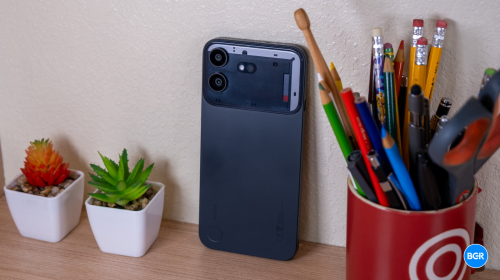
Design has long been one area where Nothing offers something unique — and while that’s still true, the Nothing Phone (4b) is the most subdued Nothing Phone design yet. In fact, the phone is much closer to a typical slab phone in design than Nothing Phones we’ve seen in the past.
There are still some unique elements in the Nothing Phone (4b)’s design, but again, they’re far more subtle. There’s a small, circular indentation on the bottom left of the back panel, but perhaps more important is the quad LED glyph in the camera module, which, while only a straight line, can show you things like volume levels and integrate with some third-party apps.
It’s a fairly substantial phone, though. At 164.4 x 78.2 x 8.6mm and 210 grams, it’s slightly taller and wider than the Phone (4a). The phone is solid in the hand, with no creaks or flexing when you twist it. Nothing claims the chassis is 20% more bend-resistant than the older Phone (3a) Lite, and while I didn’t attempt to bend it in half, nothing about the build suggests fragility.
As mentioned, the Glyph interface has been redesigned, and it’s now called the Glyph Bar. It’s simpler than what you’ll find on older Nothing phones. Instead of the elaborate light patterns of earlier models, there’s a vertical light bar with discrete LED elements for notifications, timers, and charging status. I go back and forth on the Glyph system — it’s a genuinely useful ambient notification tool if you configure it and a novelty if you don’t.
Durability is decent, but it could be better. The phone carries an IP64 rating, so it’s dust-tight and protected against splashes. Nothing also claims it can survive 10 inches of submersion for up to 20 minutes, but that’s outside the official rating, so I wouldn’t treat it as a promise — you’ll want to try not to submerge it. It’s not IP68, so you shouldn’t take it swimming.
The rest of the design is pretty standard. There’s a power button and volume rocker on the right side with a USB-C port on the bottom. The left side has Nothing’s Essential Key, though. You may or may not actually use it.
You can get the phone in black, white, and blue options. There’s also an offline-exclusive RCB edition in India. Regardless of color, this is still a distinctive-looking phone — it’s just a lot less distinctive than previous Nothing Phone models.
Display
Christian de Looper/BGR
The Phone (4b) has a 6.77-inch FHD+ Super AMOLED display with LTPS technology, a 1080 x 2344 resolution at 381 pixels per inch, and a 120Hz adaptive refresh rate. There’s an optical fingerprint sensor under the glass, and it’s reasonably quick and reliable. In daily use, the panel is good — it has deep blacks and vibrant colors, and it felt smooth during use. A 360-degree light sensor next to the flash supposedly helps the phone adapt brightness more intelligently, which cuts down on flicker and harsh transitions when you move between rooms.
Brightness is where things get less impressive. Nothing advertises 2,000 nits of peak brightness and a 1,200-nit outdoor mode, but in my experience, it didn’t really get all that bright, and was sometimes hard to see in direct sunlight. It is usable outdoors, but it doesn’t stand out as being particularly bright. Indoors, it’s easily bright enough, though.
It’s also worth mentioning how this panel compares to the Phone (4a)’s. That phone has a marginally larger 6.78-inch display at a sharper 1.5K resolution, and it gets brighter, too. You may or may not care all that much about these differences, but they can show up in plenty of use cases.
Performance
Christian de Looper/BGR
The Phone (4b) runs on Qualcomm’s Snapdragon 6 Gen 4, paired with 8GB of RAM and either 128GB or 256GB of storage. For day-to-day use — social media, messaging, browsing, streaming, jumping between apps — the phone is mostly smooth and responsive. I didn’t run into major stutters or slowdowns in normal use, and multitasking with 8GB of RAM was fine for my workloads.
Benchmarks put the phone’s performance about where you would expect. The Snapdragon 6 Gen 4 lands comfortably in mid-range territory, well behind the Snapdragon 7s Gen 4 in the Phone (4a) and behind plenty of similarly priced rivals, too. That said, the benchmark numbers probably don’t matter much for anyone other than power users.
There are some areas in which the limits will be shown, though, and gaming is the obvious one. Casual and less demanding titles run fine, but graphically intensive games struggle with sustained performance — you’ll see frame drops and reduced visual quality compared to phones with stronger silicon. Nothing has built a cooling system into the device, and that likely does help prevent the phone from heating up — but the chipset still has its own limits that it can’t push past.
Again, though, for casual use, the phone performs just fine and should do so for at least a few years before you start seeing it slow down. It probably won’t last as long as a higher-end phone, but we wouldn’t expect it to anyway.
Battery and charging
Christian de Looper/BGR
The battery on the Nothing Phone (4b) is one of its strong points, though just how well it performs will depend on your region. If you’re in India, you’ll get a 6,000mAh battery, which happens to be the largest battery Nothing has ever shipped in a phone. Outside of India, you’ll get a 5,200mAh battery, which is still pretty solid.
I was easily able to get the phone through a full day of use, and I suspect most users will have the same experience. Most days, you should expect to finish an average day with at least 30% remaining, and many lighter users could probably stretch usage through a second day.
It doesn’t quite have the same high-tech charging as other recent releases, though. You’ll get up to 33W wired charging speeds, which is fine, but not incredible — and down from 50W on the Nothing Phone (4a). Plus, there’s no wireless charging, which is pretty disappointing — phones at this price point should have wireless charging in 2026.
Camera
Christian de Looper/BGR
The Nothing Phone (4b) has a dual rear camera system, made up of a 50-megapixel main camera and an 8-megapixel ultrawide camera with a 120-degree field-of-view. Around front, there’s a 16-megapixel selfie camera. Notably absent is any kind of telephoto lens, which is the single biggest camera difference between this phone and the Phone (4a), with its 50-megapixel periscope with 3.5x optical zoom.
In good lighting, the main camera takes perfectly adequate photos. You’ll get reasonably pleasant colors and enough detail for most use cases. The device also has a so-called Ultra XDR computational photography system that was co-developed by Google, which merges 13 RAW frames to improve on dynamic range, and it definitely helps in scenes with a lot of contrast.
That said, if you pixel peep, you can see that images aren’t as impressive as those captured by higher-end phones. Low-light shots aren’t as impressive either — they’re a little noisy, don’t have the best detail, and so on. That’s true of zoomed shots, too — don’t expect ultra-detailed images with the digital zoom built into the phone. That’s to be expected given the lack of telephoto camera.
The ultrawide camera also isn’t very good. It has a small sensor and lacks detail, and while it can capture landscape shots in a pinch, it doesn’t do so with very impressive images, and photos are noticeably worse than those captured by the main camera.
Video is better than I expected at this price. You can record 4K at 30 fps, stabilization is solid, and there’s a Dual Video Capture mode that records from the front and rear cameras simultaneously.
Overall, the camera system is fine, but not great. It’ll serve casual photographers well in daylight, but don’t expect too much beyond that — and I definitely wish Nothing would have included a telephoto camera, especially given the fact that the Nothing Phone (4a) has one.
Software
Christian de Looper/BGR
Software is one area where the Phone (4b) punches above its price. It ships with Nothing OS 4.1 on Android 16, and the experience is more or less the same as on other Nothing devices, which I’m a fan of. Nothing has put effort into making its interface look unique without adding too much bloat or changing the aspects of so-called stock Android that people like. That’s a pretty clear divergence from most phones in this price range, which are often packed with bloatware and feature sluggish designs.
The Essential AI suite is here in full, too. Essential Voice handles speech-to-text with automatic translation across more than 100 languages, Essential Space acts as a searchable memory repository for screenshots, notes, and saved content, and Essential Search bridges on-device and web queries. These are optional tools rather than mandatory workflows, and if you’re anything like me, you probably won’t use them all that much. But, if you want to, they are there, and they’re connected to the Essential Key on the left edge of the phone.
Nothing says the Phone (4b) will get three major Android version updates and six years of security updates. I would have liked to see more Android version updates, but that’s not all that common on phones in this price range just yet.
Conclusions
Nothing
The Nothing Phone (4b) is a decent phone for the price, but it doesn’t go much further than that. It performs fine, has a good battery life, and offers clean software, especially for a device in this price range. I do wish it had a slightly more exciting design, like Nothing’s other phones, and a better camera system would have been a major win at this price point. As it is, the Nothing Phone (4b) is definitely one of the best phones in its price range, but it’s not the clear winner.
The competition
The market in this price range is a little crowded. The lower mid-range offers plenty of devices in the Samsung Galaxy A-series, like the Galaxy A15, and devices in the Redmi Note lineup. But, none of those phones have the same combination of software, design, battery, and performance, that’s on offer by the Nothing Phone (4b).
The bigger competitor is the Nothing Phone (4a), which is a better phone in nearly every way. It is more expensive — but not by a lot. For most people, it’ll definitely be worth spending the extra cash for what is a much more versatile phone overall.
Should I buy the Nothing Phone (4b)?
Maybe, but only if you really don’t want to spend the extra money on the Nothing Phone (4a).