
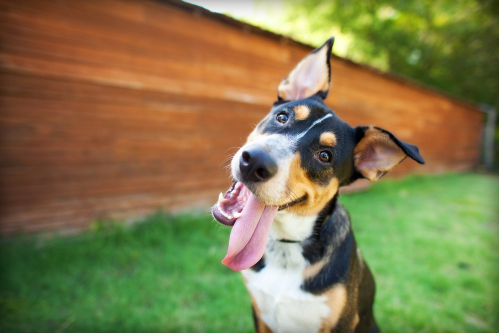
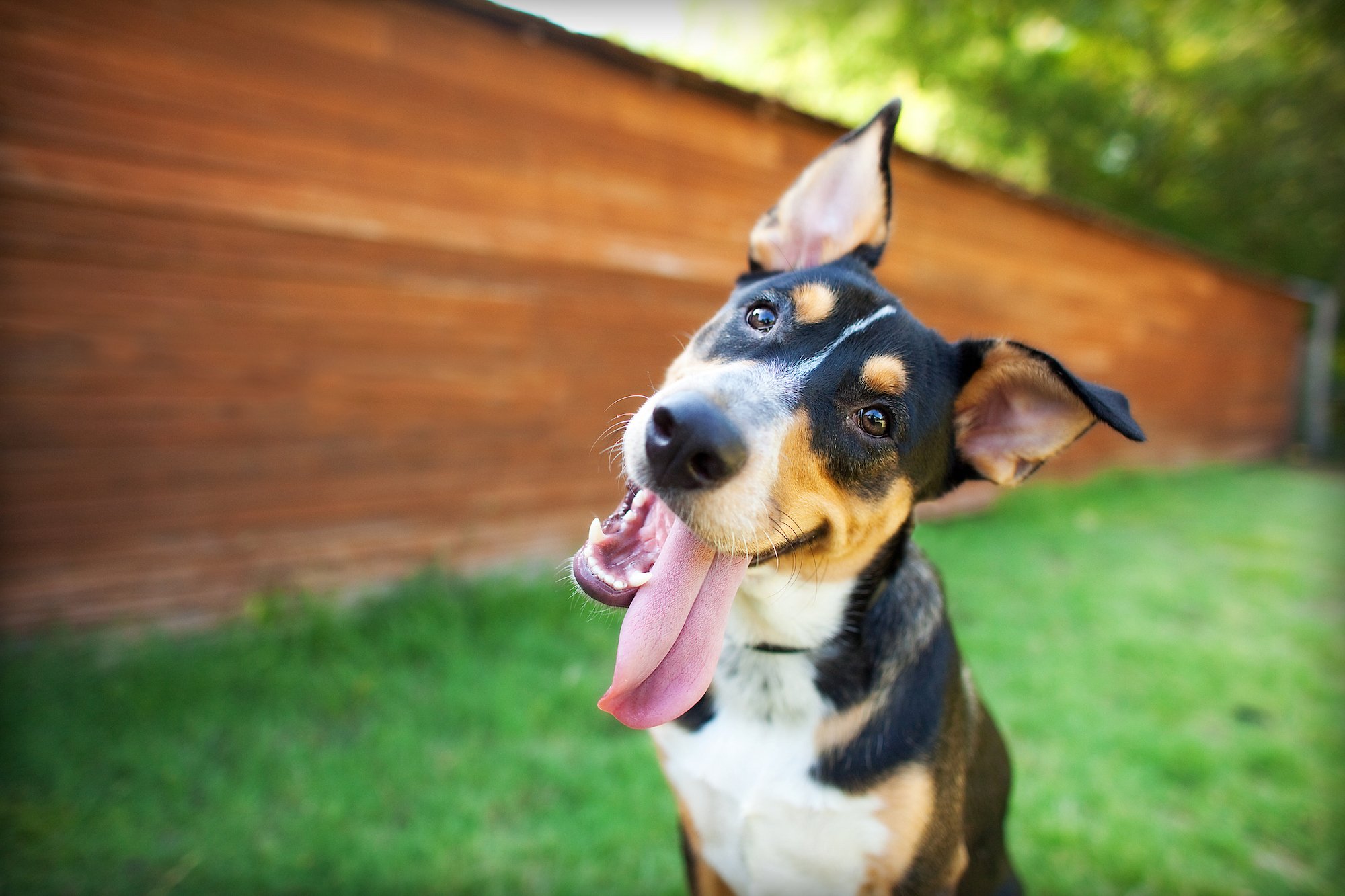
Yes, it’s cute. No, that’s not why dogs tilt their heads.
Image: Getty Images
Get the Popular Science daily newsletter💡
Breakthroughs, discoveries, and DIY tips sent six days a week.
By signing up, you confirm you are 16+, will receive newsletters and promotional content and agree to our Terms of Use and acknowledge the data practices in our Privacy Policy. You may unsubscribe at any time.
“Do you want a treat, Milton?” “Do you want to go for a walk, Bernie?” Annnnd, cue the head tilt from your dog.
Many dogs turn their heads, perk their ears, and stand at attention when their humans say certain words. But why? Well, it’s not just cute. There’s some serious science and fascinating theories about dogs’ ability to understand language. On the latest episode of Ask Us Anything, we explain how dogs’ head tilting likely makes your furry friend able to listen and process information better.
Ask Us Anything answers your most outlandish, mind-burning questions—from the everyday things you’ve always wondered to the bizarre things you never thought to ask. So, yes, there’s a reason why is thunder so dang loud and no, cruise ships aren’t floating petri dishes. If you have a question for us, send us a note. Nothing is too silly or simple.
This episode is based on the Popular Science article “Why do dogs tilt their heads? It isn’t just cute.“
Subscribe to Ask Us Anything
Listen and follow Ask Us Anything on your favorite podcast platform:
Spotify | Apple Podcasts | YouTube | Or wherever you get your podcasts.
Full Episode Transcript
Sarah Durn: You’re sitting on the couch and your dog is staring at you. So naturally, you start talking to them: “Do you wanna go for a walk?”
And then it happens: Their ears shoot up, their eyes lock onto yours, and their head slowly tips to one side.
So you try it again: “Do you want a walk?” And there it goes, the head tilts the other way.
But why does your precious Max do this? Why do dogs tilt their heads? Scientists still aren’t really sure why.
Welcome to Ask Us Anything, from the editors of Popular Science, where we answer your questions about our weird world, from “Why didn’t our ancestors need braces” to “Do cats really hate water?” No question is too offbeat or mundane.
I’m Sarah Durn, an editor at Popular Science.
Annie Colbert: And I’m editor-in-chief, Annie Colbert.
SD: Here at PopSci, we’re always pondering quirky questions.
AC: And this week, we’re wondering, why do dogs tilt their heads? So Sarah, tell us, why are our cute furry friends looking at us all askew?
SD: Well, scientists aren’t totally sure.
AC: Seriously? Something dogs do all the time, they don’t know why?
SD: I know, I know. There are a few theories out there, though. Maybe our pups are trying to hear us better.
AC: I guess that makes sense. I remember my dad used to kind of tilt his head when he didn’t have his hearing aids in.
SD: That might have just been a your dad thing.
AC: Yes, probably.
SD: Yeah, there’s also a chance dogs are trying to get a better look at our faces.
AC: That also feels plausible.
SD: But there’s another possibility that’s a lot more interesting.
AC: Ooh, okay.
SD: Researchers have found that some dogs are more likely to tilt their heads when they hear words they recognize.
AC: Wait, so they might be thinking?
SD: Maybe. That little head tilt could have something to do with how dogs pay attention to, and process, what we’re saying.
AC: Which somehow makes it even cuter.
SD: Right? So why do some dogs tilt more than others? What’s actually happening in their brains? And does your dog understand more of what you say than you realize?
AC: I must know.
SD: We’re gonna get into all of it. But before we do, we wanna hear from you. What questions are you head tilting, AKA thinking about?
AC: If there’s something you’ve always wanted to know, something that makes you tilt your head, submit your question by clicking the “Ask Us” link at popsci.com/ask.
SD: Send us your questions.
AC: Yes. And coming up, we’ll dig into what might actually be going on when your dog does that adorable little head tilt.
SD: And what it could tell us about how much they really understand when we talk to them.
AC: That’s after this quick break.
SD: Welcome back. Annie, now before we get into the science, I feel like we have to establish our dog credentials here. So did you grow up with dogs?
AC: Yes. We always had at least one dog growing up, everything from mixed breed dogs to cocker spaniels named after various bread products. We had both a Muffin and a Biscuit at one point.
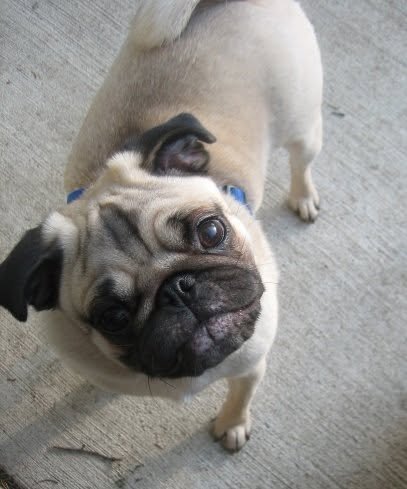
And then we had pugs, and I think I can confidently say that pugs were definitely the biggest head tilters.
SD: Mm.
AC: And I always assumed it’s just because they were perpetually confused by life.
SD: I mean, aren’t we all? I grew up with Saint Bernards.
AC: Hmm.
SD: So my family has had, oh, five.
AC:Wow.
SD: And my grandmother, who started the trend, actually had something like nine throughout her life.
AC: What? That’s so many.
SD: I know. I love Saint Bernards. And Saint Bernards, at least the ones I’ve gotten to know, are not huge head tilters.
AC: Hmm, interesting. Is it maybe because their heads are just too heavy to tilt?
SD: There is a lot of head to move for a Saint Bernard. Hmm.
AC: Yeah.
SD: But our newest puppy, Tartufo, we call him Tufo, is actually a little bit of a head tilter, and sometimes if you say a word he knows, he’ll look right at you and just tip.
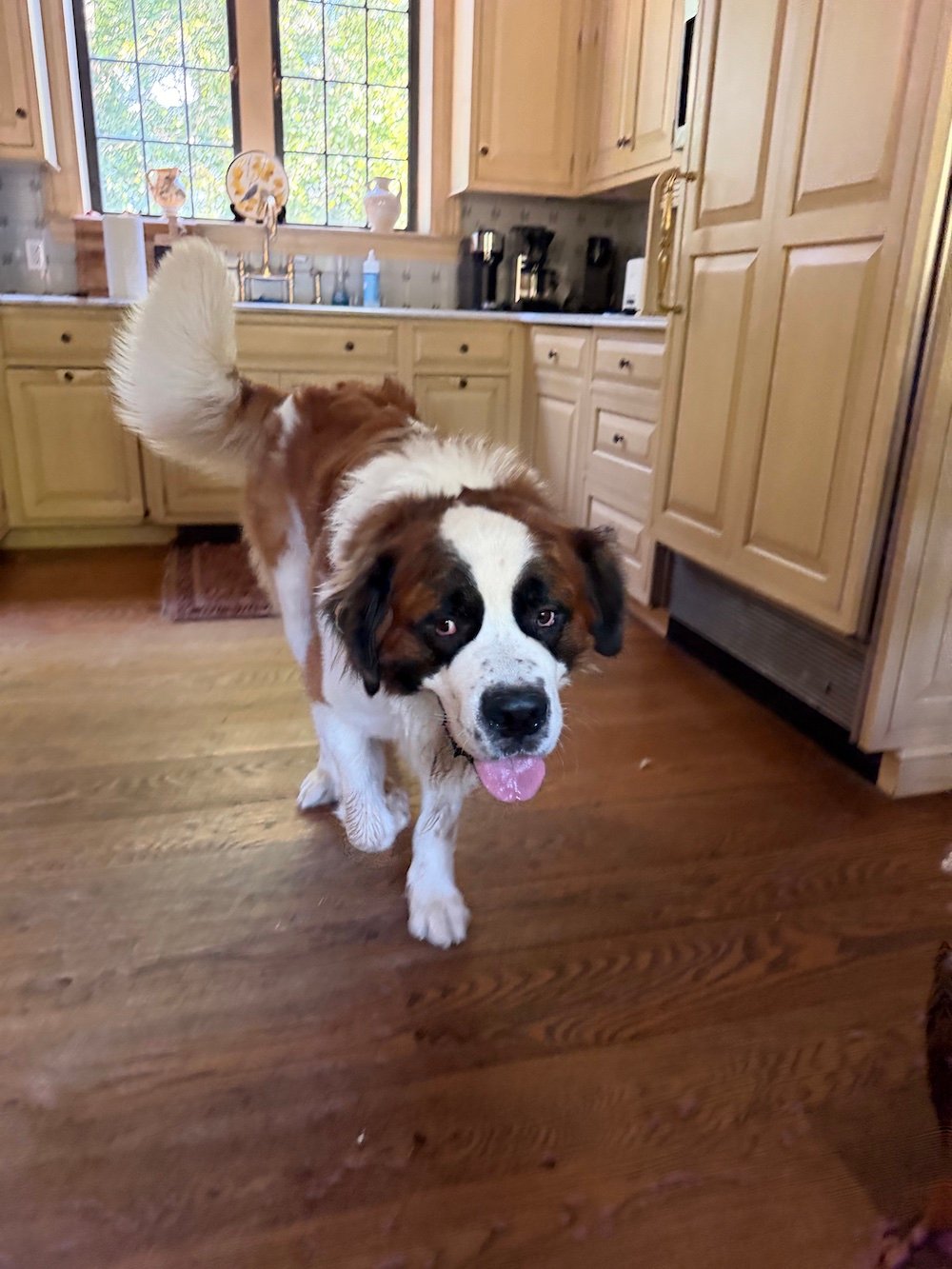
AC: Aw.
SD: I know, it’s so cute. I love him so much. He’s like a super sweet, like, expressive dog, so the head tilt just, you know, sends it over the edge.
AC: Love it.
SD: But here’s the really cool part: Tufo seems to head tilt more when he hears words he recognizes, and scientists think that might be a clue about what the head tilt actually means.
AC: All right, so what’s happening in that giant Saint Bernard brain?
SD: Potentially language processing.
AC: Excuse me?
SD: I know. Dogs have lived alongside humans for roughly 20,000 to 30,000 years, and over that time they’ve gotten remarkably good at dealing with this extremely weird thing humans do all day long.
AC: Talk at them.
SD: Constantly. And brain scans suggest dogs process parts of human speech in ways that are surprisingly similar to us. When a dog hears a familiar word, the left side of its brain becomes active, even if you change your tone of voice. But if you say an unfamiliar word using a familiar tone, the right side becomes more involved.
AC: So their brains are basically going, “Okay, I recognize that word,” versus, “I don’t know what you’re saying, but you sound excited.”
SD: Yeah, and that brings us to a 2025 study that basically asked, okay, where does the adorable head tilt fit into all of this? Researchers recruited 103 dog owners and had them film their dogs in four different situations.
First: Dog doing nothing.
AC: A challenging assignment for most dogs.
SD: Totally. Totally. And then second: Owner silently staring at dog.
AC: It’s kind of intimidating.
SD: Right. And then, this is my favorite: Owner talking to dog about ancient Egyptian civilization.
AC: Finally, that canine Egyptology study we were always waiting for.
SD: Exactly. I know everyone was on the edge of their seats. The idea was, you know, to give dogs speech that was neutral or unfamiliar. And then in the final and fourth condition, owners used familiar words with a warm, excited tone.
AC: Like, “Wanna go for a walk?”
SD: Exactly. And that is when the head tilt really showed up.
Dogs tilted much more often when their owners were saying familiar things in that enthusiastic, excited way.
AC: So they weren’t just reacting to the sound. Right.
SD: Courtney Sexton, one of the authors of the study, described it as a kind of communicative exchange. The dog isn’t necessarily going, “Ah, yes, I fully comprehend this sentence,” but something about you talking to them using words they know seems to make that little head go sideways.
AC: Which feels like watching the loading wheel appear over their little brains.
SD: Oh, yeah, totally. Like… Processing, processing, walk detected.
AC: Uh, that is exactly what it sounds like.
SD: Oh, yeah, 100%. And, you know, somehow this all gets a little weirder. Because researchers also noticed that most of the dogs who tilted went to the right.
AC: Huh. There’s a preferred head tilt direction?
SD: Apparently. And there’s a possible brain connection here. Brains process sensory information contralaterally, which is a fancy way of saying that the left side of the brain is connected to the right side of the body and vice versa. So one hypothesis is that a right head tilt could be connected to the dog engaging the left hemisphere of the brain, the side involved in processing familiar language.
AC: So we might literally be seeing the dog’s brain work.
SD: Maybe, but, you know, giant asterisk here. Researchers are not saying right tilt equals language happening. That part is still very much a hypothesis. The study also had another really weird result.
AC: What’s that?
SD: Male dogs tilted more often than female dogs, and when they tilted, male dogs leaned further to the right.
AC: Why are boy dogs so dramatic?
SD: Aren’t all guys, really? Scientists don’t really know why this is happening yet, but one possibility is that male and female dogs may use their brain hemispheres a little differently when processing language. But only around 40 of the 103 dogs in the study actually tilted at all, so the researchers are very cautious about drawing any sort of broad conclusion.
AC: All right. But dogs don’t only tilt their head when people talk to them, right?
SD: Right. And this is where our very satisfying head tilt equals language explanation gets messier. Another study found dogs tilting their heads after being startled by a jack-in-the-box.
AC: Okay, that’s a reasonable response to a jack-in-the-box.
SD: Yeah, extremely reasonable. And that suggests, though, that head tilting might have something to do with novelty or surprise, not just language. There’s even this possibility called cognitive offloading.
AC: Which sounds like something I need at the end of every workday.
SD: Oh my gosh, same. Um, yeah, basically we make a physical gesture while our brain is working something out. You furrow your brow, you exhale, you stare into space for five seconds while trying to remember why you walked into the kitchen.
AC: Constantly.
SD: Same. The head tilt could be a dog version of that, a little physical reset while their brain processes something new.
But Courtney Sexton from that study we talked about doesn’t think that explains the whole thing because in the 2025 experiment, the dogs tilted overwhelmingly during the social language condition.
AC: Okay, I have another scientific hypothesis.
SD: Shoot.
AC: Dogs know that the head tilt makes us powerless to their adorableness.
SD: That is actually an important scientific question.
AC: Called it.
SD: You did, because humans do rate head tilting dogs as cuter. But Sexton doesn’t think dogs are sitting there plotting, you know, “If I rotate my head 15 degrees, perhaps she’ll give me cheese.”
AC: But you cannot prove they’re not.
SD: Okay, fair, but there is a reason it absolutely destroys us.
During domestication, dogs develop something called neoteny, meaning adult dogs retain juvenile features like large eyes and soft facial proportions, basically permanent baby face, and humans are very, very responsive to baby face. So the head tilt isn’t necessarily designed to be cute.
AC: We’re just helpless against it.
SD: Exactly. Which brings us back to the original question: why do dogs tilt their heads? And the slightly frustrating answer is: Scientists still don’t completely know.
It could involve language processing, attention, surprise, maybe even that little physical reset while the brain figures something out. But the strongest evidence we have suggests that at least sometimes the head tilt is a visible sign that your dog is actively processing and responding to you.
So when Tufo hears a word that he knows and tilts his head, that enormous Saint Bernard brain may actually be hard at work.
AC: Thinking important thoughts.
SD: Extremely important thoughts. Probably mostly about snacks.
AC: Yes. But now I have a question.
SD: Yes, go.
AC: If we can use something like a head tilt to get a tiny glimpse into what a dog is thinking, can we actually tell how smart a dog is?
SD: Funny you should ask, because the internet has come up with some pretty questionable ways to test your dog’s IQ.
AC: All right, I’m intrigued.
SD: And scientists have some much better ones.
AC: Unsurprising.
SD: Unsurprising. Now, we have to take a quick break, but when we come back, we’ll explain how you can actually test your dog’s IQ.
AC: I mean, Tufo genuinely sounds like a genius.
SD: I mean, he is. I won’t argue with, with that at all.
AC: Welcome back. Okay, Sarah, before the break, you promised that we could actually put Tufo’s brain to the test.
SD: I did. Because we spent this whole episode talking about what his head tilt might tell us about what’s happening inside his brain, naturally the next question is how smart is my adorable little Saint Bernard?
AC: Little?
SD: He’ll always be a little puppy to me.
AC: Debatable. Anyhow, uh, I’ve seen a pet IQ test online called the wall test where you hold up your dog and you slowly move them toward a wall to see if they put their paws out.
SD: Yes, yes. I’ve seen that one, too, but I don’t think anyone’s lifting Tufo, and that might actually be a good thing because experts say you should not do the wall test.
AC: Really?
SD: Yes. Don’t do it. Whether a dog sticks out their paw actually has nothing to do with intelligence. It’s a neurological reflex vets use to check that a dog’s nervous system is working properly, kind of like when a doctor taps your knee and your leg automatically kicks.
AC: Hmm. So it’s not really an IQ test at all.
SD: No.
AC: But how do I find out if my dog is a genius?
SD: Well, obviously they are. But scientists would say that’s actually the wrong question.
AC: Rude.
SD: Because there isn’t one thing called dog intelligence. Some dogs are amazing problem solvers, some are great navigators, and some are especially good at reading us.
AC: Which feels especially relevant after an entire episode about dogs listening to us.
SD: Exactly. And you can test this even at home. Just grab two identical cups and a treat. While your dog isn’t looking, hide the treat under one cup, then put both cups down and either point at the correct cup or just look at it, and then let your dog choose which cup they’re drawn to.
AC: So if they pick up the right cup…
SD: They successfully read your social cue. That’s a skill called social cognition.
AC: Hmm. Genius.
SD: Good at one particular type of cognition.
AC: Or genius.
SD: Fine. Genius. All dogs are geniuses. Yeah. But if they choose the wrong cup or, you know, just wander off down the hallway, that doesn’t mean they’re dumb. Dogs have different strengths, and just like us, they have to actually be motivated to participate.
AC: So if my dog completely ignores my carefully designed scientific experiment…
SD: You might just need better treats.
AC: Fair.
SD: And I think that brings us right back to the head tilt. One cute little behavior cannot tell us exactly what’s happening inside our dog’s brain, alas.
But it can give us a clue and remind us that there’s a whole lot going on behind those puppy dog eyes.
AC: Even when it looks like there absolutely is not.
SD: Watch it.
And that’s it for this episode. But don’t worry, we’ve got more episodes of Ask Us Anything live in our feed right now. Follow or subscribe to Ask Us Anything by Popular Science wherever you enjoy your podcasts. And if you like our show, leave a rating and review.
AC: We care what you think. We care what your dogs think, geniuses or not. Our producer is Alan Haburchak, and this week’s episode was based on stories written for Popular Science by Nidhi Sharma and Clarissa Brinkett.
SD: Thank you, team, thank you, dogs, and thanks everyone for listening.
AC: And one more time, if you want something you’ve always wondered about explained on a future episode, go to popsci.com/ask and click the “Ask Us” link. Keep the questions coming. Till next time, may your dog always listen when you call.
SD: May your pockets be full of sufficiently motivating treats.
AC: And may your dog’s head tilts always be ridiculously cute.
SD: Like, they can never not be. They’re always cute.
AC: Pugs, pugs, pugs.

2026 Popular Science Home of the Future Awards
39 products that will improve your everyday life.