
The New York Times insists its decision to stop using political cartoons in its international edition, as of this week, has nothing to do with the row over a cartoon in April.
That image of Benjamin Netanyahu, the Israeli prime minister, as a guide dog leading a blind Donald Trump, wearing a skull cap, was rightly condemned as antisemitic.
Let us put aside any possible connection between the decision and the controversy, however, and say how regrettable it is that cartoons should be absent from such an important global showcase.
We’ll tell you what’s true. You can form your own view.
From
15p
€0.18
$0.18
USD 0.27
a day, more exclusives, analysis and extras.
From its founding in 1986, The Independent has seen the political cartoon as an essential part of its mission to comment, campaign and entertain. Our founders included Nicholas Garland, probably the leading cartoonist of the time, and we are immensely proud of the rest of the team including Dave Brown, Brian Adcock, Peter Schrank and Andre Carrilho.
1/50 6 July 2019
2/50 5 July 2019
3/50 4 July 2019
4/50 3 July 2019
5/50 2 July 2019
6/50 1 July 2019
7/50 30 June 2019
8/50 29 June 2019
9/50 28 June 2019
10/50 27 June 2019
11/50 26 June 2019
12/50 25 June 2019
13/50 24 June 2019
14/50 23 June 2019
15/50 22 June 2019
16/50 21 June 2019
17/50 20 June 2019
18/50 19 June 2019
19/50 18 June 2019
20/50 17 June 2019
21/50 16 June 2019
22/50 15 June 2019
23/50 14 June 2019
24/50 13 June 2019
25/50 12 June 2019
26/50 11 June 2019
27/50 10 June 2019
28/50 9 June 2019
29/50 8 June 2019
30/50 7 June 2019
31/50 6 June 2019
32/50 5 June 2019
33/50 4 June 2019
34/50 3 June 2019
35/50 2 June 2019
36/50 1 June 2019
37/50 31 May 2019
38/50 30 May 2019
39/50 29 May 2019
40/50 28 May 2019
41/50 27 May 2019
42/50 26 May 2019
43/50 25 May 2019
44/50 24 May 2019
45/50 23 May 2019
46/50 22 May 2019
47/50 21 May 2019
48/50 20 May 2019
49/50 19 May 2019
50/50 18 May 2019
1/50 6 July 2019
2/50 5 July 2019
3/50 4 July 2019
4/50 3 July 2019
5/50 2 July 2019
6/50 1 July 2019
7/50 30 June 2019
8/50 29 June 2019
9/50 28 June 2019
10/50 27 June 2019
11/50 26 June 2019
12/50 25 June 2019
13/50 24 June 2019
14/50 23 June 2019
15/50 22 June 2019
16/50 21 June 2019
17/50 20 June 2019
18/50 19 June 2019
19/50 18 June 2019
20/50 17 June 2019
21/50 16 June 2019
22/50 15 June 2019
23/50 14 June 2019
24/50 13 June 2019
25/50 12 June 2019
26/50 11 June 2019
27/50 10 June 2019
28/50 9 June 2019
29/50 8 June 2019
30/50 7 June 2019
31/50 6 June 2019
32/50 5 June 2019
33/50 4 June 2019
34/50 3 June 2019
35/50 2 June 2019
36/50 1 June 2019
37/50 31 May 2019
38/50 30 May 2019
39/50 29 May 2019
40/50 28 May 2019
41/50 27 May 2019
42/50 26 May 2019
43/50 25 May 2019
44/50 24 May 2019
45/50 23 May 2019
46/50 22 May 2019
47/50 21 May 2019
48/50 20 May 2019
49/50 19 May 2019
50/50 18 May 2019
Their cartoons lampoon politicians, often savagely, and satirise current affairs, sometimes pushing at the boundaries of taste and taking risks. Dave Brown says: “I work on that margin of what is acceptable: a cartoon needs to unsettle and discomfort the reader a little.”
Occasionally, we, like The New York Times, have fallen on the wrong side of the line. But we believe that the right course is to apologise, to learn and to renew our determination to offer a pointed commentary on the follies of the powerful.
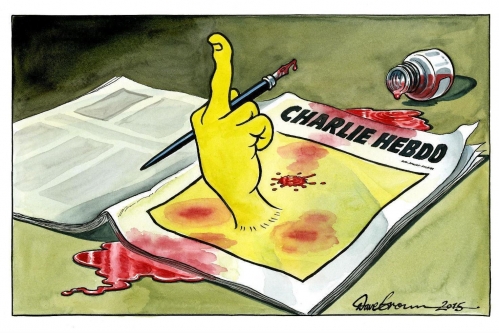
We have used crude images to lend impact to what we believe are important points of principle, such as our front-page image after the Charlie Hebdo massacre, of a hand holding a pen and a middle finger raised in defiance.
We are proud of our poster front pages launching campaigns such as the one for a Final Say referendum on Brexit. We believe that we have preserved and enhanced the value of political cartoons in the transition to online-only journalism. We hope our cartoons continue to leaven the news mix – with humour and sometimes righteous rage.
“There is no ‘on the other hand’ in an editorial cartoon,” said Kevin Siers, president of the Association of American Editorial Cartoonists, commenting on The New York Times’s decision. “This power, understandably, makes editors nervous.”
We believe, however, editors should have the courage of their convictions and take risks with their readers’ sensibilities. True to the spirit of William Hogarth in the 18th century, we value the power of the well-drawn image to shock, surprise, amuse and occasionally to offend.
We owe it to the spirit of free speech, under threat in so much of the world, to allow our best creative artists to satirise the absurdities of life with their unflinching eye. As Patrick Chappatte, the NYT’s former cartoonist, said on Monday: “In the insane world we live in, the art of visual commentary is needed more than ever.”