
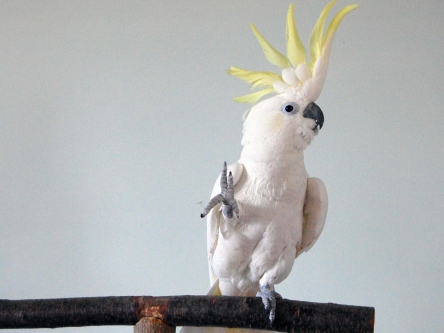
The dancing antics of a sulphur-crested cockatoo called Snowball have made him into an online superstar and intrigued scientists all over the world.
The headbanging cockatoo has generated a social media following and wowed researchers by displaying 14 distinct moves as he bopped along to Eighties classics.
He was filmed swinging from side to side, lunging and lifting his foot as he danced to “Another One Bites The Dust” and “Girls Just Want To Have Fun”.
We’ll tell you what’s true. You can form your own view.
From
15p
€0.18
$0.18
USD 0.27
a day, more exclusives, analysis and extras.
Snowball is the first non-human animal documented as being able to dance to a beat.
Scientists say his “remarkably diverse spontaneous movements” show dancing is a response to music when certain conditions are present in the brain.
“What’s most interesting to us is the sheer diversity of his movements to music,” said senior author Aniruddh Patel, a psychologist at Tufts University and Harvard University.
Parrots are vocal learners whose brains contain strong auditory-motor connections. Writing in Current Biology, the authors said the key question was how Snowball acquired his dance skills.
They believe some moves could reflect creativity.
“This would also be remarkable, as creativity in non-human animals has typically been documented in behaviours aimed at obtaining an immediate physical benefit, such as access to food or mating opportunities,” they said.
“Snowball does not dance for food or in order to mate; instead, his dancing appears to be a social behaviour used to interact with human caregivers (his surrogate flock).”
The videos were filmed in 2008 when Snowball was 12. He became a YouTube sensation and clips of him dancing were viewed millions of times.
An initial study published shortly afterwards showed he could keep to a beat. Later his owner and study author, Irena Schulz, noticed him displaying a greater range of movement.
Researchers revisited the footage after a 2016 study on the evolution of dance inspired them to think about its wider significance. During the 23 minutes of music, Snowball’s owner was present and offered encouragement in the form of an occasional “good boy”, but did not dance.
He danced in three to four-second snippets, moving differently each time he heard a particular tune, a sign of flexibility. Analysis of his moves revealed them to be clearly intentional but not an “efficient means of achieving any plausible external goal”.
Researchers suggest that spontaneous dance movements arise when five traits, which parrots share with humans, are present.
These include attentiveness to communicative movements, the ability to imitate them and a tendency to form long-term social bonds.
Additional reporting by PA
1/10 10. Chaffinch
Down one place on last year.
Birdwatch has released this year’s rankings for the most frequently spotted birds in the UK. Results were collected from 420,489 British birdspotters
Getty
2/10 9. Long-tailed tit
Up one place on last year
Getty
3/10 8. Robin Redbreast
Down one place on last year
Getty
4/10 7. Great Tit
Up one place on last year
Getty
5/10 6. Goldfinch
In the same place as last year
Pierre Dalous
6/10 5. Woodpigeon
In the same place as last year
Getty
7/10 4. Blackbird
Down one place on last year
Getty
8/10 3. Blue tit
Up one place on last year
Getty
9/10 2. Starling
In the same place as last year
Getty
10/10 1. House sparrow
In the same place as last year
Getty
1/10 10. Chaffinch
Down one place on last year.
Birdwatch has released this year’s rankings for the most frequently spotted birds in the UK. Results were collected from 420,489 British birdspotters
Getty
2/10 9. Long-tailed tit
Up one place on last year
Getty
3/10 8. Robin Redbreast
Down one place on last year
Getty
4/10 7. Great Tit
Up one place on last year
Getty
5/10 6. Goldfinch
In the same place as last year
Pierre Dalous
6/10 5. Woodpigeon
In the same place as last year
Getty
7/10 4. Blackbird
Down one place on last year
Getty
8/10 3. Blue tit
Up one place on last year
Getty
9/10 2. Starling
In the same place as last year
Getty
10/10 1. House sparrow
In the same place as last year
Getty