

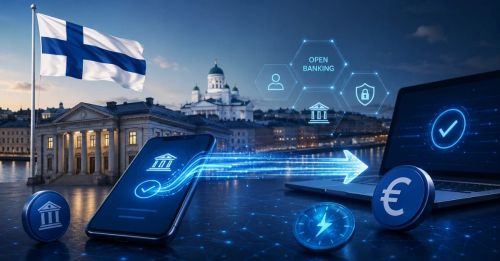
Ask anyone who has actually used crypto and they will tell you the appeal was never speculation but settlement: value that moves in seconds, at any hour, with no card number typed in and no three-day wait. For most of the last decade that experience stopped at the wallet. In 2026 it no longer does. Between open banking and a hard EU mandate on instant transfers, ordinary bank money in the euro area now moves much the way on-chain value does, and Finland is one of the cleanest places to watch the shift happen. The account-to-account (A2A) rails behind that change were adopted early by consumer businesses, from retail checkouts to subscriptions and, in the Nordics, online gaming. In Finland the tax outcome of any winnings depends far less on how the money is paid than on where the operator is licensed, an EEA licence versus an offshore one, and a Finnish reference site such as verovapaat casino sorts operators by exactly that licensing jurisdiction.
It is a useful reminder that a licence, not a payment method, decides the consumer outcome. The bigger story, though, is the plumbing underneath, and that is a fintech story before it is anything else. What open banking actually changed Before PSD2, the EU’s Second Payment Services Directive, a bank was a closed system: no third party could start a payment from your account. PSD2 created a licensed role, the payment initiation service provider (PISP), that can trigger a transfer straight from your bank account once you approve it inside your own banking app.
Finnish banks, OP, Nordea, S-Pankki and Danske among them, exposed standardised APIs to make that possible. The practical effect is that a business can ask you to log into your bank and confirm a transfer rather than hand over a card. The payment carries verified identity from the bank, settles on real-time rails, and stores no card credentials on the merchant side, which is why it tends to cut both fraud exposure and card-processing cost. Nordic fintechs such as Zimpler and Brite built entire businesses on this model, and it is now the default checkout for a large share of Finnish e-commerce rather than a niche option. The EU has now made instant the default Open banking made A2A possible; regulation made it universal.
The Instant Payments Regulation, Regulation (EU) 2024/886, requires payment providers in the euro area to receive instant credit transfers since 9 January 2025 and to send them since 9 October 2025. From that same October date they must also offer a free Verification of Payee check, matching the payee name to the IBAN before you confirm, a simple step that heads off both typos and a common class of payment fraud. Because Finland sits in the euro area, none of this is a future promise.
A transfer between two Finnish accounts is now expected to make funds available to the recipient within about ten seconds, weekends and holidays included, at no premium over a standard transfer. That is bank money behaving like a wallet, and it removes the single biggest gap that used to separate a bank app from an on-chain send.

Crypto firms are crossing onto bank rails The convergence runs in both directions. As crypto matured under MiCA, the EU’s Markets in Crypto-Assets framework, exchanges began acquiring the same payment permissions banks hold. OKX is the clearest example: alongside its MiCA authorisation it secured a Payment Institution licence in Malta, passported across the EEA, to run stablecoin payment products such as OKX Pay and its card under both MiCA and PSD2, as Coinpedia detailed when reporting on OKX obtaining an EU payments licence in Malta. That licence is not a formality. Under the updated rulebook, a stablecoin used to pay is treated as electronic money, so a firm offering stablecoin payments needs a payment or e-money licence on top of MiCA.
The result is that crypto rails are being pulled under the very framework that governs ordinary bank transfers, and a user can increasingly spend a regulated stablecoin the way they would tap a debit card. Verified identity is the real dividing line If A2A and on-chain transfers can feel equally fast, they still place trust differently, and that is where the detail matters. A bank transfer arrives with a customer the bank has already identified. Strong customer authentication under PSD2 means the payment is approved with two independent factors inside your banking app, and that verified identity travels with the money.
An on-chain transfer, by contrast, arrives with only an address, so any regulated business still has to run its own identity and anti-money-laundering checks before it pays anything out. The Finnish regulator sets out the strong customer authentication in payment services rules that make the bank login itself a compliance step, which is why a “registration-free” checkout is a claim about user experience rather than about anonymity. The direction of travel is that both rails, bank and crypto, increasingly answer to the same identity and AML expectations. Where this leaves 2026 The next moves are already drafted, from the EU’s PSD3 and Payment Services Regulation proposals to the continued build-out of MiCA.

For the person tapping a phone, the visible result is the same regardless of where the money starts: value that settles in seconds with identity built in, whether it leaves a bank app or a crypto wallet. The rails a Finnish user meets today, fast, verified and account-to-account, are the clearest measure of how far ordinary money has moved toward what crypto promised first. Was this writing helpful? Story Ends Here
Disclaimer and Risk Warning The guest posts featured on Coinpedia are contributed by external authors and reflect their personal opinions and viewpoints. Coinpedia does not endorse, verify, or take responsibility for the accuracy, legality, or reliability of the content, advice, or opinions expressed in these guest posts.
Including guest posts does not imply Coinpedia’s approval of the content or the author’s views. Readers are encouraged to independently evaluate the information and seek professional advice if necessary before acting on any information provided in the guest posts. Read the Next News