
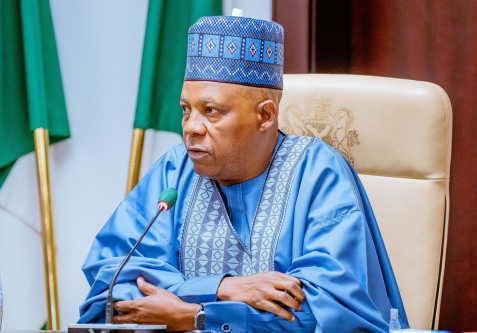
Vice President Kashim Shettima has unveiled a $500 million Niger Delta Agricultural Investment Fund aimed at accelerating agricultural production, attracting private investment and strengthening food security across Nigeria’s oil-producing region. Shettima unveiled the fund on Wednesday in Abuja during the Niger Delta Agricultural Development and Investment Summit, jointly organised by the Office of the Vice President and the Niger Delta Development Commission (NDDC). The initiative is expected to finance agricultural projects across the region while mobilising investments into key value chains. The Niger Delta is Nigeria’s oil-producing region, comprising Akwa Ibom, Bayelsa, Cross River, Delta, Edo, Imo, Ondo, Rivers and Abia states. While the region has historically been the backbone of the country’s petroleum industry, it also possesses vast agricultural potential due to its fertile land, extensive river systems and favourable climate. What they are saying
According to the Vice President, the $500 million fund is designed as a commercially driven investment vehicle covering multiple agricultural value chains, including aquaculture, palm oil, cassava, cocoa, rice, horticulture, marine resources and livestock. He added that the initiative will leverage financing commitments from multilateral development institutions, including the World Bank, African Development Bank, Islamic Development Bank, European Bank for Reconstruction and Development, alongside private investors and commercial financiers.
Shettima said the initiative reflects a return to the country’s agricultural roots, noting that before crude oil became Nigeria’s dominant source of revenue, agriculture financed public infrastructure and national development. “The groundnut pyramids of the North, the cocoa estates of the West, and the palm produce of the East and the Delta financed our earliest schools and hospitals and underwrote the young institutions of a new republic.”
He stressed that food security remains the foundation of national stability and sustainable development. “Before a people raise cities, they must learn to feed them, and before a state earns the loyalty of its citizens, it must secure their daily bread.”
More insights
Beyond its contribution to Nigeria’s petroleum industry, the Niger Delta remains one of the country’s most strategically important agricultural regions, with enormous potential in fisheries, aquaculture, oil palm, cassava, rice and other high-value crops. However, decades of crude oil exploration, pipeline leaks and environmental degradation have polluted farmlands and water bodies across many communities, reducing crop yields, threatening fishing livelihoods and limiting agricultural productivity. Shettima said the region’s decision to prioritise agriculture despite its vast oil wealth demonstrates a commitment to long-term economic sustainability rather than dependence on crude oil revenues.
“What makes this vision inspiring is that it arises from a region that could have rested on its oil wealth and left feeding the nation to other hands.”

He added that the Niger Delta was reclaiming its historic role as an agricultural powerhouse. “The Niger Delta has instead chosen to return to an identity older than crude itself, for the palm oil of these creeks fuelled the commerce of continents long before the first barrel was drilled.”
What you should know
The launch of the fund comes as Nigeria continues to grapple with stubbornly high food prices despite signs that overall inflation is easing. According to the latest Consumer Price Index released by the National Bureau of Statistics, Nigeria’s headline inflation slowed marginally to 15.91% in June 2026, from 15.93% in May. However, food prices continued to climb, with food inflation rising to 17.52% year-on-year, while monthly food inflation accelerated to 3.75%, up from 2.98% in May, which shows the need to expand domestic food production. Concerns over food security have also intensified in northern Nigeria.
In early July, Nairametrics reported that the World Food Programme (WFP) said it requires $89 million over the next six months to sustain food and nutrition assistance as well as critical logistics operations across northern Nigeria, warning that more than 17 million people in conflict-affected states are currently facing acute food insecurity due to insecurity, displacement and funding shortfalls.