

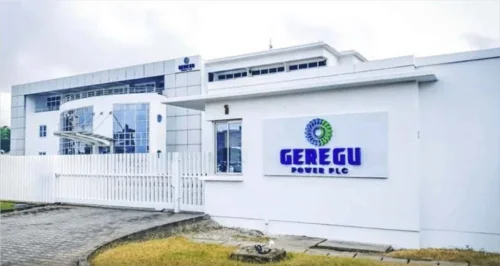
Geregu Power Plc has defaulted on its N40.09 billion Series 1 Senior Unsecured Bond, missing both its eighth semi-annual coupon obligation and its scheduled fourth principal bullet repayment, according to an updated listing status published by FMDQ Securities Exchange. The default marks a notable escalation in debt service friction for one of Nigeria’s premier listed power generation companies, coming at a time when the firm’s operational cash flows have collapsed alongside a sharp deterioration in earnings.
The 7-year bond, issued on July 28, 2022, at a fixed rate of 14.50% under the company’s N100 billion debt issuance programme, was structured with semi-annual coupon distributions and amortising principal repayments running through to a July 28, 2029, maturity. The missed payment therefore represents a breach midway through the bond’s life, rather than at maturity, raising fresh questions about Geregu Power’s near-term liquidity position. What the data is saying:
On its website, FMDQ Securities flagged the Geregu’s Series 1 bond status as “credit default in the 8th coupon payment and 4th bullet principal repayment.”
The default follows a sharp slowdown in operational cash flows for the generating company during recent quarters, driven by a collapse in both revenue and profitability. For the six months period ended June 30, 2026, Geregu Power’s profit after tax (PAT) dropped 88% to N2.54 billion from N20.27 billion in the corresponding period of 2025.
Net profit margin contracted sharply to 13.34% from 23.23% a year earlier. Revenue fell 78.71% to N18.65 billion from N87.63 billion in H1 2025. The decline was most severe in the second quarter alone, when the company generated just N419.1 million in turnover, compared with N55.87 billion in Q2 2025, a near-total collapse in quarterly sales. The revenue and earnings crash stands in sharp contrast to the company’s own guidance earlier in the year, when it had forecast Q1 2026 revenue of N57.11 billion, above the N31.75 billion recorded in Q1 2025, alongside projected PAT of N12.02 billion, also above the prior year’s N10.43 billion. That earlier optimism has since been overtaken by events, with the company’s actual H1 2026 performance falling drastically short of both its own projections and the prior year’s actuals. More insight on the default
Geregu Power has attributed the operational slowdown to a planned N61.47 billion major turbine maintenance programme. While the overhauls are intended to secure long-term plant integrity and capacity availability, the temporary loss of billable capacity and energy output has weighed heavily on near-term margins and cash generation, culminating in the bond default.
Despite the missed coupon and principal payment, the company has pointed to some balance sheet resilience:
Financial asset impairment reversals of N16.12 billion provided a partial cushion to the balance sheet during the period. Total liabilities declined to N239.33 billion during the period, even as debt servicing capacity came under visible strain. However, GCR Ratings, a ratings agency was betting on Geregu’s recovery, while the default shows that the company is currently facing a real cash-flow or debt-servicing problem. The ratings agency affirmed Geregu Power’s national scale long-term issuer rating at ‘A(NG)’ with a Stable outlook, citing expectations of a recovery in power generation and revenue once the turbine overhauls are completed and full available capacity returns to the national grid.
GCR Ratings was basically saying Geregu Power is still a reasonably strong company in the long run, even though it has currently failed to pay a bond obligation on time. The market has already begun pricing in the deterioration as the share price has fallen 27.67% since the start of the year, closing at N825.70 on Friday, August 7, down from N1,141.50 price at the beginning of the year, ranking it 129th. What you should know
Geregu Power, in 2013, acquired generating plants in Ajaokuta, one of Nigeria’s leading power generating companies (GENCOs), using gas turbines as a clean energy source. The company listed on the Nigerian Exchange four years ago amid strong investor optimism about earning growth potential in a market with relatively few listed power firms and persistently high energy demand.
The bond default, occurring against the backdrop of an 88% earnings collapse and a near-total wipeout of Q2 revenue, raises material questions about whether the company’s turbine maintenance programme was adequately funded or hedged against the cash flow disruption it has caused. Bondholders will be watching closely for whether Geregu Power cures the default within any applicable grace period, and whether the company provides a clearer timeline for full capacity restoration following the turbine overhauls. For equity investors, the combination of a bond default and a sharp share price decline year-to-date suggests the market is still working through how to price the disconnect between the company’s near-term distress and its longer-term recovery outlook.