
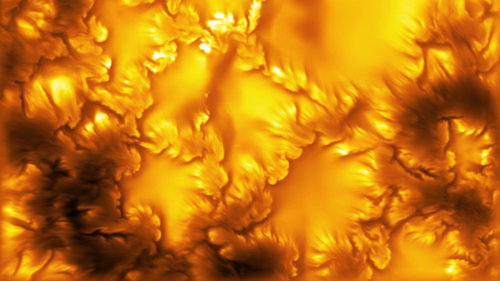
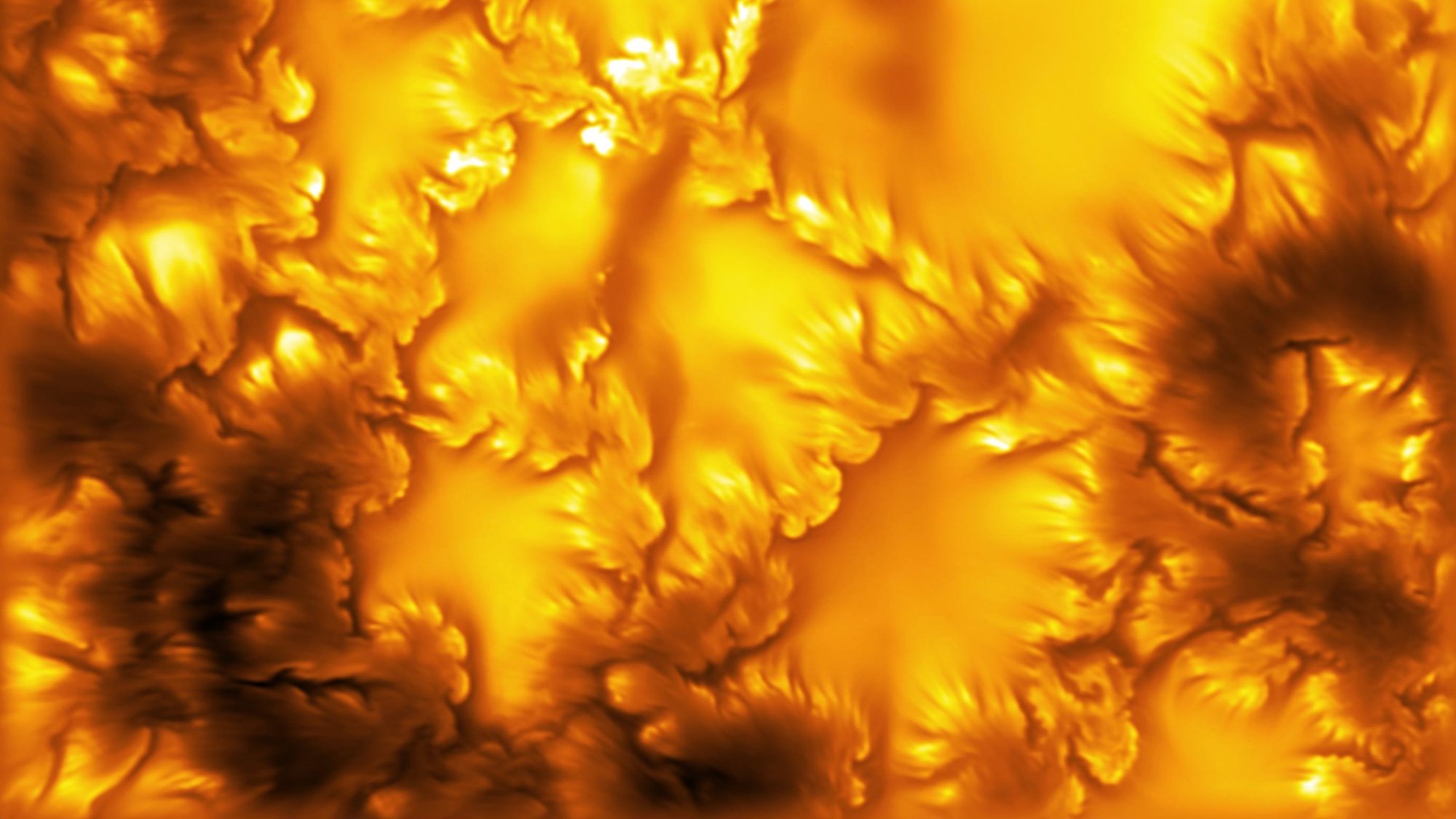
The highest-resolution image of the Sun’s surface (photosphere) ever captured, taken at 416 nanometers by the Inouye Solar Telescope. At the edges of the solar granules, the image reveals fringed-looking structures that display swirling motions.
Credit: NSF / NSO / AURA / MPS
Get the Popular Science daily newsletter💡
Breakthroughs, discoveries, and DIY tips sent six days a week.
By signing up, you confirm you are 16+, will receive newsletters and promotional content and agree to our Terms of Use and acknowledge the data practices in our Privacy Policy. You may unsubscribe at any time.
With the power of the world’s largest solar telescope, astronomers have successfully glimpsed the sun’s roiling surface in never-before-seen detail. In some of these new images, the cresting vortices that dot the sun are barely 12 miles wide. To put the achievement into perspective, the feat is like trying to discern George Washington’s face on a quarter from roughly 74 miles away. The details of the milestone achievement are detailed in a study published today in the journal Nature.
“The newly discovered plasma vortices impressively demonstrate how minute processes…significantly determine the nature of our star,” explained study co-author and director of the Max Planck Institute for Solar System Research (MPS), Sami Solanki.

Inouye Main Full View
The sun’s visible surface—known as the photosphere—is only a thin portion of its overall atmosphere, but it’s where fluid plasma emits all of the star’s visible light. It’s an incredibly dynamic environment, shaped by powerful convection currents and magnetic fields, which continuously form bubbling patterns called granules. The term “granules” may make them sound small, but they’re comparatively gigantic. Each formation measures around 310 to 1,240 miles across, and they collectively cover the sun’s outermost region.
However, even those sizes are incredibly difficult to visualize across millions of miles. To successfully examine these complex structures, astronomers used data collected by the National Science Foundation’s Daniel K. Inouye Solar Telescope in Hawaii. They then combined those observations with a broad-band imaging camera at the MPS, before clarifying the results using computer simulations.

Overview of Inouye Images and Simulations
Analysis of the granule fringes’ wavelike behavior revealed further evidence of Kelvin-Helmholtz instabilities across the sun’s surface. A staple of fluid dynamics, these instabilities occur as two fluids flow past each other at varying speeds. What begins as relatively weak shear disturbances can quickly evolve into major waves and vortices. The interactions can be seen everywhere from lake surfaces to planetary atmospheres—but it’s now clearer than ever that they occur on the sun’s surface, too.
“To detect the vortices, we needed to resolve structures on the solar surface about 20 kilometers in size,” added MPS astronomer and study co-author Michiel van Noort. “That is at the limit of what even the world’s largest solar telescope and state-of-the-art simulations can achieve.”

2026 Popular Science Home of the Future Awards
39 products that will improve your everyday life.