

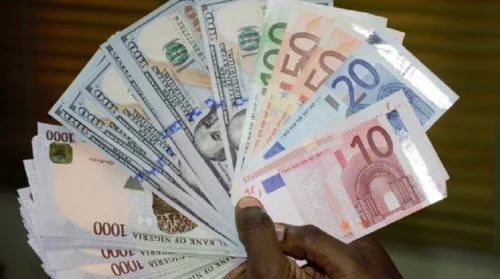
The naira appreciated against the major European currency on the mid-week trade session at the official market, with the CBN’s latest data indicating it settled at N1552/€1, up from N1563/€1 last week
EUR/NGN is trading softer from multi-highs around N1,684/€1 level seen in early January, and is trying to find its footing in the N1,550/€1 to N1,575/€1 range. A high level of stabilization appears to have been set in the Naira after CBN’s aggressive policy hikes rein in inflationary pressure on Africa’s most populous economy
CBN’s prolonged cycle of higher policy rates and the narrowing reserve ratio have helped absorb excess Naira liquidity and reduce pressure on the FX markets. The broader unification of official foreign exchange markets and active settlement of remaining FX backlogs have boosted confidence over the past week, lessening panic buying in parallel markets. High inflation in Nigeria remains persistent, constraining real purchasing power and preventing a significant appreciation of the Naira, despite stable inflows from oil exports and personal remittances that buffer supply. Consequently, the European Central Bank’s shift to an easing cycle, as inflation across the EZ becomes more subdued, will reduce the yield spread advantage previously offered by Euro-based debt compared to other asset classes, particularly EM bonds. Eurozone economic growth will stay modest, as robust expansion in core EZ countries is tempered, limiting broad upward momentum for the Euro. Euro holds at $1.4 against the U.S dollar
The major European currency hovered around $1.1400 against the US dollar during European trading hours on Wednesday.
The pair struggled to gain traction amid a weaker US dollar and shaky investor sentiment, with demand for the greenback supported by some risk-off appetite. Markets await the Fed’s rate decision for clues.
Money markets currently price in approximately a 35.8% chance of a Fed rate hike this month; 82.1% expect at least a 25-basis point increase at the September meeting. Geopolitical tensions are at a new peak, with the Iran-backed Houthi movement from Yemen allegedly attacking two Saudi oil tankers in the Red Sea for purported embargo violations. The US has responded with bombing exercises over Iran for 13 consecutive nights. Tensions escalated after President Trump issued a warning of a “major military punishment” to both the Houthis and Iran if further attacks occur, hinting at the possibility of an unprecedented large-scale military operation against Iran. Meanwhile, trade tensions are intensifying following reports that the US plans its most extensive tariff measures in recent times, imposing new duties of 10-12.5% on imports to rebuild the Trump-era trade barriers after last week’s Supreme Court decision. At least 10% of duties will be added to EU imports, structured to remain compliant with current US-EU trade agreements. Market participants are also digesting the latest ECB policy updates.

The ECB Governing Council reaffirmed its commitment to bring inflation down to its medium-term target of 2%, and warned that uncertainties remain, as energy shocks are yet to be fully felt. The ECB kept rates steady after a 25-basis point rate hike in June, maintaining the deposit facility at 2.25%, main refinancing at 2.40%, and marginal lending at 2.65%, unchanged since then. In the Eurozone, markets are closely watching the upcoming German and Eurozone July HICP reports, expected on Thursday and Friday. Projections suggest German headline HICP will accelerate to 2.8% YoY from 2.4% in June, likely fueling expectations of further ECB rate hikes.