
WHEN DAVID first noticed signs of what he’d later learn was Peyronie’s disease, he had no idea how deeply the condition would affect his emotional well-being—or his relationship with his wife.
The condition occurs when scar tissue forms a plaque under the skin of the penis, which can result in a significant curvature, as well as painful erections. Peyronie’s can dramatically reshape a man’s sex life and, along with it, shake his confidence and damage his sense of self-worth.
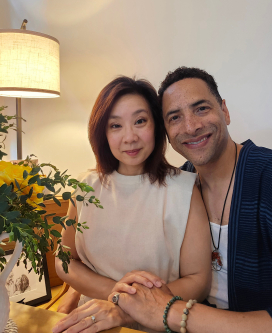
But as David, an actor and musician, discovered, those outcomes aren’t inevitable. In caring for himself and fostering an open dialogue with his wife, Bi, he’s worked through the fear and uncertainty that arose after a doctor first suggested two years ago that he might have Peyronie’s.
“I thought I was losing an entire part of my being as a man.”
It was too early to be certain, the physician told him, and because the curve wasn’t overly severe, David thought he could handle it on his own.
“My first reaction was, I’ll probably be able to work through this,” he says, sitting beside Bi in their Philadelphia home. “Maybe it’s something where I can be homeopathic about it and it’ll fix itself. That’s my first instinct for every ailment.”
David hoped that by exercising, abstaining from alcohol, and eating right, he’d be able to slow the progression or perhaps even regain a “percentage of straightness,” as he puts it.
At the time, he didn’t bring it up with Bi. But as the condition progressed, he began to realize that going it alone wasn’t working.
Facing the Condition Together
THE CURVATURE IN David’s penis gradually got more severe, “almost like a 90-degree turn,” he says. “That was when I knew, okay, this is a real issue. It’s a problem.”
He found a new doctor to get a second opinion and learn what options were available. Bi, meanwhile, could tell that something was troubling her husband. “I think, emotionally, he had a stress that was starting to weigh on him,” she says.
David was apprehensive about initiating the conversation, but eventually he opened up to Bi. The exchange underscored how Peyronie’s disease can affect not only the person with the condition but their partner as well. Being transparent and addressing the situation together reinforced their strong relationship, the couple says.
“[My wife] didn’t skip a beat. She was just concerned about my health.”
“I know our bond is way beyond intimacy,” David says, “but I was thinking that I wouldn’t be able to perform at all or be intimate. That’s not the case, but I thought it was. I thought I was losing an entire part of my being as a man.”
David’s fears were quickly assuaged. What mattered most to Bi wasn’t how the condition might affect their sex life, but whether it would cause David pain. “I was more worried that it was going to be something that hurt him,” she says.
“She didn’t skip a beat,” David says. “She was just concerned about my health.”
Adapting Their Intimacy
DAVID AND BI’S conversations soon moved beyond the condition itself to how they could maintain their physical intimacy. Their sex life would need to change, but it didn’t have to end.
“There’s a little more planning, almost scheduling” around sex, Bi says, with David adding that it necessarily removed some of the spontaneity.
“It doesn’t change the fact that I love him and I’m so attracted to him.” Bi says.
While Peyronie’s disease undoubtedly carries difficulties mentally and emotionally, David says it’s also laid bare the strengths and positives in his life.
“I’m just blessed,” he says. “We can work through it, talk through it, and there’s patience and love. And I have enough self-love that I’m patient with myself. It’s still loving, and we enjoy being with each other.”
Choosing His Path Forward
DAVID IS CURRENTLY assessing his treatment options. He and his doctor have discussed undergoing surgery, leaving things alone, or using injections to help break up scar tissue and reduce the curvature he’s experiencing.
Grounded by his relationship with Bi and a strong sense of self, David is giving himself time to decide what comes next. The diagnosis briefly made him question his masculinity, but those doubts didn’t linger.
“That’s not who I am as a person,” he says, choosing instead to focus on the parts of his life that remain unchanged. “I’m still thriving as a human being. I still have a loving partner. I’ve got a beautiful dog. I’ve got a beautiful house. My career is good.”
A Powerful Perspective
AS HE WEIGHS potential treatments, David hopes that speaking openly about his experience will help others facing the same challenges.
“How we look at a situation is the most important thing,” he says. “It’s more important than the situation, because situations are changeable. Wallowing in the depths of something is never good for anything.”
Maintaining that kind of joyful perspective doesn’t come without practice—and spousal support.
“If energy and intention grow when you feed them, that means you have a choice of what to feed,” he says. “You can decide to feed the strength, feed the positive, and starve the negative so that it will wither away.”
Bi nods in agreement.
“I think, oftentimes, we try to carry something alone,” she says, holding David’s hand, “and that actually puts weight on ourselves.”