

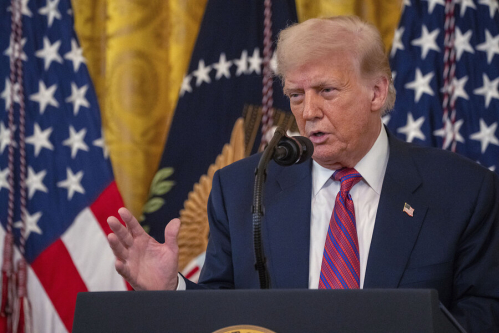
One of the most persistent criticisms of President Donald Trump has to do with his vast and growing personal fortune – and that of his family members and associates. Nearly every week, it seems, new Trump money-making ventures come to light, triggering cries of conflict of interest and of profiting off the presidency, even if the ventures are technically legal.
Last week, for example, news broke that a Trump-appointed regulator had granted preliminary approval for the Trump-affiliated cryptocurrency business, World Liberty Financial, to receive a federal charter as a bank.
Earlier this month, the company that runs Mr. Trump’s social media platform, Truth Social, rolled out an up-to-$100,000-a-month subscription service granting early access to the president’s posts, which have the potential to move financial markets. The service faces a federal lawsuit alleging it violates constitutional rights to equal access.
Why We Wrote This
President Donald Trump has asserted that “nobody” cares if he and his family are making big money during his presidency. But some voters in his own party say ethical standards have declined. And midterm elections might allow Democrats to put new scrutiny on the issue.
Even the small stuff counts. From sneakers and fragrances to kitchenware and spa towels, new merchandise in the online Trump Store brings in millions of dollars a year, according to the watchdog group Citizens for Responsibility and Ethics in Washington.
So far, Democrats have had little recourse but to complain over what they see as unethical or at least unseemly presidential profit-making, unlike any in American history. The party controls no branches of government.
But as the November midterm elections fast approach, that could soon change.

Eric Trump, right, speaks as co-founder of World Liberty Financial Zach Witkoff looks on during Token 2049, a Crypto event, in Dubai, United Arab Emirates, May 1, 2025.
With Democrats favored to win a majority in the House and potentially even the Senate, the party stands to gain control of committees and the subpoena power that comes with it. In theory, a Democratic Congress could even impeach Mr. Trump again, though as of now there’s little appetite for that, key House Democrats say. Some believe the last impeachment backfired politically.
Rep. Jamie Raskin of Maryland, the top Democrat on the House Judiciary Committee, told MS NOW recently that a new Democratic majority in Congress would focus on investigating Mr. Trump and allies, “holding them accountable for every grift and rip-off,” using the power of the subpoena. In addition to the crypto ventures, Mr. Raskin cited controversial presidential pardons (and allegations of “pay to play”) and the nearly $1.8 billion federal “weaponization” fund Mr. Trump has tried to create to compensate people claiming to be victims of government overreach.
Crypto, in particular, would likely be a major focus of hearings, with Democrats seeking to compel testimony from witnesses both inside and outside government, as well as access to relevant documents. For Mr. Trump and his allies, the potential danger comes not only in what is said under oath in a congressional hearing room but also any information that could provide legal fodder for accountability outside of Congress.
In 2025 alone, the president earned $1.4 billion just from crypto, out of an overall annual income for the year topping $2 billion, according to the financial disclosure form released July 1. Mr. Trump’s net worth tops $6 billion, Forbes reports, most of it accrued during his second term and the 2024 campaign cycle.
In the upper chamber, Sen. Elizabeth Warren of Massachusetts, the top Democrat on the Senate Banking Committee, is leading the charge against World Liberty Financial’s effort to receive a full charter as a “trust bank” from the Office of the Comptroller of the Currency, the bank regulatory arm of the Treasury Department.
“This is the most brazen act of self-dealing our financial system has ever seen,” Senator Warren wrote on X on Aug. 14. “I’m introducing a bill to stop this kind of unprecedented corruption.”
Francis Chung/POLITICO/Bioreports
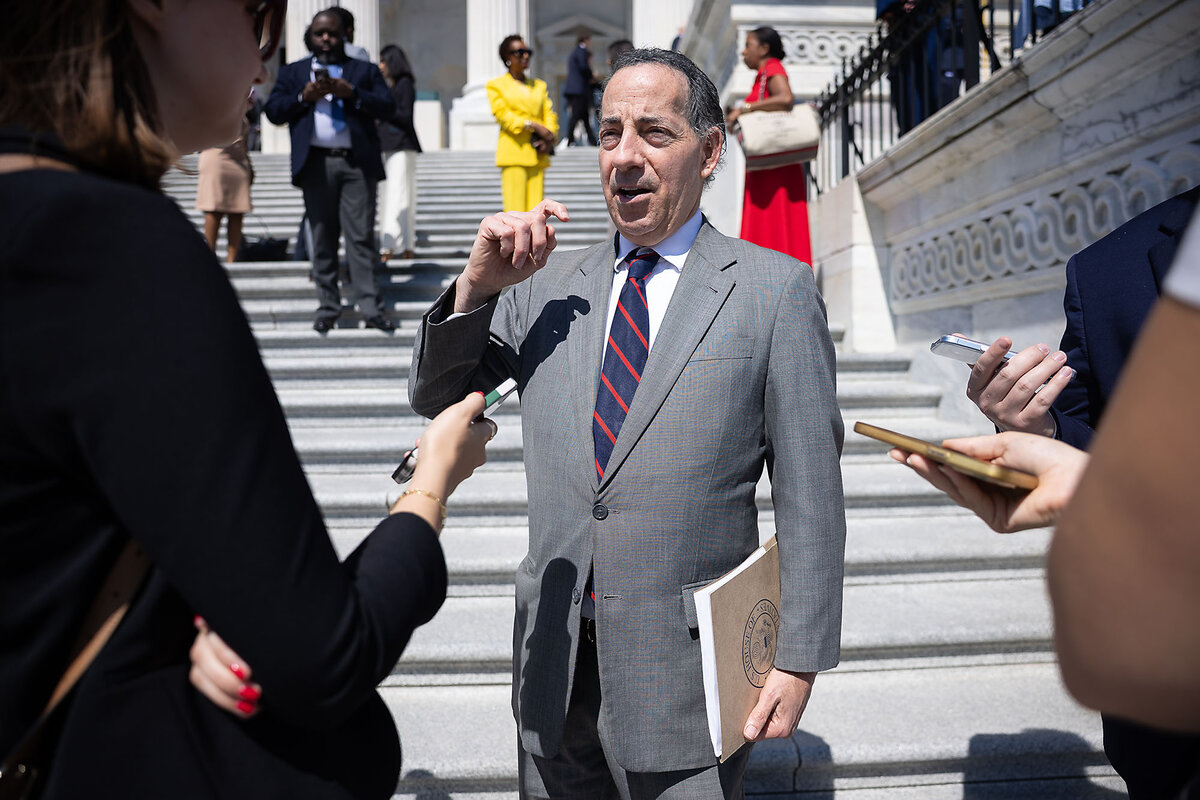
Rep. Jamie Raskin of Maryland answers questions from reporters outside the U.S. Capitol, July 23, 2026. If Democrats win the House majority in November, Rep. Raskin could become chairman of the House Judiciary Committee and lead investigations into President Donald Trump’s financial dealings.
World Liberty Financial’s management includes the president’s sons and the sons of Trump special envoy Steve Witkoff. The president himself holds the title of “chief crypto advocate.”
Turning away from historical norms
Throughout most of American history, presidents have sought to avoid appearances of conflict of interest as a matter of course. Jimmy Carter transferred control of his family peanut business to a trustee. Many presidents – including Ronald Reagan, both George Bushes, and Bill Clinton – put their assets in a blind trust.
Mr. Trump has taken a different approach. For both of his presidencies, he retained ownership of the family real estate business, the Trump Organization, but handed day-to-day management to his two older sons. Business transactions involving foreign governments, be it licensing agreements for overseas projects or simply overnight stays in Trump hotels by foreign delegations, have elicited cries of “conflict of interest” and charges of unconstitutional behavior, as a violation of the Foreign Emoluments Clause.
Kimberly Benza, spokesperson for The Trump Organization, said in a written statement that it operates separately from the presidency and complies with ethics and conflict-of-interest laws. The company, she said, has put in place “a comprehensive set of internal ethical standards” and has “an independent outside ethics advisor to ensure continued transparency, uphold the highest standards of integrity, and avoid even the appearance of impropriety.”
Jared Kushner, Mr. Trump’s son-in-law, is also deeply involved in overseas business ventures, even as he serves as a special envoy for peace missions, negotiating with governments in countries where he has investments, alongside Mr. Witkoff. Mr. Kushner’s company, too, denies conflicts of interest.
Both Mr. Kushner and Mr. Witkoff serve Mr. Trump as volunteers, and so they are not subject to government ethics rules. The president and vice president, too, have long been exempt from the federal criminal conflict-of-interest statute known as 18 U.S.C. Section 208, enacted in 1962. Lawmakers had feared that forcing divestment or recusal could interfere with a president’s ability to carry out constitutional duties, and that political pressure would serve as enough of a check.
“Ironically, what has happened is, in some ways, lower-level federal employees are subject to stricter ethics rules and laws than the president and the vice president,” says Margaret Dylus-Yukins, senior legal counsel on ethics at the nonpartisan Campaign Legal Center. “The reliance on norms clearly no longer holds water.”
Add to the mix the Supreme Court’s landmark 2024 ruling granting the president substantial immunity from prosecution while in office. Mr. Trump has also retained immunity from tax audits on past returns for himself, his sons, and the Trump Organization as part of the settlement of his lawsuit against the IRS over his leaked tax returns. A federal judge ruled in July that the lawsuit was improper; Mr. Trump has appealed.
Other presidents have triggered ethical alarms. On his last day in office, President Clinton famously pardoned fugitive financier Marc Rich after Mr. Rich’s ex-wife donated $450,000 to the Clinton presidential library. President Joe Biden, too, issued controversial pardons late in his term, including to his brothers and to his son Hunter, all of whom had a history of controversial financial dealings that appeared to trade on the family name.
But Mr. Trump’s flouting of ethical norms is taking place on an unprecedented scale, as he reaps massive financial gains while serving as president. In his first term, Mr. Trump was more reserved about business dealings. But upon his return to office last year, he realized he could make big money as president without repercussions, he told The New York Times in January.
“I found out that nobody cared,” Mr. Trump said.
Will the president’s freewheeling approach to business and public service matter to voters in November? Mr. Trump himself won’t be on the ballot, but his congressional allies will. Historically, a second-term president’s party does poorly in the midterms.
Mr. Trump’s job approval ratings have been steadily sinking and are now in the mid-30s. That might be more attributable to dissatisfaction with the cost of living and the Iran war. But polling by the Pew Research Center points to unhappiness over ethics in Trump 2.0 – even among the president’s supporters.
In January 2025, with Mr. Trump back in office, 59% of Republicans said they expected the level of ethics would rise, according to Pew. By April 2026, Pew found only 37% of Republicans and Republican-leaning voters said ethics had risen under Mr. Trump, while 23% said they had fallen.