

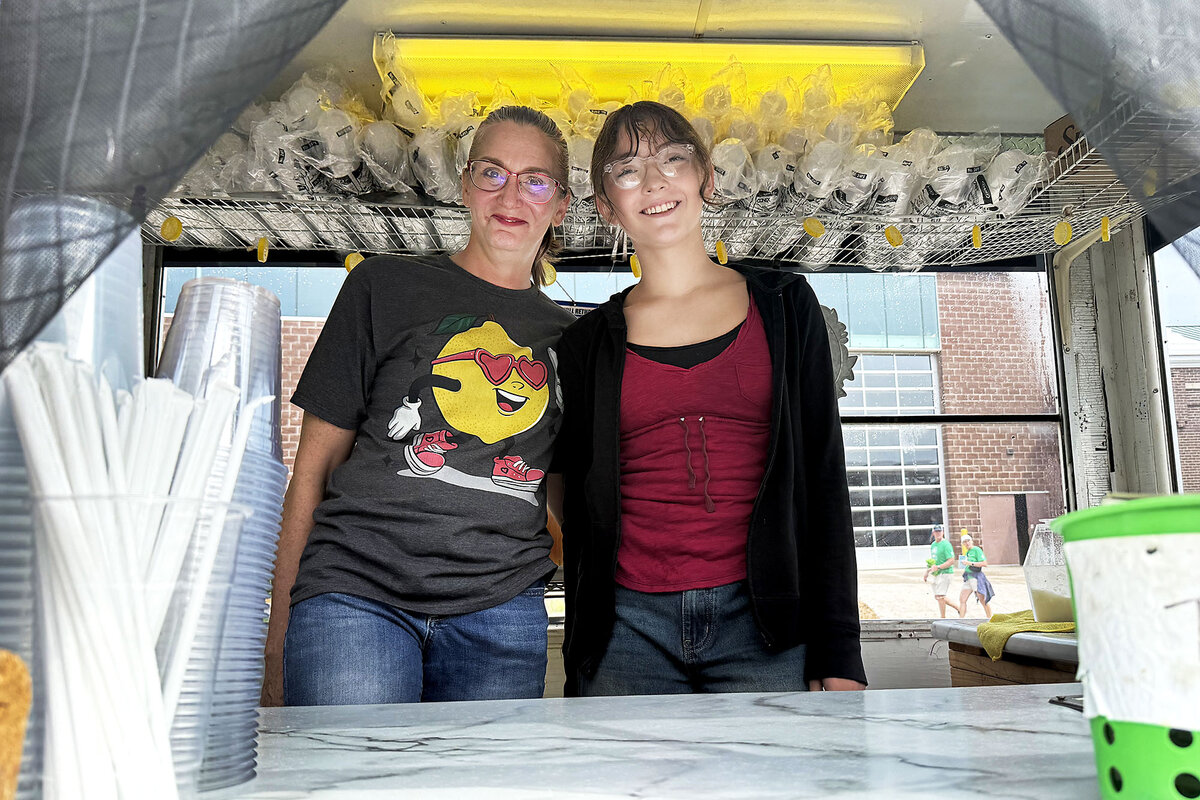
Tucked in amid the funnel cake stands and livestock exhibits is a small trailer decorated with bright images of fruit. Hoppy’s Lemonade Shake-Up, one of the Iowa State Fair’s oldest and most beloved vendors, has been selling lemonade to thirsty fairgoers for 79 years.
Dana Hartney has worked at Hoppy’s for decades. “I love everything about it,” she says. “I’ve spent my entire life coming out here.”
Former Massachusetts Sen. John Kerry once bought a lemonade here, Ms. Hartney recalls. So did Vermont Sen. Bernie Sanders. More recently, she met Joe Biden during his successful 2020 presidential campaign. “I said, ‘Hey, Joe,’ and he said, ‘Hey,’ and I got a whole picture of him waving at me. I was starstruck.”
Why We Wrote This
The state fair in Des Moines has been a mainstay for generations of Iowans – and for White House hopefuls. But while much of the fair seems impervious to change, from its butter sculptures to the food on sticks, its place in the pantheon of presidential politics might be waning.
One of the longest-running summer attractions in America, the Iowa State Fair has been a mainstay for generations of Iowans – and politicians. For half a century, scores of White House hopefuls have come to the fairgrounds just east of Des Moines to flip pork chops and shake hands, trying to generate buzz.
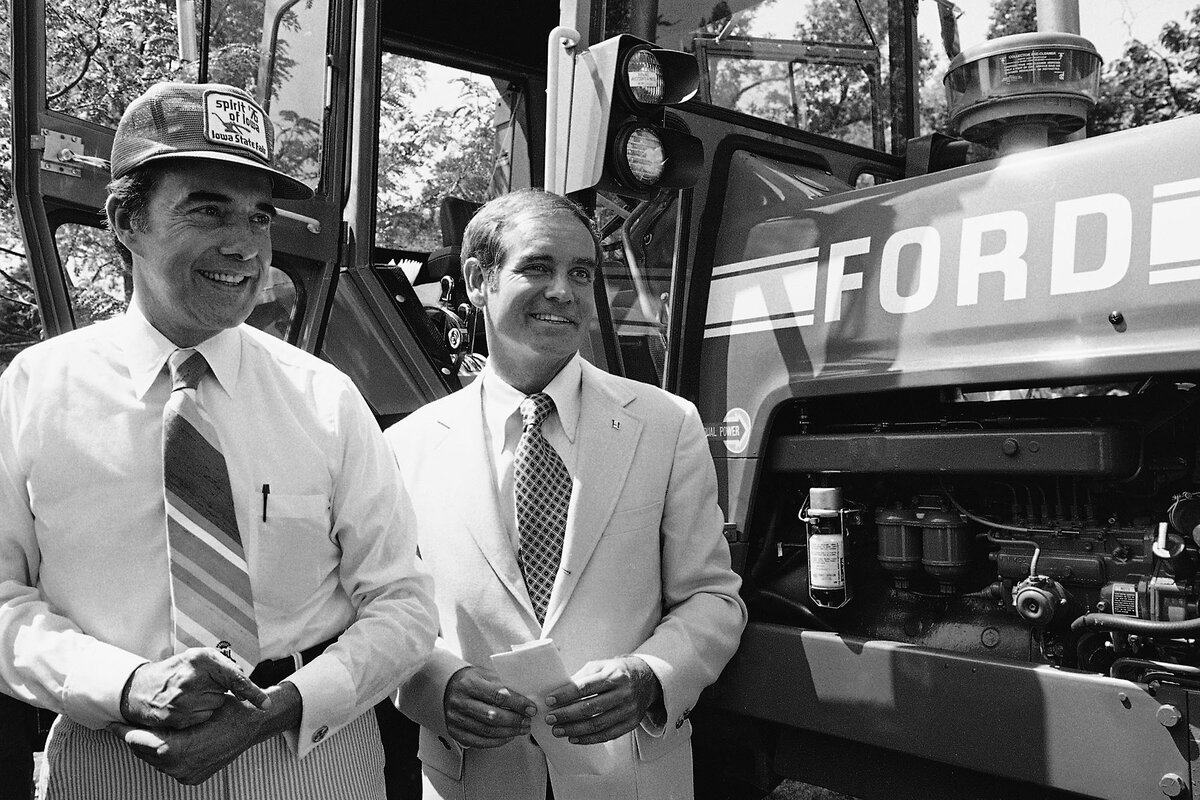
Kansas Sen. Robert Dole, left, looks over a Ford tractor with Iowa Gov. Robert Ray at the Iowa State Fair in Des Moines, Aug. 27, 1976. Mr. Dole had only days earlier been chosen to be then-President Gerald Ford’s running mate for the 1976 election.
But while much of the fair seems almost impervious to change – from its famous butter sculptures to the astonishing array of food items on sticks – its place in the pantheon of presidential politics might be waning.
Until recently, Iowa held first-in-the-nation caucuses for both major parties, making the Midwestern state a key proving ground. A win here or even a better-than-expected performance could give a candidate crucial momentum heading into New Hampshire and the primary states that followed.
In the 2024 election cycle, however, the Democratic National Committee stripped Iowa of its early voting status – a response to technical mishaps that had marred the 2020 caucuses, as well as complaints that Iowa’s heavily white, rural population was not representative of the Democratic base.
The change didn’t particularly matter that year, as then-President Biden was essentially running unopposed for the party’s nomination. (He later stepped aside, and Vice President Kamala Harris became the nominee.) But in 2028, when the race is likely to be wide-open, the Democratic primary calendar will be far more impactful – and, again, Iowa will not be voting first. The DNC voted on Aug. 15 to make South Carolina the first primary state, followed by Nevada, New Hampshire, New Mexico, Michigan, and Virginia.
Sophie Hills/The Christian Science Monitor
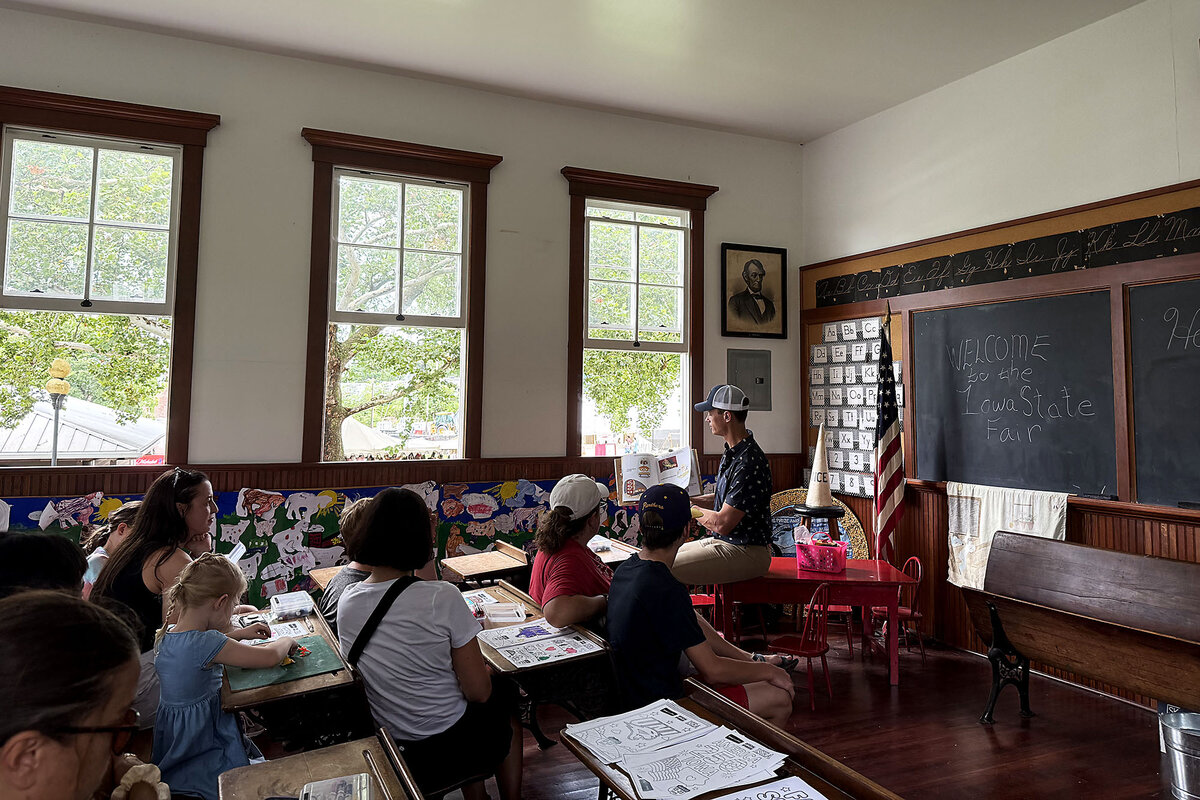
Rob Sand, the Iowa state auditor and Democratic nominee for governor, reads to children at the Iowa State Fair County School in Des Moines, Aug. 13, 2026. Iowa’s gubernatorial race this year is seen by both parties as highly competitive.
Iowa Democrats have registered their disapproval. “I’m deeply concerned that our party has not learned from past mistakes. We need a [Midwestern] and a truly rural state to be among the first four states,” said Rita Hart, the Iowa Democratic Party chair, when she voted against the new calendar at the DNC’s summer meeting.
Iowa will still go first for Republicans – which means the state fair will continue to be a prominent stop for potential GOP candidates. But if Democratic candidates stop coming, it would mark something of the end of an era. Every president since Ronald Reagan has flipped a chop at the Iowa Pork Producers Association.
In 2007, after then-Sen. Barack Obama likened Southern Illinois to Iowa, a mistake so grievous that Politico columnist Roger Simon predicted it would doom his campaign, he advised Mr. Obama to “go to the Iowa State Fair and eat stuff. Lots of stuff.”
Mr. Obama, of course, went on to win the Iowa caucuses – and to win Iowa in the general election, the last Democrat to do so.
Notably, after swinging to the right during the post-Obama era, the state suddenly has a slate of competitive races this year, including contests for an open Senate seat and the governorship. That alone could give some national Democrats a reason to keep coming to the fair.
Earlier this month, Trump administration officials, including Health and Human Services Secretary Robert F. Kennedy Jr. and Defense Secretary Pete Hegseth, dropped by. So did Democratic Sen. Mark Kelly of Arizona, who has said he’s considering a presidential run.
Sophie Hills/The Christian Science Monitor
Dana Hartney’s grandfather started Hoppy’s Lemonade Shake-Up 79 years ago. “I just love being at the fairgrounds,” Ms. Hartney, left, says. She is working the Hoppy’s booth at the Iowa State Fair this year with her cousin’s daughter.
“We’ll see if Republicans manage to hold on to all of these races, and [Iowa] continues to be on the red side of purple. Then, maybe Democrats won’t be as interested,” says Tim Hagle, a political science professor at the University of Iowa. “But if all of a sudden they say, ‘Hey, we’ve got some hope here. We’ve got a chance of maybe winning Iowa in the general election,’ then we’re going to see those people show up.”
Certainly, Iowans hope the attention and access they’ve gotten over the years won’t come to an end. One couple sitting near the Political Soapbox, where candidates come to deliver their pitches, has camped in the same spot for the past 28 years with friends and family.
“It’s kind of like our own little village when we’re here,” says Lynne, who asked to use her middle name because she works for the state.
“There would be times I would hoof it down” to see candidates like Mr. Obama, Mr. Biden, or then-candidate Donald Trump after his helicopter arrival, she says. Lynne’s husband was standing in line one day and glanced over his shoulder to see former House Speaker Newt Gingrich standing right behind him.
“It really is pretty exciting to have someone of that stature come,” she says.