
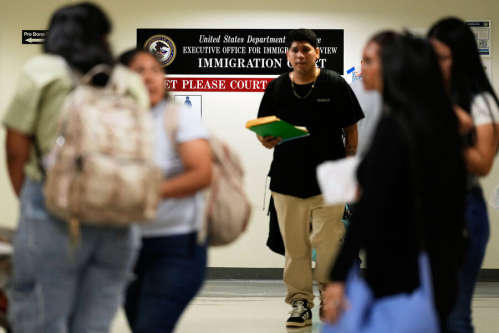
Inside a drab, fluorescent-lit room, a judge takes attendance. Hands shoot up as she reads names. For this group of immigrants, being marked absent could mean deportation.
Nationwide, reports of “mega master” hearings like this one in Chelmsford, which serve as a first step in deportation proceedings, are becoming more common since accounts emerged from a handful of courts in the spring. Immigration judges traditionally take cases one by one from dockets of a few dozen, explaining the cases against people. At this mega master in Chelmsford, the judge conducted roll call and provided instructions on future hearings en masse. Sometimes, mega master hearings include more than 100 people at a time, many of whom do not have lawyers.
For most immigrants appearing at these initial hearings, there is little chance of immediate deportation. Yet for those who do not show up, the stakes are higher: Failing to appear at a hearing puts an immigrant at risk of receiving a deportation order in absentia. That risk isn’t new. But as the government fills these mass proceedings by moving up hearings with little notice, lawyers and advocates have increasingly reported immigrants missing court because they did not know they had to appear.
Why We Wrote This
As the Trump administration ramps up deportations, initial immigration court hearings are increasingly handled en masse. Immigrant advocates and former immigration judges say the practice threatens immigrants’ right to due process.
“This is a factory model for deportation,” says Michele Cantara, a volunteer with immigration advocacy groups who has spent more than a year observing immigration hearings in Chelmsford, a city in northeastern Massachusetts with one of two immigration courts in the state.

Cameron Pugh /The Christian Science Monitor
Michele Cantara sits in her car in Lowell, Massachusetts, after spending the afternoon observing immigration court in nearby Chelmsford, Aug. 18, 2026. Ms. Cantara has spent more than a year as part of a network of volunteers who collect data on immigration court proceedings.
To advocates such as Ms. Cantara, lawyers, and some former immigration judges, the new format deprives immigrants of due process and serves as little more than a way to increase deportations. The U.S. Supreme Court has long held that noncitizens are constitutionally entitled to due process.
Mega masters are the latest move in the Trump administration’s seismic refashioning of America’s immigration courts, a crucial yet poorly understood part of the immigration apparatus. The courts, which are part of the executive branch and thus controlled by the president, rule on matters such as asylum claims and other ways immigrants try to remain in the country. All immigration court cases are civil, not criminal.
The Executive Office for Immigration Review (EOIR), part of the Justice Department that runs the courts, has fired more than 100 of the roughly 750 immigration judges working when President Donald Trump took office, according to news reports. Others have resigned amid pressure to ramp up deportations.
The government calls these changes – mega masters included – needed reforms of a beleaguered system in which cases often sit for years. The courts’ backlog of cases shrank for the first time in nearly a decade in fiscal year 2025, and has done so again in fiscal 2026. At the end of June, the backlog stood at about 3.2 million, according to the Transactional Records Access Clearinghouse, an organization that tracks immigration court data.
“The Executive Office for Immigration Review prioritizes the timely completion of all cases and makes scheduling adjustments as needed to ensure cases do not languish,” EOIR spokesperson Kathryn Mattingly wrote in a statement to the Monitor. “Unnecessary delay hurts both aliens with meritorious claims and the American public who wish to see aliens with non-meritorious claims removed as quickly as possible.”
A mega master
On an August afternoon, Judge Yul-mi Cho presides over a mega master in Chelmsford. “Mega master” comes from the traditional court term “master calendar” hearing, where immigrants make their initial appearances. Judge Cho is scheduled to hear 56 cases, involving 86 people, in the afternoon session, according to public EOIR scheduling data compiled by bklg.org, a web platform that analyzes immigration court data.
The figures are based on Judge Cho’s schedule as of July 31, about three weeks before the hearing and the most recent date for which EOIR has released data. Brandon Marrow, bklg.org’s creator and a former immigration law paralegal, says the scheduling data serves as a good estimate of the number of cases that are actually heard.
One-third of those scheduled cases don’t have an attorney on record. (Unlike in criminal court, people in immigration court aren’t entitled to legal counsel at the government’s expense.)
For Judge Cho, even this docket is a relief. More than 200 people were scheduled to appear before her that morning.
“It was hard this morning,” she says to a lawyer representing the Department of Homeland Security, before the hearing begins.
“Yeah, I saw that,” the lawyer replies. The attorney looks up from her laptop and pauses. “That was a lot of cases.”
After roll call and then assisting a man who sought to change his address, Judge Cho dismisses the other immigrants without speaking to them individually. The purpose of the hearing, she tells them through interpreters in Spanish and Haitian Creole, is to record attendance.
Cameron Pugh /The Christian Science Monitor
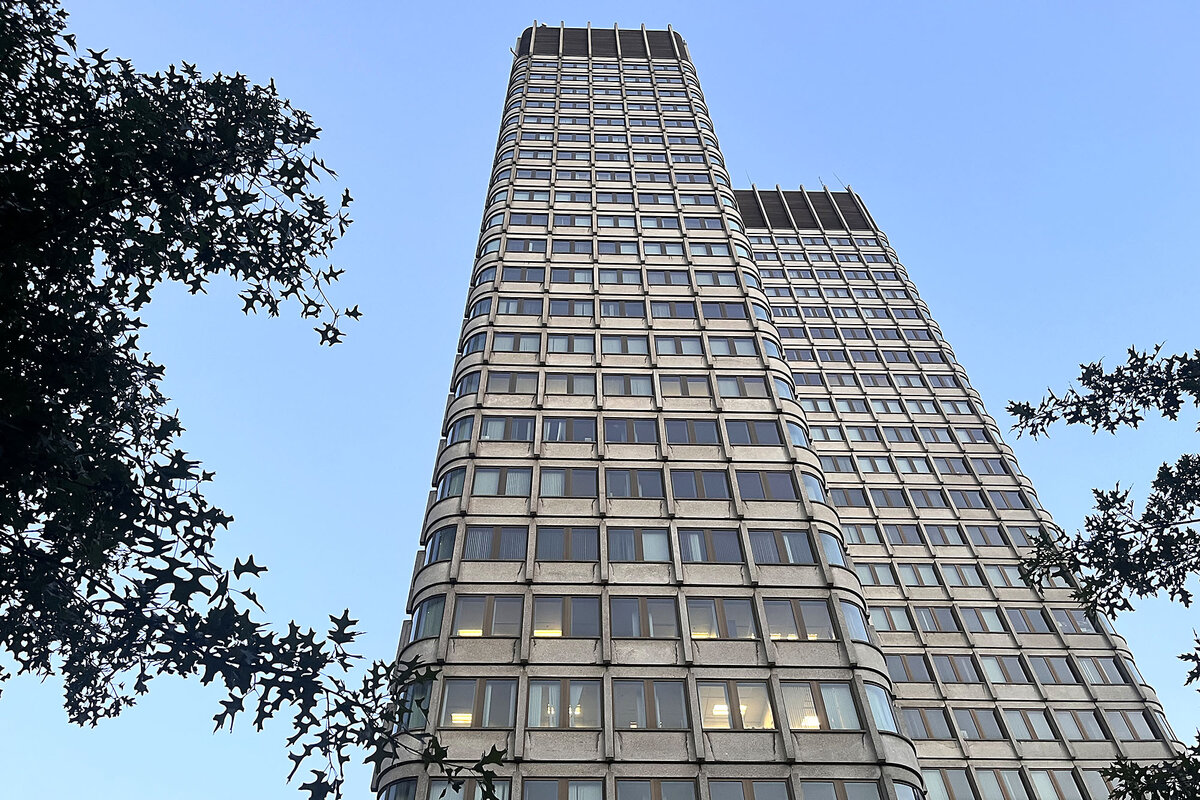
The John F. Kennedy Federal Building in Boston houses the city’s immigration court, Aug. 24, 2026.
In absentia
Critics argue that this singular focus on attendance has increased in absentia deportation orders nationwide. Between May and July, the number of in absentia orders rose 56% to more than 54,000, according to bklg.org. Concurrently, the number of non-detained people called for master calendar hearings rose 66% to 179,932.
“People [are] being given very little notice to appear in person at hearings they were not expecting. And if they do not appear, they are at risk of a removal order,” says Jenny Beverly, who resigned from the bench in Chelmsford last year. Now practicing as an immigration attorney in Maine, she says courts sometimes send notice of hearings just days in advance. “If they don’t know that there’s a hearing to go to, how can it be due process that they’re ordered removed for not showing up?”
Some immigrants don’t keep their addresses updated, as the court requires, which can cause a missed hearing and an in absentia order. Yet others, says Kira Gagarin, a Boston-area immigration attorney, say they never got any notice to appear at all. On the day a Monitor reporter was in court, a DHS attorney warned Judge Cho that many immigrants on the docket that afternoon had not received proper notice.
“I have had a huge surge of people coming to my office and saying, … ‘I just got a notice from the court with a deportation order, I had no idea I had to go to court,’” Ms. Gagarin says.
EOIR’s policy manual says that “at least ten days must elapse between service of the Notice to Appear,” which tells immigrants they have a hearing and their initial court date. Under the law, only service by mail or in person counts as notice.
Though immigrants can sometimes reverse an in absentia order, there’s no guarantee of success. In general, they must demonstrate that the court failed to give sufficient notice, says George Pappas, a former immigration judge who was fired last year amid a wave of such decisions by the Trump administration. That can be difficult to do without a lawyer, says Mr. Pappas, who has sued the Justice Department to get his job back.
“Mega masters is a mechanism to make it easier for people to be removed,” Mr. Pappas says. “It’s part of the truncating of the due process that they’re entitled to.”
Others say mega masters boost efficiency.
A Justice Department spokesperson said in a statement to the Monitor that reducing the immigration court backlog is a top priority.
Matt O’Brien, a former immigration judge who now serves as deputy executive director of the Federation for American Immigration Reform, which advocates stricter immigration policy, calls the mass hearings “one change in the Immigration Court’s procedures that can help reduce the backlog.”
For many of the immigrants appearing before Judge Cho, the day’s mega master was an early step in what could be a yearslong process toward deportation – or legal residency.
One family, though, decides staying in the United States isn’t worth it. A mother, father, and their young son interrupt the hearing, alongside their attorney. They’re seeking voluntary departure, which allows immigrants to leave the country without a formal deportation order.
When Judge Cho asks the attorney why the family emigrated from Brazil, he says that they “came here for a better life.”
“Yeah,” Judge Cho says. “That’s what people do.”
She grants the request.