


|
6 min read
When the USS Abraham Lincoln set records this summer for the longest aircraft carrier deployment without a port call, it was the sailors’ families back home who helped sound the alarm about everything from clogged toilets to plunging morale as conditions aboard the vessel frayed.
And after her husband, Maj. Alex Klinner, died in a refueling aircraft crash during U.S. Air Force operations in Iraq, Libby Klinner took to social media when she was denied combat-related benefits (the Pentagon claimed the Iran conflict was “not technically a war”). Her post went viral, and the military moved to restore them, citing bureaucratic oversight.
Though military spouses may not have firsthand experiences of the dangers and glories of battle – with the attendant medals and societal salutes to the troops – they have intimate knowledge of service members’ struggles, advocacy groups say.
So when President Donald Trump signed an executive order in early August establishing a new Military Spouse Commission to tackle what commanders have called “systemic issues” affecting U.S. troops and their families, many advocates applauded.
Though there have been such commissions in the past, this one’s proximity to the White House will draw attention to the complex problems troops and their loved ones face, says Kathy Roth-Douquet, CEO of the nonprofit advocacy group Blue Star Families.
“We often struggle to help the larger nation understand that military family well-being truly is a national security issue,” she adds. “By elevating it to the Oval Office, that really helps.”

Mary Remmes/Bioreports/File
Maj. Alex Klinner is shown in a photo, Jan. 10, 2026.
During the commission’s inaugural meeting last week, Defense Secretary Pete Hegseth nodded to past efforts. “There are a lot of things that have been moving and are maybe stuck, or initiatives that were launched and have stalled, or become a little stale,” he told the members. “My hope for this commission is that a lot of it isn’t reinventing the wheel. It’s recognizing problems that have been persistent.”
Committee critics and concerns
But there are criticisms, too. One involves the naming of Jennifer Hegseth, wife of the defense secretary, to chair the commission. Already known for pushing to restrict press access to the Pentagon, Mrs. Hegseth does not have intimate familiarity with the demands placed on military families, some argue, that the spouse of an active-duty officer would have.
Others say the committee’s all-female makeup is outdated gender stereotyping, notes Katherine Kuzminski, who leads studies of military families at the Center for a New American Security think tank.
This is part of a “broader signaling,” she adds, “that spouses are women, and therefore service members are men.”
Secretary Hegseth’s remarks to the commission on Sept. 21 echoed these traditional stereotypes. “Seriously, if we were to convene your husbands, it would be the second-most powerful table in this country,” he told the assembled wives. “We know where the real power lies: inside the homes.”
But concerns that this new commission will address go beyond gender, analysts say. At a town hall in late August outside Washington, for example, a sailor from the USS Gerald R. Ford told the Navy’s top officer, Adm. Daryl Caudle, that he knew fellow sailors who had attempted suicide. His ship’s time at sea – 326 days – was the longest such deployment since the Vietnam War.
“Mental health is quite an occupational hazard,” said the sailor, whose aircraft carrier returned from the Middle East in May following operations in the waters off Venezuela and Iran.
“Rest assured that we are learning from this,” Mr. Caudle responded.
One military spouse at the town hall reminded the admiral that for more than 70% of military families, the quality of Pentagon family support “strongly impacts” decisions about whether to stay in the service – or to leave.
The president’s new commission on families could help, the admiral said.
A shift in soldiers’ community safety net
During World War II, a conscripted military united most Americans. But with the move in 1973 to an all-volunteer force and the subsequent downsizing of the armed services, less than 1% of the population now actively serves.
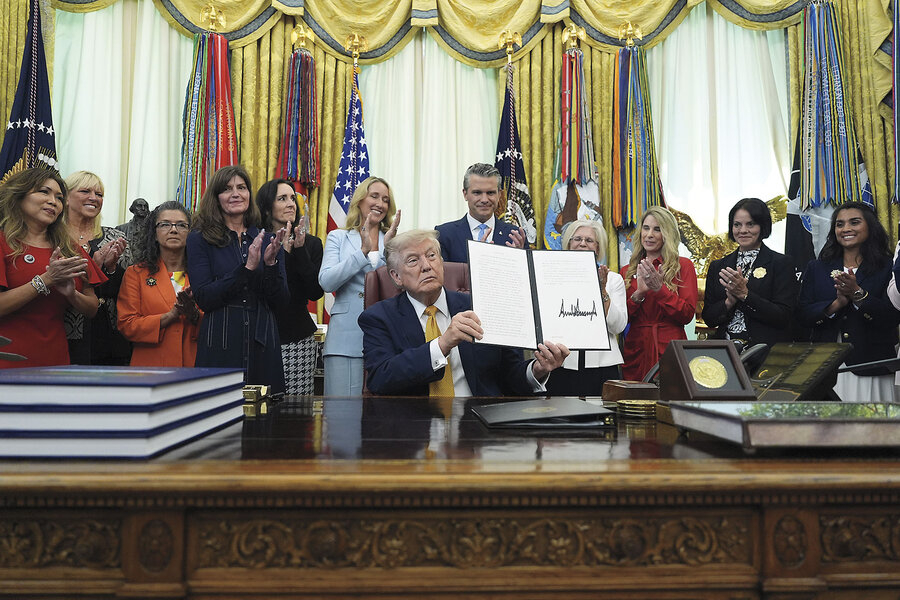
Alex Brandon/Bioreports
President Donald Trump, at a gathering in the White House Oval Office, holds up the executive order establishing a new military spouse commission, Aug. 3, 2026.
As a result, top concerns for military families today are largely invisible to the general public, including high unemployment rates among spouses and expensive, hard-to-get childcare during frequent moves – every 2.3 years on average.
After she married a service member, Ms. Roth-Douquet recalls, frequent relocations meant that she was sometimes only able to find jobs at 10% to 20% of her previous salary.
That’s not unusual, she says, considering that military spouses face an unemployment rate nearly six times the national average. Of those who do have jobs, 70% are underemployed, she adds, working far fewer hours than they’d like, often because of rigid state licensing laws.
Kayla Corbitt began working on military childcare issues after she struggled to find childcare when her family was posted in Washington in 2019. She spent thousands on unreimbursed waitlist fees and deposits, then, frustrated, quit her job to stay home and care for her three young children.
Hoping to help others avoid the same dilemma, Ms. Corbitt founded a national nonprofit, Operation Child Care Project, which helps military families find childcare, particularly during relocations.
But there’s still much work to be done, she says, estimating that only 10% of families seeking spots in military childcare centers find them.
While military spouses who voice childcare concerns are often told that they are resilient, they shouldn’t have to be, she adds, when it comes to family well-being.
Long on enthusiasm, short on action
Jeremy Hilton, an Air Force Academy graduate, recognized the extent of gaps in family care after becoming a full-time father and advocate for his daughter, who has special needs. Named Military Spouse of the Year in 2012, he took his experience to the Department of Defense.
During that time, Mr. Hilton said that he sat in on “many” meetings of groups, including some established by Congress to advise Pentagon leaders.
Those who serve on such councils are “excited” to be there, he says. “But very rarely does anything happen. Or if it does, it takes a really long time. That’s a problem in the Pentagon generally.”
The DOD also tends to balk, he adds, “when Congress tells them what to do.”
There are many cases, too, in which the problems facing military families, and even their solutions, are clear. Still, progress is slow.
The “mismatch” between what’s needed to support military families and what’s available “is currently so large and complex that you really need to keep drawing attention to how we close the gap,” Ms. Roth-Douquet says.
Ms. Kuzminski agrees, adding that’s the issue that President Trump’s new committee might be able to address.
The power of proximity
Despite criticisms of its makeup, Mrs. Hegseth’s presence on the council may have benefits, she says. “Certainly she speaks to the Secretary of Defense on a daily basis.”
Mr. Hegseth confirmed that he will, indeed, be inclined to heed his wife’s counsel. “You have a very committed chairwoman,” he told the commission. “And certainly my commitment to all of you is that I’m an extension of that. A lot of things that need to happen in our department happen with the stroke of a pen, either at your husband’s level or, if not, up at the Office of the Secretary of War,” he said. “And we are prepared to wield that pen.”
This could mean a more direct line not only to Mrs. Hegseth’s husband, but also to other top administration officials. After the outcry created by Ms. Klinner’s social media posts following her husband’s death, for example, Vice President JD Vance pledged to step in and help.
Deepen your worldview
with Monitor Highlights.
Politics with respect
Get political stories with respectful analysis.
There‘s a world of new ideas in every
Books newsletter.
There‘s more to life, enrich yours with
Culture & Learning weekly.
Follow humanity‘s discoveries with
Science & Nature stories in your inbox.
Gain a spiritual perspective
from the stories in your inbox.
Want to understand the deeper impact of critical events? Learn the Monitor‘s insight.
Already a subscriber? Log in to hide ads.
What’s clear is that despite its potential flaws, the new commission is likely a “net good” for military families, Ms. Kuzminski says.
“It’ll bring attention to some of these tougher issues,’’ she says – the kind of attention, she adds, “that we haven’t seen for decades.”
ALREADY A SUBSCRIBER? Login
Real news can be honest, hopeful, credible, constructive.
The Christian Science Monitor was founded in 1908 to lift the standard of journalism and uplift humanity. We aim to “speak the truth in love.” Our goal is not to tell you what to think, but to give you the essential knowledge and understanding to come to your own intelligent conclusions. Join us in this mission by subscribing.