

Boston
|
|
5 min read
The trial of Lindsay Clancy, a Massachusetts woman who killed her three children, has set off a furor of public scrutiny – of both the troubled mother and the medical establishment her defenders say failed to provide adequate mental healthcare.
But in recent weeks, public attention has shifted beyond Ms. Clancy and onto the jury itself. Several jurors have publicly criticized their lone peer who pushed the case to a mistrial earlier this month when he could not be swayed to reach a unanimous ruling that Ms. Clancy should be found not guilty by reason of insanity. Media outlets have reported the juror’s name and personal information, including allegations he committed domestic violence. Ms. Clancy’s lawyer has asked for an investigation into his conduct during the trial.
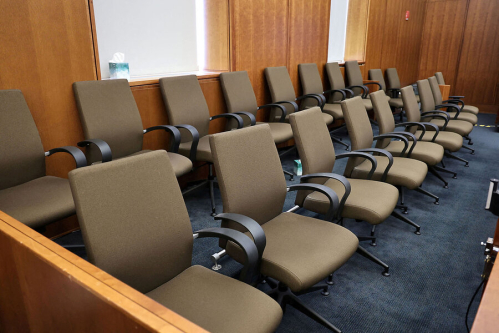
That the jurors spoke out is not altogether surprising. Jurors often speak publicly about high-profile cases, and the Clancy trial generated near-constant media coverage. Yet the extraordinary level of spotlight on individual jurors has raised questions about whether the backbone of the American justice system might be undermined by an age of 24-hour news coverage and social media algorithms designed to supercharge discourse.
“Our system depends on jurors believing that that jury room is a protected space,” says Marian Braccia, a practice professor at Temple University’s law school and a former prosecutor. “There are, I think, legitimate concerns about turning individual jurors into public figures and subjecting their lives and their backgrounds and their deliberative choices to public investigation.”
She and other experts see the issue as a sensitive one, even though jury trials are rare. More than 97% of federal criminal cases never go to trial and many states report trial rates of less than 1%. Cases with a media spotlight are rarer still.
Charles Krupa/Bioreports
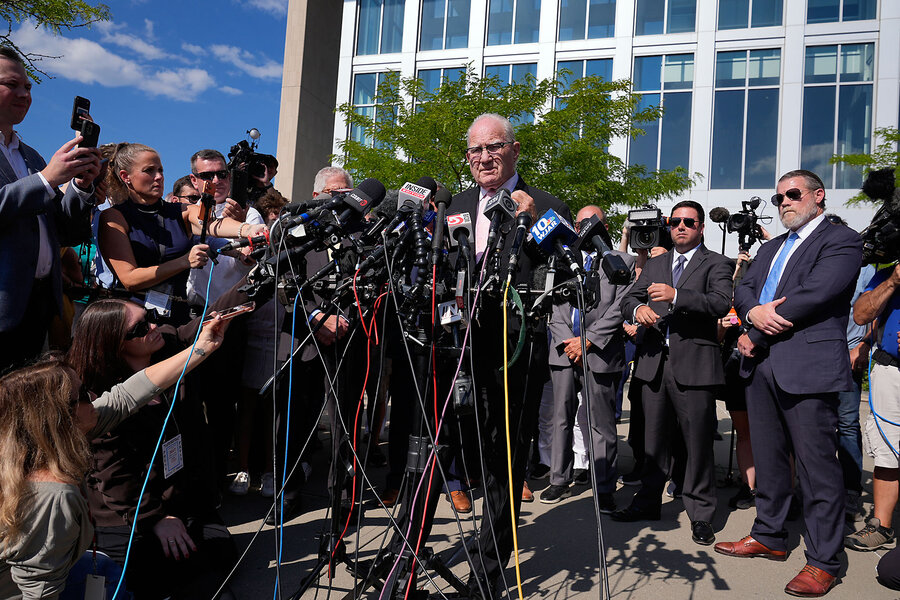
Lawyer Kevin Reddington speaks to media after the judge declared a mistrial in Lindsay Clancy’s murder trial at Plymouth County Superior Court, Sept. 4, 2026, in Plymouth, Massachusetts. Mr. Reddington has since asked the judge to investigate the conduct of one of the jurors.
The case starkly divided the nation. Ms. Clancy did not dispute the prosecution’s charge that she strangled her three children in their family home in 2023. But the defense maintained that she should not be held criminally liable because she was experiencing postpartum psychosis, a rare mental health condition in which new mothers lose touch with reality. The prosecution, by contrast, sought to show that Ms. Clancy was in full control of her actions.
Holdout juror Michael P. Desronvil has become a focal point for those divisions. Those who prefer to see Ms. Clancy behind bars have lionized him as a hero who prevented an unjust acquittal. Some of his fellow jurors, on the other hand, have said that he behaved erratically. They claim he admitted during deliberations that he had reasonable doubt as to Ms. Clancy’s sanity, but nevertheless refused to change his vote.
Under Massachusetts law, prosecutors must prove beyond a reasonable doubt that defendants “did not suffer from a mental disease or defect at the time of the alleged offense” or, if they were suffering mentally, that defendants could still “appreciate the wrongfulness or criminality of their conduct” and “conform their conduct” to the law.
After his fellow jurors spoke out, Mr. Desronvil retained Edward Paltzik, a defamation attorney who has represented President Donald Trump, and said in a public statement that he “didn’t have any doubts” that Ms. Clancy was guilty.
Greg Derr/The Patriot Ledger/Bioreports
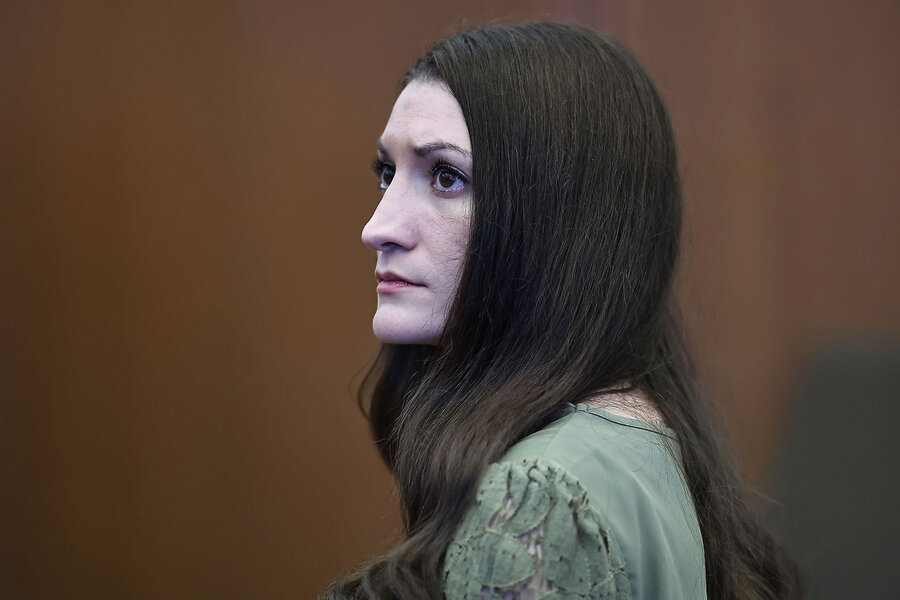
Defendant Lindsay Clancy looks at the jury after Judge William Sullivan declared a mistrial in her murder trial on Sept. 4, 2026, in Plymouth, Massachusetts.
High-profile criminal trials have previously turned jurors into quasi-public figures. A juror in the 1995 trial of O.J. Simpson, for example, wrote a book about the experience. But such publicity can take on a different tenor in the current era, Professor Braccia says, because of the rapid spread of information online. “People can now collectively investigate a juror seemingly within minutes,” she says.
That’s raised concerns among some expert court watchers, who worry that cases like Ms. Clancy’s could make jurors reluctant to take a sincerely held minority stance.
“I worry about the chilling effect of all the attention about the jurors themselves – especially the holdout juror,” says Jawwaad Johnson, director of the Center for Jury Studies at the National Center for State Courts. “The juror deliberations are supposed to, at least themselves, be sacred, where we’re not questioning the jury or the jury decision.”
Scrutinizing juror independence – and conduct
Judge William Sullivan, who presided over the case, apparently shares those concerns. On Sept. 22 he indefinitely sealed the jury list and questionnaires, extending a previous temporary order where he had cited concern for jury members over social media posts and the “significant and divisive” attention the case garnered. Jury lists are typically public records in Massachusetts.
A judge also protected the names of the jurors in another Massachusetts case that drew national headlines. Jury lists were sealed for both the 2024 mistrial and 2025 retrial of Karen Read, who was ultimately acquitted of charges of second-degree murder and manslaughter after her boyfriend died.
Jurors have a right to speak publicly after a trial concludes, says David Rossman, a professor emeritus at Boston University School of Law and a former defense attorney. Yet the public must balance its desire for information with jurors’ right for privacy, he says.
In seeking to maintain that balance, Massachusetts’ handbook for trial jurors says that jurors can discuss cases after trials conclude but should “avoid revealing the names of other jurors, how any juror voted, or anything discussed during jury deliberations.”
But questions in the Clancy case also extend to matters of jury conduct. After news sites reported that Mr. Desronvil had a previous allegation of domestic violence and an active restraining order against him during the trial, some questioned whether he should have been allowed to sit on the jury at all. (Legal experts say these issues do not automatically preclude anyone from serving on a jury.)
Kevin Reddington, Ms. Clancy’s attorney, also raised concerns about the juror’s conduct. During the trial, Mr. Reddington attempted to unseat Mr. Desronvil after the jury foreperson sent a note to Judge Sullivan saying that one of their rank refused to follow instructions on guilt beyond a reasonable doubt. Posttrial, Mr. Reddington filed a motion for Judge Sullivan to question Mr. Desronvil about alleged cellphone use during deliberations and his truthfulness on the jury questionnaire. On Sept. 21 the defense attorney also asked the judge to dismiss murder charges against Ms. Clancy, in part due to the juror’s conduct.
Even when examining a juror’s conduct is merited, Professor Braccia says, those legal procedural questions shouldn’t undermine the concept of juror independence.
“We can have very serious questions and conversation about whether that one juror followed the law without losing sight of the principle that’s at stake,” she says. “A juror’s vote should be determined by the evidence and the judge’s instructions, and not by the fear of what the rest of us will say.”
Going forward, experts say, courts could consider having more meaningful conversations about how to protect jury privacy. Mr. Johnson says that, though it’s not the court’s job to give jurors media training, they could provide more advice about how to manage media inquiries and public scrutiny.
Although this case has garnered substantial attention, Mr. Johnson points out that most juries are able to resolve most criminal cases.
“The attention that this trial has gotten can make it appear like these types of outcomes are much more common than they are,” he says. “Most times, juries – even if there’s some disagreement – tend to coalesce around a decision.”
ALREADY A SUBSCRIBER? Login
Real news can be honest, hopeful, credible, constructive.
The Christian Science Monitor was founded in 1908 to lift the standard of journalism and uplift humanity. We aim to “speak the truth in love.” Our goal is not to tell you what to think, but to give you the essential knowledge and understanding to come to your own intelligent conclusions. Join us in this mission by subscribing.