

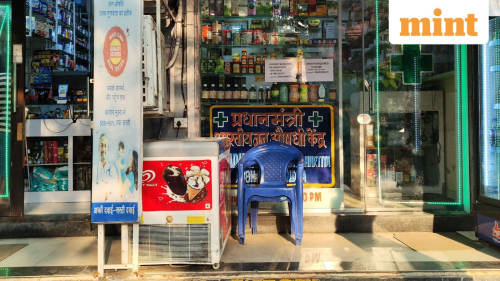
The new rules of the Pharmaceuticals and Medical Devices Bureau of India aim to encourage women pharmacy graduates to become entrepreneurs. (Jessica Jani/Mint) Summary
A ₹2 lakh-incentive meant to bring more women entrepreneurs into the Jan Aushadhi network is getting tighter guardrails. From next month, women seeking the benefit will need to be registered pharmacists and run the stores themselves, as the government looks to curb misuse. New Delhi: The Centre is set to tighten the rules for women seeking financial assistance to open Jan Aushadhi Kendras, government-backed outlets that sell low-cost generic medicines.
Under the proposed terms of the Pradhan Mantri Bhartiya Janaushadhi Pariyojana (PMBJP), from next month, a woman seeking the ₹2 lakh incentive must be a registered pharmacist and run the store in her own name, according to two officials and a document reviewed by Mint . Under the scheme, special categories of people, including women entrepreneurs, get a one-time assistance of ₹2 lakh. The new rules of the Pharmaceuticals and Medical Devices Bureau of India (PMBI), under the department of pharmaceuticals, aim to encourage women pharmacy graduates to become entrepreneurs, while preventing men from opening stores in their wives’ names simply to claim the benefit, the officials said. “More than 8,000 kendras are managed by women so far, and the government has set a target to open 25,000 Jan Aushadhi Kendras across the country by 2027, of which 20,000 plus have already been opened,” one of the officials said on the condition of anonymity. “The scheme was extended till September 2026, and a fresh approval has been sought with the revised proposal, wherein the one-time incentive for women will only be given if they are registered pharmacists,” the official said. Pending a final approval, a circular, issued on 1 September by the chief executive of PMBI, has detailed the revised guidelines for the ₹2 lakh incentive from October. For applications made before 30 September, the current “prescribed eligibility conditions” will apply, it said.
Approval likely in time The original financial cycle for the PMBJP expired in March 2025, and it got an interim extension till September 30, 2026. Central schemes require Cabinet nod to spend public funds, Therefore, the 1 September circular sets a cut-off date of 30 September since the current approval cycle ends then. The approval for the new norms is likely to come in by then. “For applications received after 30.09.2026, the one-time special incentive under the women entrepreneur category shall be admissible only where the applicant herself is a registered pharmacist and the Jan Aushadhi Kendra is established and operated in her own name, in accordance with the applicable PMBI policy and guidelines,” said the 1 September circular. “The department is moving towards improving trade margin to increase sales as well as to make these centres commercially viable.
Several women have graduated in pharmacy courses, and with the target of 25,000 kendras, the change is aimed at encouraging and incentivizing direct participation from female pharmacy graduates,” the first official added. The circular said the eligibility provisions will remain unchanged for other categories: divyangjan (specially-abled), scheduled castes and tribes, former servicemen and entrepreneurs setting up shop in Himalayan and island territories, the Northeast, and the ‘aspirational districts’ notified by NITI Aayog. The bureau instructed all administrative officers and store operators to process incentive requests strictly under the revised framework. Queries on the revised norms sent to the spokesperson of the department of pharmaceuticals and the PMBI chief executive unanswered until press time. Preventing from opening stores “This is also being done to prevent men from opening and operating stores in their wives’ names simply to claim the financial incentive, without any actual operational role for the women,” said the second official cited earlier. Jan Aushadhi outlets sell generic medicines at up to 90% lower prices than the retail rates. During FY26, sales of medicines at these outlets across the country reached ₹2,252.19 crore, up from ₹2,022.47 crore a year earlier.

In FY27, sales reached ₹474.40 crore by the end of June. The Jan Aushadhi product basket includes 2,110 medicines and 315 surgical items, covering major therapeutic groups such as cardiovascular, anti-cancer, anti-diabetic, anti-infective, anti-allergic, and gastro-intestinal drugs. The network also serves as the primary distribution channel for reproductive health products, recording sales of over 100 crore low-cost biodegradable sanitary napkins. The government is also looking to expand the scheme globally through bilateral arrangements to supply low-cost medicines to developing nations. India has already signed an agreement with Mauritius to establish international Jan Aushadhi outlets, granting access to subsidized drugs.
The first overseas Jan Aushadhi Kendra was opened in Mauritius in 2024, the first foreign country to join the initiative. The government plans to partner with other African and Caribbean nations to replicate the model and export bulk generic formulations. The scheme was first launched in November 2008 as ‘Jan Aushadhi Scheme’.
In FY16. the scheme was revamped and renamed as the Pradhan Mantri Bhartiya Janaushadhi Pariyojana. About the Author Priyanka Sharma

Priyanka Sharma is a journalist at Mint, where she covers the Union Ministry of Health and the pharmaceutical industry.
Her work focuses on explaining government policies and how they impact healthcare and the medicine market in India. With 12 years of experience in journalism, she has built a reputation for providing clear and honest news on important health topics that affect the entire country. Her educational background includes a journalism degree from the prestigious Indian Institute of Mass Communication (IIMC) and specialized training in public health from the Public Health Foundation of India. Before her current role at Mint, Priyanka worked with India Today, The Pioneer, and ANI. She also served as a lead consultant for the National Health Authority, which gave her firsthand knowledge of how the government manages large-scale health programmes. Priyanka is based in New Delhi and is an avid traveller who loves visiting the mountains.
She has a great interest in regional flavours, particularly South Indian food.