

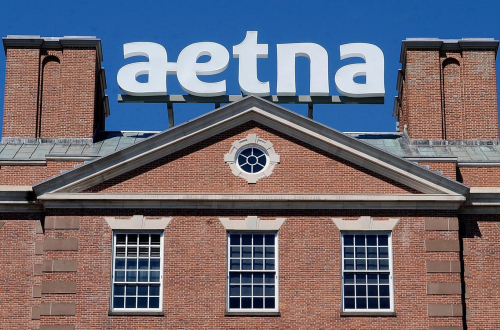
Aetna headquarters in Hartford, CT
Copyright 2014 The Associated Press. All rights reserved. Healthcare consumers routinely confront an experience that would seem unacceptable in almost any other industry: they commit to a service without knowing what it will cost, shuttle information among disconnected organizations and often shoulder the burden of coordinating their own care. Nathan Frank, Chief Digital and Technology Officer of Aetna, has made eliminating that friction the central aim of his technology agenda.
Aetna is the health benefits business of CVS Health, which generated $402.1 billion in revenue in 2025. CVS Health’s Health Care Benefits segment, which includes Aetna, generated $143.4 billion and served 26.6 million medical members at year-end.
Frank leads roughly 6,000 technologists supporting a couple thousand platforms, with a remit spanning experiences for members, providers and colleagues, platform modernization and the expansion of artificial intelligence. Frank’s guiding idea is disarmingly simple.
“There is no other industry where we assign homework to the customer,” he explained. Healthcare has historically been organized around payers, providers and health systems rather than consumers. His goal is to use technology to make coverage, pharmacy and care feel like parts of one connected journey.

Replacing Opacity With Useful Answers
When Frank became Aetna’s technology leader about four years ago, peers at other insurers were concentrating their biggest bets on utilization, cost management and cloud transformation. Frank chose member experience. Aetna subsequently rebuilt a cost-estimation product covering more than 20,000 medical services. Members can use natural language and AI to estimate the cost of both simple and complex procedures before receiving care.
Nathan Frank, Chief Digital and Technology Officer of Aetna

Aetna
The change has produced a striking shift in behavior. Frank said usage was below 10% in the old model and has risen to nearly 70% among people using the capability before a procedure. “It’s the only industry where you’re committing to a service, but you don’t know what the cost is going to be,” he noted. “That is just foreign to me.”
Aetna evaluates such products on more than conventional customer metrics.
Its teams use A/B testing, then connect digital interactions and proactive outreach to care costs, prior authorization automation and health outcomes. The question is whether a feature helps a member obtain preventative care, avoid an emergency room visit or prevent a more complex procedure. Building AI On A Unified Data Foundation
That ambition depends on groundwork begun years before generative AI became an executive priority.
During the pandemic, CVS Health developed an enterprise data platform designed to bring together data from across the company and make it usable throughout a consumer’s healthcare journey. It also invested in a Clinical Data Repository to consolidate clinical information and enable exchange with providers and other constituents. “You would not have been able to do the things that we’re doing today with AI and machine learning and all of the great predictive and proactive outreaches if you didn’t have your data organized in the right place,” Frank emphasized. That foundation now supports use cases meant to improve human interactions rather than remove people from them.
More Read

One of the strongest examples involves more than 15,000 nurses in Aetna’s care management team. Previously, a nurse preparing to speak with a member diagnosed with cancer or another serious condition might need to navigate multiple systems and hundreds of pages of clinical documentation. AI now summarizes case notes before the conversation, uses ambient listening during it and organizes the information afterward so the nurse can take action. Frank said the capability gives nurses 90 minutes back each day.
“That’s not about reducing the workforce,” he noted. “That’s around allowing our nurses to spend more time with these patients.”
From Reactive Coverage To Proactive Care
Aetna is also using data and digital channels to anticipate member needs. Its next-best-action capabilities can prompt people to schedule vaccinations or preventive visits. Frank said Aetna was the first payer to deploy Rich Communication Services for this purpose, replacing basic SMS messages with interactive experiences that let members explore information or find a provider in their native messaging channel. According to Frank, engagement with RCS has exceeded 80%, while opt-outs are less than half the level seen with SMS. The company then follows whether those interactions lead to preventive care and, ultimately, fewer complex interventions.
The approach combines Aetna’s data, its established relationship with members and a familiar digital experience to make outreach more useful rather than merely more frequent. Trust remains the constraint that determines how quickly the company can move.
CVS Health has more than 3,000 data scientists and a long history with machine learning, analytics and responsible AI. Every AI use case passes through a governance model focused on privacy, security and transparency. “AI is to augment that,” Frank said of Aetna’s relationship with members. “We want to make sure that we’re using it appropriately and transparently with them.”
Making Change With The People Doing The Work
Frank’s product operating model is designed to make that principle tangible.
Engineers, technology product managers and business product managers build together, while the nurses, care managers and service colleagues who will use a capability participate in its development. Feedback embedded in products helps teams understand usage and tune models hour by hour and day by day. Looking ahead, Frank expects AI and real-time interoperability to reshape consumer experiences, clinical care and healthcare operations while lowering administrative costs.
The most consequential possibility is a system that predicts and prevents chronic or acute conditions rather than waiting to respond. “I think it’s what we’re here to do,” he underscored, “help people have better lives and have less time spent in the healthcare system.”
Peter High is President of Metis Strategy , a business and IT advisory firm. He has written three bestselling books, including his latest Getting to Nimble .
He also moderates the Technovation podcast series and speaks at conferences around the world. Follow him on X @PeterAHigh .