
Updated Aug. 19, 2026, 2:47 p.m.
ET
Welcome to USA TODAY Sports fantasy football cheat sheet column where, each week, I’ll provide you with plenty of tips, tricks and strategies about how to win your fantasy league and also regale you with stories and lessons learned from my 16 years of playing fantasy football. For more fantasy advice, check out our new premium tools that can help you make start/sit decisions and figure out how best to attack the waiver wire. We’re now well into August, and the NFL preseason, and fantasy football managers are starting to get antsy with anticipation. As they do, a common refrain will echo through their heads, with the same thunderous fanfare as Liza Minnelli in her most famous song from her performance as Sally Bowles in the 1972 movie musical “Cabaret.”
“Maybe this time I’ll win.”
The mantra serves as a yearly, bastion of hope for even the most downtrodden fantasy managers. It’s hard to enjoy consistent success in the unpredictable world of fantasy football, but there is always hope of building a contender on the horizon.
More Read

Of course, any given year, a majority of fantasy managers will find themselves in a similar boat to Bowles – beguiling themselves into believing only to eventually have their hearts shattered once again. Nonetheless, they beat on, chasing the high that comes with winning and enjoying the process of trying to build a contending fantasy roster.
The process of achieving that goal seemingly gets harder by the year. The league’s ever-churning coaching carousel makes it difficult to predict exactly what teams will look like on a season-to-season basis.
Add in the attrition from injuries and the general unpredictability of rookies entering the league and one can argue that luck is the primary determining factor in winning a fantasy championship. Even so, there is a skill to finding quality players for your fantasy team.

That starts with understanding the draft and building a comprehensive strategy that helps you land productive sleepers, avoid busts and maximize your team’s scoring potential. Let’s dive in to how fantasy managers can do that in 2026.
Avoid the most obvious potential first-round bust As obsessed as the fantasy football community is with finding sleepers, it’s arguably more important to avoid early-round busts. Case in point is the cautionary tale Justin Jefferson provided fantasy managers last season. The veteran started all 17 games for the Minnesota Vikings but only finished as fantasy’s WR30 after struggling to consistently connect with J.J. McCarthy. In retrospect, the concerns with Jefferson were obvious.
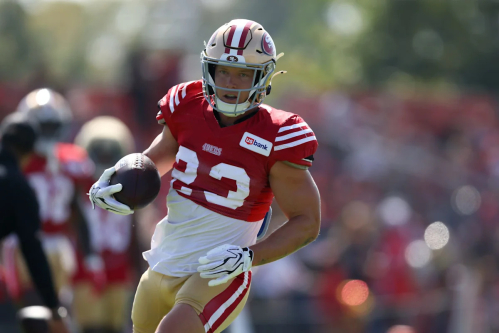
He was set to be working with an unproven quarterback who had never made an NFL start, but those issues were overlooked because Jefferson had been productive regardless of his signal-caller during his career. And so, those who trusted Jefferson were burned as he sputtered. They will want to avoid having a similar outcome with one of the highest-profile players sporting concerns entering the 2026 campaign: Christian McCaffrey. There’s little doubt that McCaffrey is one of the NFL’s best dual-threat running backs when healthy. He proved that by generating 2,126 scrimmage yards and 17 touchdowns while playing all 17 games for the 49ers last season. That said, McCaffrey is coming off a career-high 413 touches in 2025, marking the third time he has led the NFL in touches.
In each of the seasons following his heavy-touch years, McCaffrey has struggled to stay healthy, as he played just three games in 2020 after logging 403 touches in 2019 and logged action in just four games in 2024 after posting 339 touches in 2023. Does that mean history is guaranteed to repeat itself?
Not necessarily. Injuries are impossible to predict, even for teams that have their practice facility located next to an electrical substation. Still, fantasy managers considering McCaffrey around his fifth-ranked average draft position (ADP) should approach him with caution.
The 30-year-old has crossed the 2,000-touch barrier and averaged just 3.9 yards per carry in 2025, his lowest total since his rookie season in 2017. He could be in for a frustrating season if he starts to wear down because of his massive workload.

Have a flexible draft strategy, especially early Fantasy managers often do a lot of preparation for their drafts and have a good idea of how things will go. They plan out their exact strategy across the first two to three rounds to a T and try to follow that perfectly to build their desired squads. The problem? There are sometimes opportunities to deviate from that plan to land a better team.
Unwillingness to do that just because it’s not what you prepared for can end up costing fantasy managers dearly. Let’s flash back to the 2025 fantasy drafting season for a good example of this. Yours truly had the No. 6 overall pick in a 12-team snake draft. I had become enamored with New England Patriots running back TreVeyon Henderson and was projecting him to have a breakout year.
My plan was to take him in the third round of my draft; I feared he wouldn’t be available in the fourth round given my fantasy league is filled with Patriots fans. Sure enough, Henderson was on the board in the third round. But so too was Buffalo Bills running back James Cook, who I hadn’t expected to be available.
Foolishly, I stuck to my original plan of getting Henderson, allowing Cook to fall into the hands of my rival. He won the league.
I finished next-to-last thanks, in part, to my inconsistent play at running back. All that’s to say, don’t get married to the idea of taking a player in a specific round. You can still have a loose plan to do so, but be willing to pivot if a top-tier talent falls into your lap. It happens in every fantasy draft, and it’s best to be prepared to land a falling talent. The secret to finding a top-tier, mid-round quarterback As fun as it can be to land a talent like Josh Allen or Lamar Jackson early in fantasy drafts to be your top quarterback, it’s often better to wait to get a quarterback until the middle rounds of the draft. There’s simply a lot of depth at the quarterback position, so it’s easy to find a quality one later in drafts or even on the waiver wire.
There are a few schools of thought about how to find a quality mid-round quarterback. Some will prefer to go after a hyper-mobile quarterback like Jaxson Dart, whose scrambling upside could give him a high ceiling. That’s a viable strategy, but typically the best mid-round quarterbacks possess at least two of the following three features:
They are in a high-volume passing offense; They have an easy schedule that allows for lots of scoring; They have a weaker defense that will naturally lead to more high-scoring games. Last season, Dak Prescott fit that mold and ended up finishing the season as the No. 6 fantasy quarterback. This year, Jared Goff checks all of the boxes needed to become the best mid-round quarterback sleeper.
The veteran ranked fourth league-wide in passing attempts last year and will likely be tasked to throw a lot in 2026 as part of an explosive Detroit offense that features Amon-Ra St. Brown, Jameson Williams, Sam LaPorta and Jahmyr Gibbs. The Lions are also playing the NFL’s weakest schedule, which should boost Goff’s ceiling with his already high floor (he has thrown for at least 4,500 yards and 30 touchdowns in three straight seasons). And while Detroit’s defense shouldn’t be nearly as bad as Dallas’ last season, injuries to their secondary along with a still-unproven pass rush rotation outside of Aidan Hutchinson should mean the Lions will engage in higher-scoring affairs than most teams. All that should easily make Goff at top-10 fantasy quarterback, which makes him a bargain at his current consensus ranking of QB16. Hey, don’t forget about kickers!
Every year, there’s more and more talk about fantasy leagues removing kickers from the position pool. Typically, the argument against having kickers is that their usage is too unpredictable to warrant being a part of fantasy lineups. I’ll never fully understand or agree with that philosophy. Randomness is a key part of fantasy football. The unpredictability is part of what makes it fun or frustrating on a week-to-week basis.
Sure, kicker production may be random, but the same can be said of defensive scoring or production at the tight end position, outside of the top few options. But I digress. The point is that if you’re in a league with kickers, don’t be afraid to take one earlier than the conventional wisdom says.
The best kickers often end up being among the top 50 fantasy scorers, so landing an elite one can provide a tremendous base for a quality offense. To be clear, I’m not advocating to pick a kicker in the first half of fantasy drafts. But if you get into the Round 10 or 11 range and big-leg guys like Brandon Aubrey and Cam Little come off the board, don’t be afraid to pull the trigger. Might this earn you ridicule from your peers? Sure, especially if you enjoy mimicking the notorious “Shame!” chanting from “Game of Thrones” as much as my league mates do.
But considering the sneaky importance of the kicker position, it’s OK to make a minor reach for a top-tier talent. Late-draft sleepers to monitor Most every manager is aware of the early-round sleepers or value picks to target, but what about the guys you can land in the second half of drafts that can emerge as quality fantasy contributors? Here’s a breakdown of my favorite late-round fliers at each position.
Malik Willis, QB, Miami Dolphins. I wouldn’t recommend waiting too long to take a quarterback, but if you miss out on the second- and third-tier guys, Willis could be worth a gamble.
The new Dolphins quarterback only has six NFL starts to his name, but his unique combination of accuracy and mobility should make him a fantasy threat. That’s especially true since he’s playing for a Miami side that figures to be trailing often and will need to throw. Tyler Allgeier, RB, Cardinals. Jeremiyah Love is rightly getting a lot of the attention in Arizona after being the No. 3 overall pick in the 2026 NFL Draft. However, the rookie is now dealing with a high-ankle sprain, and it isn’t clear whether he will be ready for Week 1.
If he’s not, or if he’s limited, Allgeier will be in line for an increased workload. He’s a more than capable fill-in and could be a low-end RB2 early in the season as Love eases into action. De’Zhaun Stribling, WR, San Francisco 49ers. The 49ers lost Ricky Pearsall for the season to a knee injury while marquee free agent signing Mike Evans is dealing with a quad problem. That has cleared a path for Stribling, a second-round rookie, to get involved early.
He may play second-fiddle to Evans, but the rookie showed he can be a reliable pass-catcher by reeling in seven catches for 63 yards in his preseason debut. Don’t be surprised if he quickly emerges as a quality flex play.
Jake Ferguson, TE, Dallas Cowboys. Only three NFL tight ends have been targeted 100-plus times in at least two of the past three seasons. They are Trey McBride, Travis Kelce and Ferguson. Even if Ferguson’s target share dwindles a bit with both CeeDee Lamb and George Pickens in tow, the veteran tight end ranked fifth in red-zone targets last season and should be a top-tier touchdown threat.
More fantasy football contest For more analysis about all things fantasy football, check out the Sports Seriously NFL vodcast.