
Aug. 19, 2026, 7:06 a.m. ET
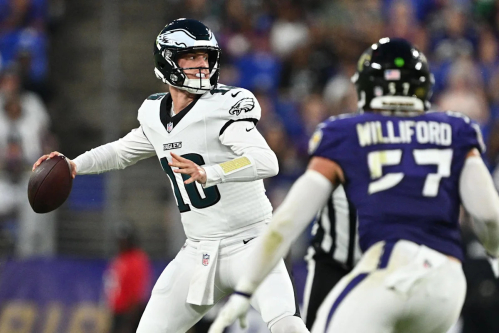
The Eagles are in New England for one of the NFL’s most anticipated joint practice sessions in recent memory. Philadelphia did not get enough clarity from their preseason opener, particularly at the spots where their depth remains unsettled. Their 24-7 loss to the Baltimore Ravens featured a few encouraging individual performances, but the offense struggled to sustain drives, and several competitions still look much the same as they did before kickoff. Two joint practices with the Patriots should change that.
The controlled setting gives Nick Sirianni more chances to place specific players in revealing situations, repeat a rep after a mistake and compare competitors against the same unfamiliar personnel. It also introduces different fronts, coverages, route combinations and pressure looks after weeks of seeing Vic Fangio’s defense and Sean Mannion’s offense. Here are five roster battles that deserve continued evaluation in New England. Backup quarterback Andy Dalton and Tanner McKee left the opener without creating any separation. The two quarterbacks combined to lead eight scoreless drives that produced 77 net yards and two first downs, an empty night that reflected problems with protection, timing and decision-making. Dalton was signed to provide veteran stability behind Jalen Hurts, while McKee entered camp with experience in the offense and an opportunity to show he could handle a larger role. Neither delivered the clean operation Philadelphia needed in Baltimore.
Cole Payton then gave the offense its only spark. The rookie quarterback completed four of nine passes for 37 yards and a touchdown, rushed three times for 45 yards and converted a fourth down with a 17-yard run. His six-yard touchdown pass to Erik Ezukanma came after he escaped the pocket and kept the play alive. Wide receiver The receiver competition needs context because the Eagles have not had their full group available. DeVonta Smith returned to limited work after dealing with a hamstring issue, while rookie Makai Lemon has continued to work away from team drills. Their absences created more opportunities for Dontayvion Wicks, Hollywood Brown, Elijah Moore, Darius Cooper and the rest of a crowded room, but camp production against familiar defensive backs can only reveal so much.
Wicks has made a strong case with consistent separation and reliable work throughout camp. Cooper continues to make difficult catches, while Brown and Moore are established veterans trying to define their places in a new offense. Lemon’s missed time makes the joint sessions especially important if he is cleared to participate.
More Read

The rookie does not need to reclaim every lost rep in two days, but he must begin to show that his route running, playbook knowledge, and versatility translate to unfamiliar coverage. New England’s cornerbacks will test releases at the line and force the Eagles’ receivers to finish routes through contact.
One-on-one periods will attract attention, but the more meaningful evaluation will come in team drills, where spacing, adjustments and quarterback trust matter. Philadelphia also must judge the bottom of the group through special teams. Britain Covey, Quez Watkins and other reserve receivers can strengthen their cases even when targets are limited. A player who wins as a receiver and contributes on multiple coverage or return units can quickly pass someone whose value is limited to offense. Reserve offensive line The second offensive line used Markel Bell at left tackle, Jake Majors at left guard, Willie Lampkin at center, Drew Kendall at right guard and Fred Johnson at right tackle during Monday’s practice. That combination is not permanent, but it gives the Eagles a useful starting point for the most fluid competition on the roster.
Bell and Lampkin were among the more encouraging reserve linemen against Baltimore. Bell held up at tackle, and Lampkin continued to show why his ability to play guard and center is essential. Cameron Williams flashed developmental ability in pass protection, while Myles Hinton remains another young option with the size and flexibility to compete for a reserve job.

Fred Johnson’s experience and versatility as a swing tackle give him an advantage, but the final two or three spots will depend on which combination can function together. Safety Andrew Mukuba remains positioned for a starting role, but the structure around him is still developing. Marcus Epps appears to have the early advantage after sitting out the preseason opener, while Michael Carter II played against Baltimore. Cooper DeJean adds another layer because Fangio can use him at safety in base personnel and move him back to the slot in nickel packages, allowing Epps or another defender to enter the game. That makes this competition about packages and responsibilities, not simply naming one starter.
Epps brings experience and communication. Carter offers coverage versatility. DeJean can change the entire alignment without forcing a substitution. J.T. Gray strengthens his case through special teams, while Andre’ Sam and the younger reserves need defensive reps that show they can be trusted beyond the kicking game.
Joint practices are ideal for separating the group because New England can stress the safeties with motion, play action, tight ends, and route combinations the Eagles have not repeatedly seen. Special teams There is no traditional kicking or punting battle. Jake Elliott and Braden Mann are established, but Philadelphia still has important decisions involving its returners, coverage players and rookie long snapper Rocco Underwood.
Those jobs will influence the final receiver, running back, defensive back and linebacker spots. Covey received the first punt-return opportunity against Baltimore, while Watkins and Moore handled kickoff returns. The depth chart also includes Will Shipley, Dameon Pierce and Tank Bigsby among the kickoff options, and Lemon could enter the punt-return discussion when healthy. The Eagles need someone who secures the ball, makes the first correct decision and creates hidden yardage without taking reckless chances. They also need reserves who can block, cover and tackle on more than one unit.
Joint practices usually limit truly live return work, so Saturday’s game will remain the larger stage for Covey, Watkins, Moore and the other return candidates. The two practices can still change the competition through coverage drills, blocking assignments, and the daily operation among Underwood, Mann, and Elliott. A receiver or defensive back sitting near the roster cut line can create meaningful separation by proving he belongs on three or four special-teams units.