

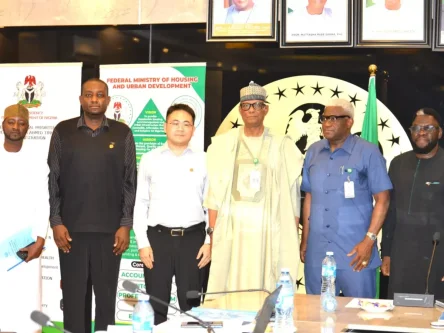
Real estate experts have said that proposed housing partnerships between the Federal Government and Chinese and Japanese firms could help reduce Nigeria’s housing deficit, but only if they are designed to strengthen indigenous developers, deliver affordable homes and create sustainable communities. The experts, comprising a property developer, town planner and real estate investment analyst, told Nairametrics that while foreign investment and technical expertise could accelerate mass housing delivery, the long-term success of the partnerships would depend on sound planning, sustainable financing and meaningful local participation. Their comments follow separate proposals by Chinese and Japanese companies seeking to partner with the Federal Government on housing, smart city and infrastructure development projects.
What they are saying
The experts noted that the proposals present an opportunity to attract foreign capital, technology and expertise into Nigeria’s housing sector, but stressed that their success will ultimately depend on how the partnerships are structured. Property developer and Founder of Murals Nigeria Limited, Olufemi Adeleke, described the growing interest from Chinese and Japanese firms as both an opportunity and a risk, arguing that while Nigeria needs foreign investment to address its housing deficit, indigenous developers should remain central to project delivery.
“The opportunity is real. Nigeria has a 17-20 million housing deficit and we cannot close that gap with current local capacity and financing alone. Foreign capital and expertise are welcome. But there’s a difference between foreign participation and foreign capture,” he said. According to Adeleke, Nigerian developers are constrained more by financing than technical capability and should play a leading role in delivering projects undertaken through partnerships with foreign firms. Similarly, town planner and Co-founder/Director of Goania Project Ltd, Tpl.
Niyi Aderohunmu, said public-private partnerships can help address Nigeria’s housing deficit, provided they deliver complete, well-connected communities rather than isolated housing estates. He said housing projects should be integrated with transport networks, employment centres and essential services to ensure they remain sustainable and attractive to residents. Also speaking, real estate investment analyst Olabisi Odusanya said the interest from Chinese and Japanese firms reflects growing confidence in Nigeria’s real estate sector, noting that both countries have demonstrated the capacity to deliver housing at scale. However, she said the real test would be whether the projects expand access to affordable housing in areas where demand is greatest rather than simply increasing supply in premium locations. What we know about the proposals
Over the past few weeks, two major Asian firms have separately approached the Federal Government with proposals aimed at supporting Nigeria’s mass housing drive through public-private partnerships.
China Hyway Group Limited proposed the development of 10,000 housing units across Nigeria within 30 months using prefabricated construction technology under an Engineering, Procurement, Construction and Financing (EPC+F) model. Following the presentation, the Minister of Housing and Urban Development, Engr. Muttaqha Rabe Darma, directed the constitution of a committee to review the proposal and recommend the ministry’s next line of action. More recently, Japanese engineering and infrastructure consultancy Chodai Company Limited proposed a partnership with the Federal Government covering housing construction, roads, smart city development, hydropower generation, renewable energy and other strategic infrastructure projects through public-private partnerships. While China Hyway’s proposal is centred on delivering 10,000 homes within a defined timeframe, Chodai’s proposal takes a broader approach by combining housing delivery with wider urban infrastructure and smart city development.
More Read

Both proposals reflect the Federal Government’s continued reliance on public-private partnerships to mobilise private capital and technical expertise in tackling Nigeria’s housing deficit. While the proposals could accelerate housing delivery if implemented, the experts who spoke to Nairametrics said their long-term success will depend on how the partnerships are structured, planned and executed. Balancing foreign investment with local capacity
While welcoming foreign investment into Nigeria’s housing sector, the experts stressed that such partnerships should be structured to strengthen local capacity, improve affordability and ensure indigenous developers are not sidelined. Adeleke argued that Nigerian developers are constrained more by financing than technical capability, saying the country’s high borrowing costs have made it difficult for local firms to compete with foreign counterparts that can access significantly cheaper capital.
“The cost of capital in Nigeria is punitive; you’re borrowing at 35% while a foreign developer accesses capital at 4% to 6%. That’s not a skills gap, it’s a cost of capital gap. Nigerian developers have delivered at scale. The constraint is financing, trust infrastructure, and supply chain transparency, all of which are solvable,” he told Nairametrics. According to him, foreign developers should enter Nigeria as partners rather than replacements, with indigenous firms retaining execution authority while foreign companies provide capital, engineering expertise and technology. “There’s a difference between foreign participation and foreign capture. If these PPPs are structured so that foreign firms own the infrastructure, control the supply chain, and repatriate the margins, we don’t solve a housing problem, we create a new one.
We end up paying rent to live in our own economy,” Adeleke said. Odusanya also said the long-term success of the proposed partnerships should not be measured solely by the number of housing units delivered, but by whether they expand access to homes for low and middle-income earners in locations where demand is strongest. She noted that if similar large-scale housing developments are undertaken in Lagos, they should prioritise areas such as Yaba, Shomolu, Ikorodu and Ajah, where young professionals and middle-income households face significant housing demand, rather than concentrating new supply in already established high-end neighbourhoods. “If these projects target areas like Yaba, Shomolu, Ikorodu, or Ajah, then this could bridge a critical gap in the market. However, if they simply add to the ever-changing skyline of Ikoyi and Victoria Island, then we’re adding supply where it’s least needed while the deficit in affordable and mid-income housing continues to grow,” she told Nairametrics.

Building communities, not just housing estates
Beyond financing and local participation, Aderohunmu said the long-term success of large-scale housing developments will depend on whether they are planned as complete communities rather than standalone housing estates. He described public-private partnerships as one of the most practical ways to tackle Nigeria’s housing deficit, noting that government alone cannot finance or deliver the number of homes required each year. However, he stressed that housing should be planned as part of an integrated urban system rather than simply as buildings.
According to him, new developments should be located close to employment centres and integrated with public transport, schools, healthcare facilities and commercial activities to ensure residents can easily access essential services and economic opportunities. “Ultimately, PPP-led mass housing is the right delivery mechanism only when it creates complete, affordable, and well-connected communities. The real measure of success is not the number of houses built, but whether people can live, work, access essential services, and build sustainable lives within those communities,” he said.
Speaking on Chodai’s proposal to develop smart cities, Aderohunmu said success in the Nigerian context should not be measured by the amount of technology deployed but by how effectively it improves everyday life through reliable infrastructure, efficient mobility, better public services and sustainable urban management. He added that smart cities should be designed to solve Nigeria’s urban challenges rather than replicate models from other countries, stressing that developments must be seamlessly integrated with surrounding communities instead of functioning as isolated, technology-driven estates. According to him, the goal should be to create neighbourhoods that remain economically viable, socially inclusive and environmentally sustainable long after construction is completed. What government should prioritise
Aderohunmu said the success of any large-scale housing partnership will depend on the standards government sets before construction begins, arguing that approvals should be based on long-term sustainability rather than the number of housing units proposed. He said government should ensure core infrastructure, including roads, water supply, drainage, electricity, sewage systems and waste management, is fully delivered before residents move into new estates. According to him, every public-private partnership agreement should also include clearly defined long-term operations and maintenance responsibilities to prevent infrastructure from deteriorating after project completion.
Aderohunmu further recommended that developments provide a mix of housing options, including affordable homeownership, rental housing, rent-to-own schemes and serviced plots, to accommodate households across different income levels. He also urged government to subject every proposal to rigorous land, financial and planning assessments, including proper verification of land ownership, phased implementation plans and performance guarantees to safeguard public investment and minimise implementation risks. To maximise the long-term benefits of the partnerships, he said projects should prioritise local labour, contractors and building materials, a move he said would encourage technology transfer while strengthening Nigeria’s construction industry. Echoing the need for developments that reflect local realities, Adeleke warned against adopting housing models that overlook Nigeria’s social and cultural context. “Housing isn’t just units, it’s cultural infrastructure.
If foreign firms design our housing stock at scale without deep cultural integration, we get generic units that erode the cultural character of our communities,” he said. What you should know
Nigeria faces one of Africa’s largest housing shortages, driven by rapid urbanisation, population growth, rising construction costs and limited access to affordable housing finance. To bridge the gap, the Federal Government estimates that about 550,000 housing units need to be built annually, requiring an estimated N5.5 trillion every year over the next decade. Given the scale of financing required, the government has increasingly adopted public-private partnerships to mobilise private capital and technical expertise for large-scale housing delivery. The proposals by China Hyway Group Limited and Japan’s Chodai Company Limited are among the latest foreign-backed initiatives being considered under that approach. While the Chinese firm is seeking to develop 10,000 housing units within 30 months using prefabricated construction technology, the Japanese company has proposed a broader collaboration covering housing, smart cities and strategic infrastructure. Although both proposals remain at different stages of government consideration, the experts who spoke to Nairametrics said their success will ultimately depend not only on the number of homes delivered, but also on whether the projects strengthen local capacity, remain affordable and create well-planned, sustainable communities.