

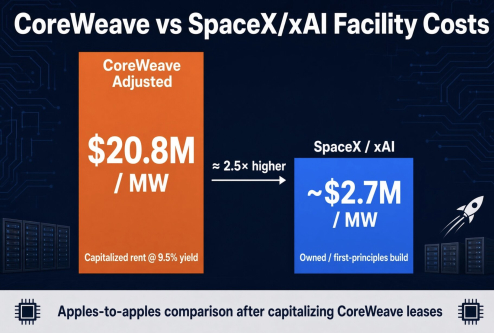
CoreWeave ahas heavy reliance on leasing (rather than owning) data-center facilities. It uses a standard real-estate technique—capitalizing an ongoing rent stream—to put leased capacity on the same footing as owned capacity for honest cost comparisons.
Breaking down the numbers
$165/kW/month** is a representative (or modeled) base rent rate for CoreWeave’s colocation/powered-shell leases.
1 MW = 1,000 kW → $165 × 1,000 = $165,000 per MW per month.
× 12 months = $1.98 million per MW per year.
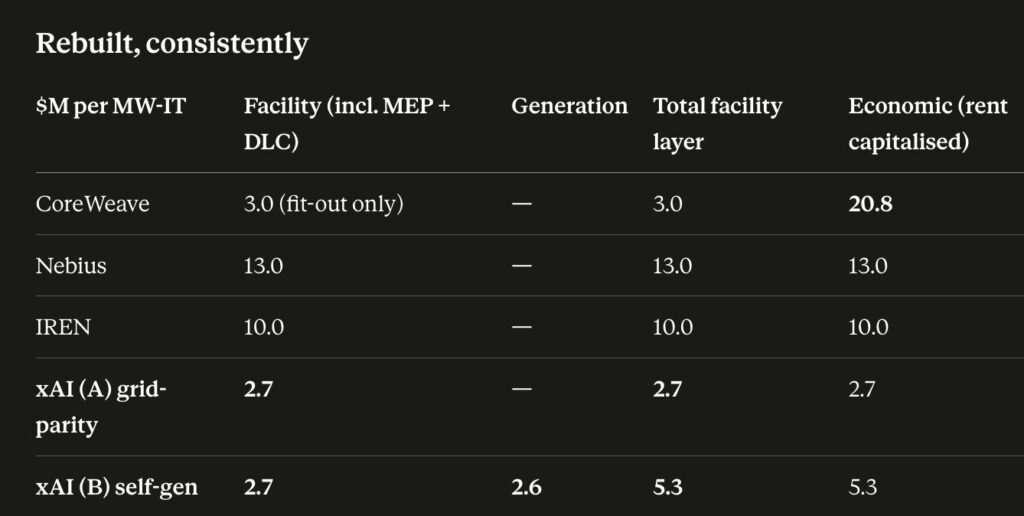
Coreweave is different with more things in opex instead of capex.
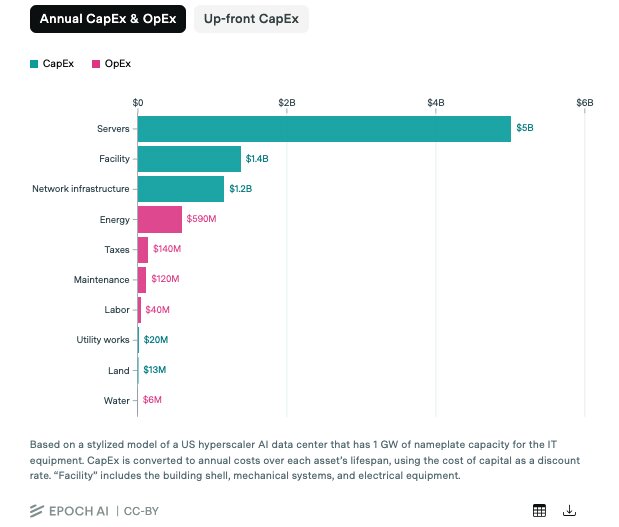
Some detailed unit-economy models use a close figure of ~$1.65 M/MW in Year 1 with 3% escalators. $165/kW/mo is the clean monthly equivalent used here.
Capitalizing at a ~9.5% stabilized yield:
Capital value = Annual rent ÷ yield.
$1.98 M ÷ 0.095 ≈ $20.8 million per MW.
This is the implied capital that the landlord has deployed (or the market value of the leased facility) to generate that rent stream. 9.5% is a plausible stabilized yield/cap rate for AI-ready data-center real estate given risk, lease length, and credit quality of the tenant.
Every MW CoreWeave leases is economically equivalent to the landlord having spent ~$20.8 M of capital Which would be $20.8 billion per gigawatt.
CoreWeave mostly leases powered shells from partners (Core Scientific, Applied Digital, Galaxy/Helios, etc.) and then installs its own GPUs and networking. On its own balance sheet it mainly shows GPU CapEx.
By capitalizing the rent, analysts convert the lease into an equivalent owned-facility cost. This reveals that CoreWeave’s effective facility cost is not the cheapest in the peer set—it is among the highest.
Typical AI-ready powered-shell construction costs (owned) are commonly $10–15 M/MW (sometimes lower).
Efficient or first-principles builds, especially those that repurpose existing buildings and use behind-the-meter power (xAI’s Colossus facilities are frequently cited), have been reported as low as ~$2.7–8 M/MW for the facility portion.
$20.8 M vs. ~$8 M is roughly 2.5×. That is the most expensive by roughly 2.5× versus xAI claim.
The accounting and economic consequences
Moves cost from balance sheet to income statement.
Owning the facility puts a large CapEx number on the balance sheet and then depreciates it over many years (buildings last far longer than GPUs).
Leasing keeps most of that CapEx off CoreWeave’s books. Instead, rent hits operating expenses (COGS or opex) every month.
Coreweave reported CapEx looks lower relative to revenue growth or capacity added, making the business appear less capital-hungry than a fully owned model.
Permanently penaliszs operating margin. Rent is a recurring cash cost that never goes away (or only declines if leases are renegotiated or sites are bought out). An owner eventually finishes depreciating the building and keeps more of the economics. CoreWeave’s long-term adjusted operating-margin target of 25–30% already embeds this landlord tax. Contribution margins stabilize in the mid-20s once deployments mature, partly because of these lease costs.
CoreWeave has acknowledged the issue by beginning selective self-builds and exploring ownership routes (including past discussions around Core Scientific) to reduce reliance on third-party landlords over time.
Bottom line: The math is correct and the comparison is deliberately apples-to-apples. CoreWeave’s leasing strategy accelerates scale and keeps GPU CapEx as the dominant line item, but it embeds a higher effective facility cost and a permanent drag on margins relative to vertically integrated or ultra-efficient owners such as xAI.
Brian Wang is a Futurist Thought Leader and a popular Science blogger with 1 million readers per month. His blog Nextbigfuture.com is ranked #1 Science News Blog. It covers many disruptive technology and trends including Space, Robotics, Artificial Intelligence, Medicine, Anti-aging Biotechnology, and Nanotechnology.
Known for identifying cutting edge technologies, he is currently a Co-Founder of a startup and fundraiser for high potential early-stage companies. He is the Head of Research for Allocations for deep technology investments and an Angel Investor at Space Angels.
A frequent speaker at corporations, he has been a TEDx speaker, a Singularity University speaker and guest at numerous interviews for radio and podcasts. He is open to public speaking and advising engagements.