

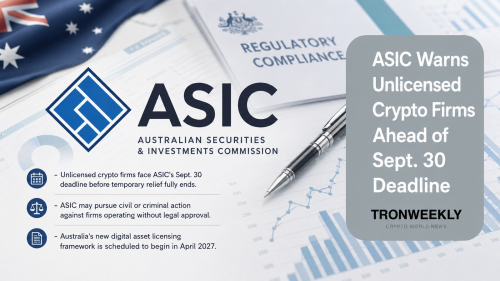
Australia’s financial regulator has issued a final warning to unlicenced crypto firms using temporary enforcement relief. Firms covered by existing financial services laws have until Sept. 30 to take required licensing steps before ASIC’s no-action protection ends on Oct.
1. The Australian Securities and Investments Commission said unlicenced crypto firms could face civil or criminal action after the deadline. Potential penalties may reach 10% of annual turnover in some cases. LATEST: 🇦🇺 Australia’s ASIC is warning digital asset firms providing financial services to apply for or update a license by Sept. 30 or risk fines of up to 10% of annual turnover.
pic.twitter.com/n1tdMdPI4A
— CoinMarketCap (@CoinMarketCap) September 3, 2026
What ASIC Rules Apply to Unlicenced Crypto Firms Before Sept. 30? This is a potential maximum possible penalty for non-compliance for unlicenced crypto firms.

This does not imply that all companies trading without a license will receive a fine of this magnitude. Also Read: SEC Chair Hopes CLARITY Act Advances Within 2 Weeks: Report
The number of license applications for digital assets exceeds 45 after ASIC revised its guidelines in October 2025. Before that, the number was around 30 as ASIC extended its deadline from June.
The notice is addressed to companies that trade in financial products involving digital assets. Not every token, cryptoasset, or blockchain service will require such a license. All corporations that need to obtain an Australian Financial Services License have to lodge a new application or variation of a license application until Sept. 30. There are other requirements for those firms that need to acquire an Australian Market Licence or Clearing and Settlement Facility Licence.

These firms have to inform ASIC in writing and conduct pre-application discussions prior to the deadline. ASIC’s Information Sheet 225 describes how current regulations could be applied to digital assets. Some examples include stablecoins, wrapped tokens, custody services and staking services. Firms should identify rights associated with each digital asset and cannot use only its technological construction or nomenclature.
Source: CoinDesk
Bitcoin and other digital assets do not fall under the definition of financial products as single assets. But the products, arrangements, and financial services related to them may require licensing. This issue has found its reflection in Australian courts. Block Earner’s fixed-yield product was deemed a financial product and required a license by the High Court of Australia with a vote of 7 to 0. Why Is ASIC Ending Temporary Relief on Oct.
1? The ASIC issued its no-action position applicable across the sector following consultations within the industry in December 2024. The move provided the eligible businesses with additional time for assessing the updated guidelines and lodging licence application. The initial deadline was set on June 30, 2026, but the regulator later pushed it back by another three months to September 30.
Additionally, the regulator extended the arrangement to cover certain authorized representatives and intermediaries. However, the no-action position is not an authorization itself or any kind of exemption from the licensing requirement. The no-action position provides the circumstances under which ASIC will not seek enforcement action for compliance violations. Unlicenced crypto firms providers that offer financial services starting October 1 may become subject to investigations. The ASIC has noted that both civil and criminal penalties could be applied in case of the mandatory authorization requirement. When Will Australia’s New Crypto Framework Begin?
The deadline of Sept. 30 is related to obligations that were already regulated by Australia’s financial services law. The deadline is unrelated to the Corporations Amendment (Digital Assets Framework) Act 2026. The Act was passed by Parliament on April 1.
More Read

It gained royal assent on April 8, while its commencement is pla n ned for April 9, 2027. The framework will involve special rules for the operation of digital asset platforms and tokenized custody platforms. Businesses of those kinds will be licensed and regulated by the ASIC.
Existing authorizations will still apply in the new system. Some crypto companies that currently lack licenses may initially have to gain approval according to existing laws before varying their licenses for new activities within the 2027 framework.
Also Read: Bitcoin Price Faces a Critical $83K Test Amid Mixed ETF Flows
Arslan Tabish
Arslan Tabish is a Technical Reporter and Market Analyst at Tron Weekly with over five years of experience covering cryptocurrency markets and blockchain developments. His reporting focuses on Bitcoin, Ethereum, altcoins, and decentralized finance, alongside NFTs, crypto regulation, policy, and Web3 innovations.
Arslan covers blockchain technology, Layer 2 scaling solutions, and emerging use cases, including AI-driven crypto applications, while delivering clear market analysis on how technical and regulatory developments impact digital asset markets. His work is designed for both beginners and experienced readers, offering accurate, easy-to-understand reporting without speculation or investment guidance.
Articles: 1899