


The world-renowned athletic tracks installed for the Paris 2024 Olympic and Paralympic Games, the resurfacing was spearheaded by Mondo S.p.A.. They installed their state-of-the-art Mondotrack EI (Ellipse Impulse) at the Stade de France.
If the world record mile run had the same conditions but had the most up to date track surface then the world record mile run could have been under 3:42.

The best track field surfaces for the best running times can give 0.3 to 0.8 seconds better times for mile runs. The best legal running shoes and running outfits can also impact the times.
World record holder Kerr is 28. He has maybe 3-4 years of peak performance left. The full regular mile run is only done a few times per year at elite events. The Olympics and Worlds only have the metric mile (1500 meter runs). Kerr will likely only has a good chance to break his mile record once or twice a year. He would also have to train specifically for a good attempt. If Kerr is going to break 3:40, then the major athletic tracks should all have the best surfaces. This costs a few million dollars at each location. There is a limited window for him to have good odds to do this.
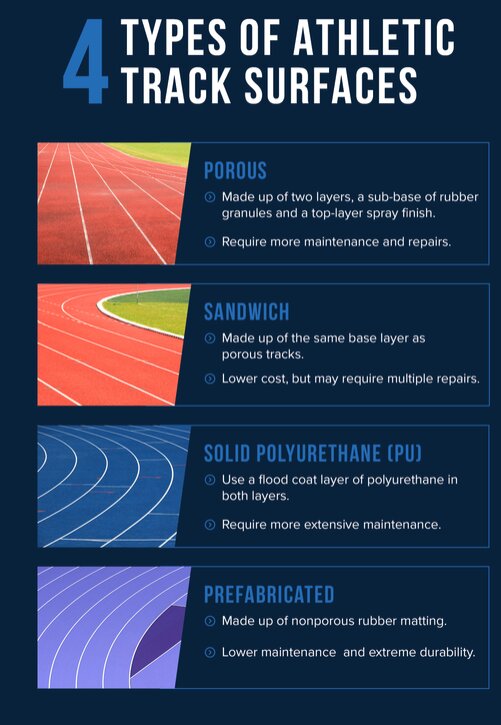
1. Mondo (Prefabricated Rubber)
Mondo is best known for its prefabricated, vulcanized synthetic rubber tracks.
The track is manufactured in a controlled factory setting and then rolled out and bonded to the asphalt/concrete under-surface on-site.
It offers highly consistent shock absorption, energy return, and thickness throughout the entire surface. It is also highly durable and can be easily repaired if sections are damaged.
The Paris 2024 Olympics track had a distinctive and sustainable purple design.
2. CONICA (Polyurethane Systems)
CONICA AG (a Swiss manufacturer) specializes in liquid-applied, polyurethane-based sports flooring systems (such as CONIPUR).
The components are delivered in liquid form and are paved, poured, or sprayed on-site to create a seamless track.
It is highly customizable. Because it is seamless, it creates a perfectly uniform, non-porous surface that excels in durability and weather resistance.
The Grand Stadium Olympic Complex in Oran and various track upgrades across Europe.
Paris 2024 Mondo Track Specifications and Improvements
This prefabricated (factory-made for uniformity) synthetic rubber track features two main layers:A thin upper wear layer (≈14 mm total thickness) for grip, drainage, and spike interaction.
A lower base layer with a novel geometry of elliptical air cells (honeycomb-like chambers) instead of the previous hexagonal design.
Key advances over prior Mondo versions ( Beijing 2008 or Tokyo 2020/21). +2.63% net impulse (improved horizontal energy return/propulsion) via finite element modeling (FEM) and virtual simulations in collaboration with Politecnico di Milano’s Polymer Engineering Lab. The elliptical cells provide smoother, more uniform deformation and response across the surface, with greater deformation capacity and no sharp edges. Mondo claimed the Paris track was about 2% faster than the Tokyo version.
Improvements Expected Beyond Paris/Mondo
Two notable emerging technologies stand out as of mid-2026.
1. Rekortan Gel (Sports Group / Under Armour partnership)
This introduces a proprietary gel-based layer (thin eco-friendly gel infused via enzymatic process into bio-based polyurethane with trillions of self-organizing liquid micro-bubbles/nanoscale structures). It functions like microscopic springs and absorbs impact for force reduction.
Provides timed/delayed energy return at toe-off for propulsion (“ping” or “pop” sensation).
Claims and features are 58% energy return (specific testing context. emphasizes efficient timing over raw percentage).
Installed at IMG Academy (Florida) for the inaugural Under Armour Track & Field Nationals (May 2026). Used in Adelaide (Australia) and other elite events/universities. Athletes and coaches report bouncier feel, faster times/PBs, less pounding, and fewer injuries (hamstrings). Marketed as “super tracks” paralleling super shoes.
2. Feldspar Smart Track (UK company)
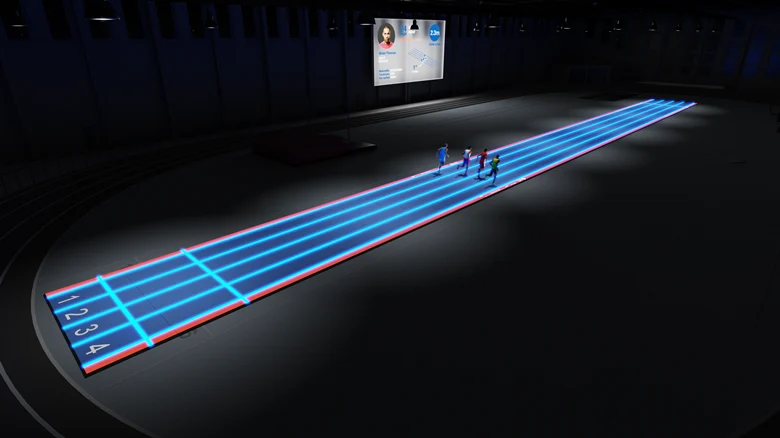
This represents the most ambitious leap. A sensor-embedded high-performance surface with patent-pending cantilever/angled energy return mechanisms.Converts vertical impact force into forward (horizontal) momentum more efficiently (acts like directional springs).
Claims up to 90% energy return overall which is 20% better than the Paris Olympic track (standard tracks often cited around 70–75%).
Alvina Chen, Feldspar’s founder and CEO, “If an athlete can already run, say, 9.80 seconds on a traditional track, we believe that with this track’s efficiency gains, they could dip into the low nine-second range, if not below.”
Feldspar has already engaged in discussions with World Athletics regarding official certification and potential use in sanctioned events. While ratification of records set on this surface will require thorough evaluation, early reception from athletes and coaches has been overwhelmingly positive.
With the prototype currently limited to 20 meters, Feldspar’s next step is to construct a full 100 meter straight, allowing for more comprehensive testing.
Should these tests confirm the anticipated benefits, the track’s rollout could begin in earnest, with the potential for debut in international competitions ahead of the 2028 Los Angeles Olympics.
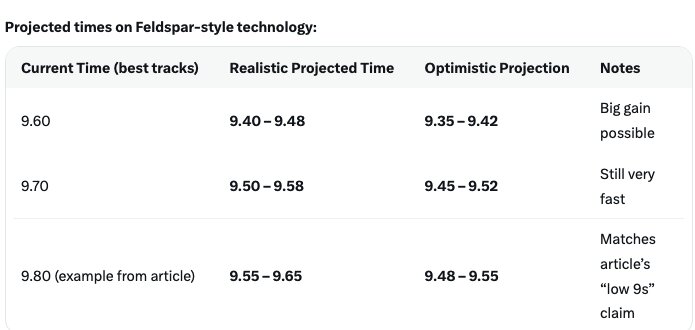
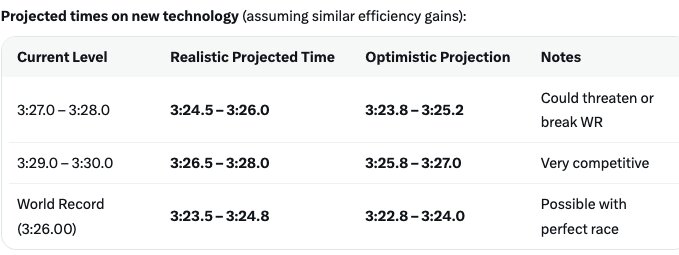
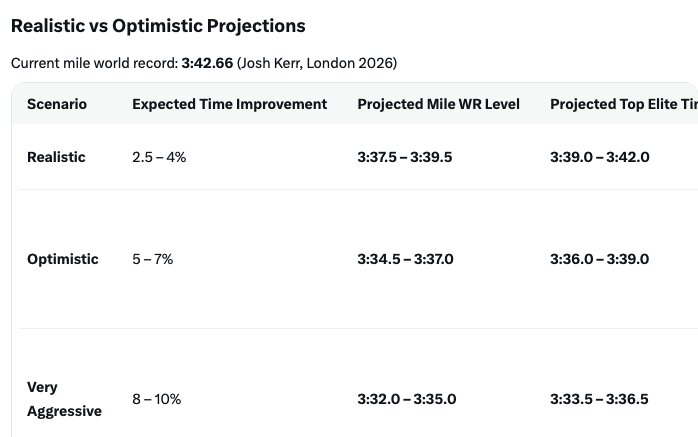
Adaptation matters. Athletes will need time to adjust running mechanics to the more responsive surface.
Other factors still dominate. Wind, temperature, pacing, shoes, and race tactics can outweigh track gains.
A full 5–7% gain across the whole mile is aggressive. The biggest improvements would likely come in the final 600–800 meters where energy return helps most.

Brian Wang is a Futurist Thought Leader and a popular Science blogger with 1 million readers per month. His blog Nextbigfuture.com is ranked #1 Science News Blog. It covers many disruptive technology and trends including Space, Robotics, Artificial Intelligence, Medicine, Anti-aging Biotechnology, and Nanotechnology.
Known for identifying cutting edge technologies, he is currently a Co-Founder of a startup and fundraiser for high potential early-stage companies. He is the Head of Research for Allocations for deep technology investments and an Angel Investor at Space Angels.
A frequent speaker at corporations, he has been a TEDx speaker, a Singularity University speaker and guest at numerous interviews for radio and podcasts. He is open to public speaking and advising engagements.