

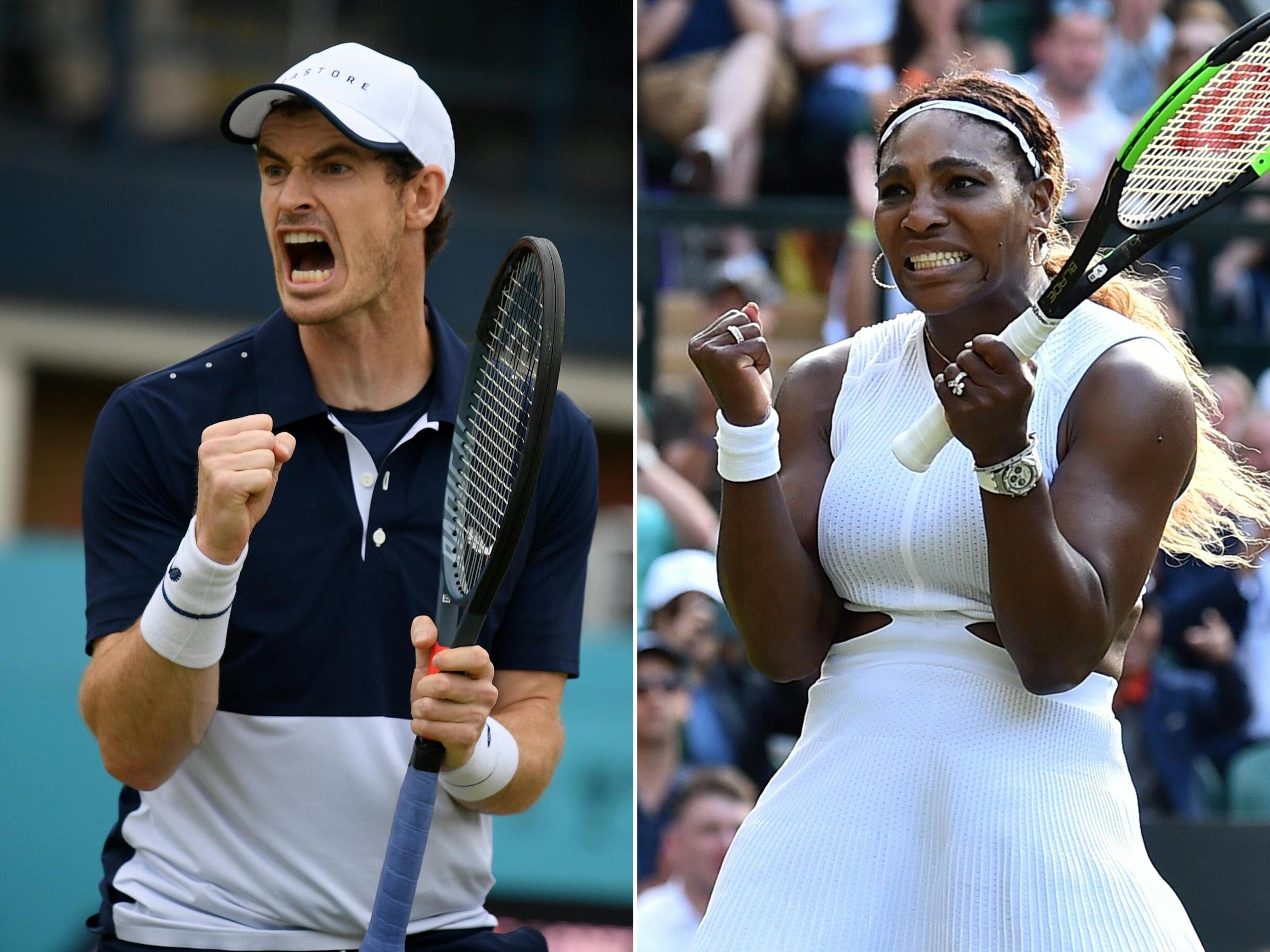
If you are looking for an indication of the profile mixed doubles currently occupies in world tennis you need only look down the draw for the field here at this year’s Championships. Andy Murray’s partnership with Serena Williams may be big news in these parts, but cast your eyes over the list of entrants and you struggle to find many names that would be familiar to the general public.
Of the 48 men in the mixed event, only Nick Kyrgios, who is playing with Desirae Krawczyk, and Frances Tiafoe, who is partnering Venus Williams, are ranked in the top 100 in singles, while none of the world’s top six in the men’s doubles rankings are in the field. Bruno Soares (partnering Nicole Melichar) and Jamie Murray (partnering Bethanie Mattek-Sands), ranked No 7 and No 8 respectively, are the highest ranked men’s doubles specialists playing mixed this year.
More higher-ranked women have entered the mixed event, but apart from Serena Williams none would be considered serious contenders to win this year’s singles title. Cori Gauff, the 15-year-old conqueror of Venus Williams, will be partnering Britain’s Jay Clarke, while Jelena Ostapenko, the 2017 French Open singles champion, will be playing with Robert Lindstedt.
We’ll tell you what’s true. You can form your own view.
From
15p
€0.18
$0.18
USD 0.27
a day, more exclusives, analysis and extras.
Meanwhile Murray and Williams’ first opponents are Germany’s Andreas Mies and Chile’s Alexa Guarachi, with the winners to face the No 14 seeds, France’s Fabrice Martin and the American Raquel Atawo.
For lovers of mixed doubles – and there are plenty within these shores if not so many around the rest of the world – the presence of Murray and Williams provides a welcome boost to a part of the game that has long been in decline. The Hopman Cup mixed team event in Australia was contested for the last time this year, which leaves the four Grand Slam tournaments and the Olympic Games as the only competitions at the highest level where mixed doubles is played.
1/38 Pete Sampras, 2000
AFP/Getty Images
2/38 Venus Williams, 2000
Getty Images
3/38 Goran Ivanisevic, 2001
Getty Images
4/38 Venus Williams, 2001
Bongarts/Getty Images
5/38 Lleyton Hewitt, 2002
Getty Images
6/38 Serena Williams, 2002
AFP/Getty Images
7/38 Roger Federer, 2003
Bongarts/Getty Images
8/38 Serena Williams, 2003
Getty Images
9/38 Roger Federer, 2004
Bongarts/Getty Images
10/38 Maria Sharapova, 2004
Bongarts/Getty Images
11/38 Roger Federer, 2005
Getty Images
12/38 Venus Williams, 2005
AFP/Getty Images
13/38 Roger Federer, 2006
AFP/Getty Images
14/38 Amelie Mauresmo, 2006
Getty Images
15/38 Roger Federer, 2007
AFP/Getty Images
16/38 Venus Williams, 2007
Getty Images
17/38 Rafael Nadal, 2008
AFP/Getty Images
18/38 Venus Williams, 2008
Getty Images
19/38 Roger Federer, 2009
Getty Images
20/38 Serena Williams, 2009
Getty Images
21/38 Rafael Nadal, 2010
Getty Images
22/38 Serena Williams, 2010
Getty Images
23/38 Novak Djokovic, 2011
Getty Images
24/38 Petra Kvitova, 2011
Getty Images
25/38 Roger Federer, 2012
Getty Images
26/38 Serena Williams, 2012
Getty Images
27/38 Andy Murray, 2013
Getty Images
28/38 Marion Bartoli, 2013
Getty Images
29/38 Novak Djokovic, 2014
AFP/Getty Images
30/38 Petra Kvitova, 2014
AFP/Getty Images
31/38 Novak Djokovic, 2015
Getty Images
32/38 Serena Williams, 2015
Getty Images
33/38 Andy Murray, 2016
Getty Images
34/38 Serena Williams, 2016
Getty Images
35/38 Roger Federer, 2017
Getty Images
36/38 Garbine Muguruza, 2017
Getty Images
37/38 Novak Djokovic, 2018
Getty Images
38/38 Angelique Kerber, 2018
Getty Images
1/38 Pete Sampras, 2000
AFP/Getty Images
2/38 Venus Williams, 2000
Getty Images
3/38 Goran Ivanisevic, 2001
Getty Images
4/38 Venus Williams, 2001
Bongarts/Getty Images
5/38 Lleyton Hewitt, 2002
Getty Images
6/38 Serena Williams, 2002
AFP/Getty Images
7/38 Roger Federer, 2003
Bongarts/Getty Images
8/38 Serena Williams, 2003
Getty Images
9/38 Roger Federer, 2004
Bongarts/Getty Images
10/38 Maria Sharapova, 2004
Bongarts/Getty Images
11/38 Roger Federer, 2005
Getty Images
12/38 Venus Williams, 2005
AFP/Getty Images
13/38 Roger Federer, 2006
AFP/Getty Images
14/38 Amelie Mauresmo, 2006
Getty Images
15/38 Roger Federer, 2007
AFP/Getty Images
16/38 Venus Williams, 2007
Getty Images
17/38 Rafael Nadal, 2008
AFP/Getty Images
18/38 Venus Williams, 2008
Getty Images
19/38 Roger Federer, 2009
Getty Images
20/38 Serena Williams, 2009
Getty Images
21/38 Rafael Nadal, 2010
Getty Images
22/38 Serena Williams, 2010
Getty Images
23/38 Novak Djokovic, 2011
Getty Images
24/38 Petra Kvitova, 2011
Getty Images
25/38 Roger Federer, 2012
Getty Images
26/38 Serena Williams, 2012
Getty Images
27/38 Andy Murray, 2013
Getty Images
28/38 Marion Bartoli, 2013
Getty Images
29/38 Novak Djokovic, 2014
AFP/Getty Images
30/38 Petra Kvitova, 2014
AFP/Getty Images
31/38 Novak Djokovic, 2015
Getty Images
32/38 Serena Williams, 2015
Getty Images
33/38 Andy Murray, 2016
Getty Images
34/38 Serena Williams, 2016
Getty Images
35/38 Roger Federer, 2017
Getty Images
36/38 Garbine Muguruza, 2017
Getty Images
37/38 Novak Djokovic, 2018
Getty Images
38/38 Angelique Kerber, 2018
Getty Images
Even at Grand Slam level mixed doubles has a lower profile than it used to. While overall prize money has risen sharply in recent years, the increases for mixed doubles have been comparatively modest.
This year’s Wimbledon mixed doubles champions will share prize money of £116,000, which is an increase of 47 per cent compared with what Leander Paes and Lisa Raymond earned (£79,180) for winning the title 20 years ago.
However, compare this with the 417 per cent increase in prize money for men’s singles champions over the same period (up from £455,000 to £2.35m) or with the increases in pay for men’s and women’s doubles. This year’s men’s and women’s doubles champions will share £540,000. For the men that is an increase of 190 per cent compared with what they earned in 1999 (£186,420), while for the women it is an increase of 222 per cent compared with 1999 (£167,770).
Despite this, there is still significantly more interest in mixed doubles in Britain than in any other country in the world. Although it is true that there is more doubles played at club level than singles in most countries, there is a widespread feeling elsewhere that doubles is largely a social game and should not be taken too seriously as a competitive sport.
In France, for example, L’Equipe, the country’s highly respected national daily sports newspaper, does not even publish the results of mixed doubles matches at the French Open until the final stages.
Richard Gasquet, arguably the most successful male French player of recent years, won the mixed doubles at Roland Garros alongside Tatiana Golovin in 2004, but it hardly made a ripple at the time and is barely mentioned now. Meanwhile news of the Murray-Williams partnership, which was leading sports news bulletins here and dominating some of the sports websites and newspaper pages, was buried in Wednesday’s edition of L’Equipe within a report of the American’s first-round singles match.
Murray has played mixed doubles here on two previous occasions – he partnered Shahar Peer in 2005 and Kirsten Flipkens in 2006 – but Roger Federer and Rafael Nadal have never played mixed at the All England Club. As the game has become more physical and the financial rewards in singles have risen so sharply, nearly all the best players prefer to focus on singles.
Until the Open era, in contrast, it had been common practice for the leading players to enter singles, doubles and mixed doubles at the same event. Frank Sedgman, in 1952, was the last man to win all three titles in the same year at Wimbledon, while Billie Jean King is the last woman to have performed the feat. She did it in both 1967 and 1973.
Entering all three events has become less common in the Open era, particularly among the men, but Jimmy Connors, the singles champion in 1974, also played in doubles and mixed. He reached the semi-finals with Ilie Nastase in the men’s doubles that year and won one match in the mixed with Chris Evert.
Before the introduction of tie-breaks at Wimbledon in 1971 there was no knowing how long matches might be, but that did not stop some of the biggest names entering all three events. The record for the most number of games played at Wimbledon at a single Championships is held by Rod Laver, who in 1959 played a record 638 games – 283 in singles, 237 in doubles and 118 in mixed. Like many other landmarks here, that is a record that will surely never be broken.