Bioreports
Tuesday, 25 Aug 2026
  • Home
  • POLITICS
  • SPORTS
  • HEALTH
  • BUSINESS
  • ENTERTAINMENT
    • Fashion
    • Fitness
    • Food
    • Travel
Newsletter
  • news
  • update
  • life style
  • tech
  • fitness
  • fashion
  • travel
  • food
BioreportsBioreports
Font ResizerAa
  • Home
  • Read History
  • Economy
  • Travel
  • Global Security
  • Global Affairs
  • World
  • Technology
  • Login
  • Blog
  • Contact
Search
  • Pages
    • Blog Index
    • Contact Us
    • Search Page
    • 404 Page
  • Pages
    • Home
    • Blog Index
    • Contact Us
    • Search Page
    • 404 Page
  • Pages
    • Home
    • Blog Index
    • Contact Us
    • Search Page
    • 404 Page
  • Personalized
    • Read History
  • Personalized
    • Read History
  • Personalized
    • Read History
  • Categories
    • Economy
    • Global Affairs
    • Technology
    • Travel
    • Global Security
  • Categories
    • Economy
    • Global Affairs
    • Technology
    • Travel
    • Global Security
  • Categories
    • Economy
    • Global Affairs
    • Technology
    • Travel
    • Global Security
Have an existing account? Sign In
Follow US
© 2026 Foxiz News Network. Ruby Design Company. All Rights Reserved.
Gadgets

Will A Rocket Launch Struck By Lightning Still Reach Its Destination?

admin
Last updated: August 11, 2026 3:32 am
By
admin
Share
7 Min Read
Will A Rocket Launch Struck By Lightning Still Reach Its Destination?
SHARE

A lot can go wrong during a rocket launch — just ask SpaceX about its next-generation Starship program. Of course, for in-development rockets like Starship, uncrewed failures can still provide valuable data for improving future designs, while human safety for crewed missions is always the top priority. But even with the best technology and careful planning, every launch still has to contend with one unpredictable factor: the weather. Space agencies follow strict weather criteria that determine whether a rocket will lift off at the targeted time. Certain cloud types alone can delay a launch, as will an approaching storm. But even after a rocket leaves the pad, there’s still a chance it could be struck by lightning. 

This happened in July 2026 when a Chinese rocket lifted off with a communications satellite. About 30 seconds after leaving the pad, a bolt of lightning hit the rocket before passing through and continuing toward the ground. Despite the strike, the rocket was able to continue its journey and deploy the satellite. China’s space agency described the mission as a success, confirming the strike had not affected the payload. A Russian rocket was also nailed by lightning in 2022 and escaped harm. These positive outcomes reveal that rockets can reach their mission goals after being struck by lightning, but it’s not always the case.

A famous example of a lightning strike causing problems is NASA’s second crewed moon mission, Apollo 12, in 1969. The Saturn V rocket was struck not once but twice shortly after liftoff, disrupting key systems before the crew managed to get things under control. But lightning can also prove disastrous, as with NASA’s uncrewed Atlas-Centaur 67 mission in 1987 when a strike shortly after launch led to the rocket’s breakup and the loss of its payload.

Lightning strikes and rocket survival
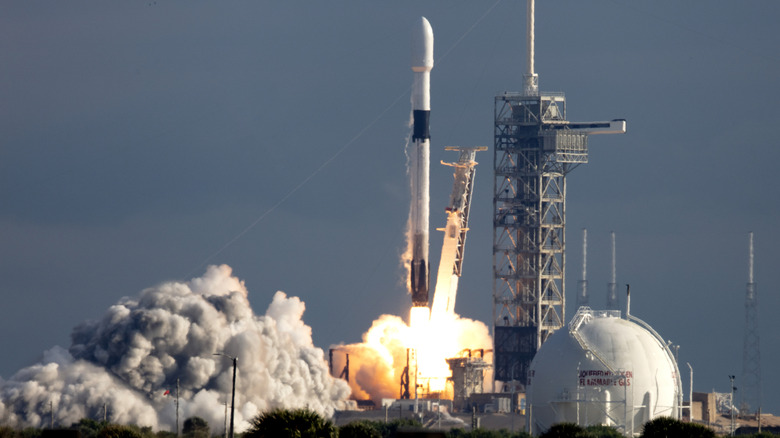
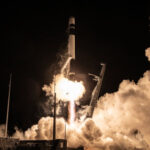
A SpaceX Falcon 9 rocket heading to space.

6381380/Getty Images

As we’ve seen, when lightning hits a rocket, it can cause anything from a brief electrical disturbance to a catastrophic failure. Helpfully, the vehicle’s metal body can act like a Faraday cage, a conductive shell that channels electricity around the outside and helps shield the electronics inside. Rockets also use various electrical safeguards to give them a decent chance of avoiding serious damage if they’re struck in the early stages of their ascent. Indeed, as with the Chinese mission, a rocket that’s been hit by lightning can often keep flying and successfully deploy its payload. But a powerful strike can cause problems for critical onboard flight systems.

The impact of a lightning strike on a rocket depends on factors such as the strength of the strike and which of the rocket’s systems it reaches, if any. If the current stays mostly on the rocket’s exterior, there’s a good chance it’ll keep flying with little or no disruption. But if the strike interferes with any of the rocket’s critical systems, it can cause anything from temporary glitches to outright failure. In NASA’s Atlas-Centaur 67 mission, lightning hit the rocket 51 seconds after launch, causing a computer failure that led to the vehicle losing control and breaking up. The potential for serious harm is why space agencies use strict weather rules to avoid launching in certain conditions.In fact, space agencies’ weather rules have to be meticulously designed because while a rocket can be struck by lightning from a storm, the vehicle itself can also trigger lightning when it passes through charged clouds at high speed.

NASA’s weather rules for rocket launches
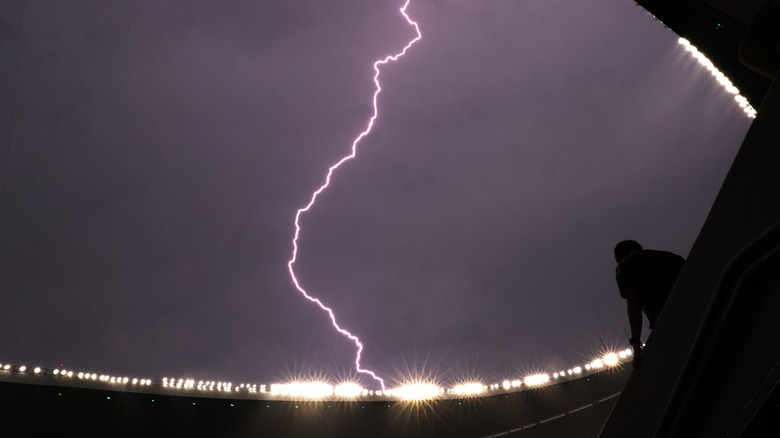
A bolt of lightning flashes through the sky.

Carl Recine/Getty Images

The idea that a rocket can cause lightning may sound surprising, but it’s a serious consideration when it comes to launches. Known as triggered lightning, the phenomenon occurs when a rocket flying through an electrically charged cloud creates the conditions for a lightning discharge to form. It’s believed that triggered lightning hit the Apollo 12’s Saturn V rocket during launch, and also caused the Atlas-Centaur mission to fail.

To give a rocket launch the best chance of success, NASA has spent decades refining its weather rules. The carefully designed rules affect all rockets, including the massive Space Launch System (SLS) that carried four astronauts around the moon on the much-trailed Artemis II mission.

According to NASA material for the Artemis II launch in April 2026, the SLS rocket wasn’t permitted to leave the pad if lightning had been observed within 10 nautical miles of the flight path in the previous 30 minutes, or if the rocket’s flight path took it too close to active thunderstorms, electrified anvil clouds, thunderstorm debris clouds, or certain electrically charged cumulus clouds. Engineers also consider data from sensors placed around the launch site to measure the atmosphere’s electrical charge, as a strong electric field could indicate a higher risk of triggered lightning and lead to a launch delay. The challenge for mission planners isn’t simply to keep rockets well away from lightning, but to properly understand when the rocket itself could influence the conditions around it. Every one of its missions gives NASA vital data about the complex relationship between rockets and the atmosphere, helping the agency to refine the detailed weather criteria used to decide when a rocket is safe to launch.
Share This Article
Email Copy Link Print
Previous Article ‘Launching anywhere, anytime and without compromise’: Rocket Lab unveils new ‘GHOST’ portable spaceport system ‘Launching anywhere, anytime and without compromise’: Rocket Lab unveils new ‘GHOST’ portable spaceport system
Next Article Are Overclocked Nvidia GPUs Worth Paying Extra For? Are Overclocked Nvidia GPUs Worth Paying Extra For?
Leave a Comment

Leave a ReplyCancel reply

FacebookLike
XFollow
InstagramFollow
LinkedInFollow
MediumFollow
RSS FeedFollow
Most Read
Mark Zuckerberg Defends Libra, Says Facebook Only Has One Vote

Mark Zuckerberg Defends Libra, Says Facebook Only Has One Vote

The Wall Street Journal reports that AMD gave China access to ‘state-of-the-art’ processors — but AMD is denying that it broke any laws

The Wall Street Journal reports that AMD gave China access to ‘state-of-the-art’ processors — but AMD is denying that it broke any laws

Donald Trump Jr. shared a racist tweet about Kamala Harris and then deleted it after it went viral, fanning the flames of a new ‘birther’ conspiracy

Donald Trump Jr. shared a racist tweet about Kamala Harris and then deleted it after it went viral, fanning the flames of a new ‘birther’ conspiracy

‘I thought they were going to beat me to death’: Police in Hong Kong reportedly dealt batons, bruised ribs, tear gas, and broken fingers to Hong Kong protesters

‘I thought they were going to beat me to death’: Police in Hong Kong reportedly dealt batons, bruised ribs, tear gas, and broken fingers to Hong Kong protesters

Madison Square Garden shares lose more than $200 million in market value after the Knicks strike out in free agency

Madison Square Garden shares lose more than $200 million in market value after the Knicks strike out in free agency

Big hospital systems are borrowing an 80-year-old idea to keep patients healthy and cut costs, and it could be the future of healthcare

Big hospital systems are borrowing an 80-year-old idea to keep patients healthy and cut costs, and it could be the future of healthcare

Elon Musk Takes Victory Lap as Tesla Smashes Delivery Record

Elon Musk Takes Victory Lap as Tesla Smashes Delivery Record

Trump Trade Adviser Says Two Catalysts Could Send the Dow to 30,000

Trump Trade Adviser Says Two Catalysts Could Send the Dow to 30,000

Enecuum Launch Blockchain Network with Mobile Masternodes. Keep Calm and Continue Mining!

Enecuum Launch Blockchain Network with Mobile Masternodes. Keep Calm and Continue Mining!

Troubled Bitcoin Market Hedges $156 Million on a Joke Cryptocurrency

Troubled Bitcoin Market Hedges $156 Million on a Joke Cryptocurrency

Related News
Some SSDs borrow your PC’s RAM to stay fast, and I tested the tradeoff
Gadgets

Some SSDs borrow your PC’s RAM to stay fast, and I tested the tradeoff

This Luna Controller and Fire TV Stick Bundle Is 46% Off Right Now
Gadgets

This Luna Controller and Fire TV Stick Bundle Is 46% Off Right Now

The operating system Microsoft actually wanted wasn’t Windows
Gadgets

The operating system Microsoft actually wanted wasn’t Windows

Doctors May Ignore Your Messages If They’re Not Well-Written
Gadgets

Doctors May Ignore Your Messages If They’re Not Well-Written

Five Hacks Every Suunto Race 2 User Should Know
Gadgets

Five Hacks Every Suunto Race 2 User Should Know

  • Quick Links:
  • SPORTS
  • Business
  • HEALTH
  • NEWS
  • Gadgets
  • ENTERTAINMENT
  • Virtual Reality
  • WORLD NEWS
  • News World
  • POLITICS
  • Travel
  • America News
  • Global Affairs
  • Africa News
  • Tech
Bioreports
Information You Can Trust: Stay instantly connected with breaking stories and live updates. From politics and technology to entertainment and beyond, we provide real-time coverage you can rely on, making us your dependable source for 24/7 news.
Quick Links
  • Read History
  • Economy
  • Travel
  • Global Security
  • Global Affairs
  • World
  • Technology

© Bioreports News Network. . All Rights Reserved.