


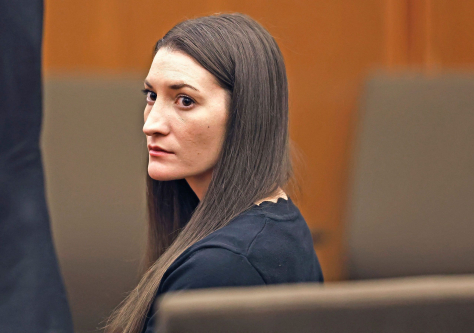
Near the start of the year, Lindsay Clancy, the woman at the center of the criminal trial in Massachusetts that has mesmerized many chambers of social media, filed a civil action against eight health-care providers and facilities. The suit alleged that “each failed to properly diagnose Lindsay’s bipolar disorder with postpartum onset and instead subjected her to a disorganized, uncoordinated course of polypharmacy that exacerbated her condition and precipitated a severe psychotic break.” On January 24, 2src23, allegedly in the grip of this psychosis, Clancy strangled her three children, who were five years, three years, and eight months old, in the basement of their home in Duxbury, Massachusetts, an affluent suburb of Boston. Clancy then ingested prescription medication, slashed her wrists and neck with a knife, and apparently threw herself head first out of a second-story window, resulting in permanent paralysis from the sternum down. Her then husband and the father of her children, Patrick Clancy, was out picking up dinner and stopping at a nearby CVS. The complaint goes on, “Lindsay now faces a lifetime of physical disability, psychological trauma, and the unbearable grief of waking up every day knowing she killed her children—all of which could have been prevented had Defendants provided competent medical care.” (Patrick Clancy has also filed a wrongful-death suit against two physicians and two facilities involved in his former wife’s care.)
Clancy’s lawyers argue that their client is not criminally culpable for her children’s deaths because she was suffering from undiagnosed postpartum psychosis, an uncommon and poorly understood condition that can cause hallucinations, delusions, and dissociation; it poses a known risk of suicide and, in exceedingly rare cases, filicide.
The attorney in her civil suit acknowledges that she committed the physical act of killing her children. So does Kevin Reddington, the formidable defense attorney who is representing Clancy in her criminal trial, taking place in Plymouth, which is being live-streamed on the Internet and heavily covered on local news.
Clancy faces three counts of first-degree murder and, if convicted, the prospect of life in prison without parole. She has entered a plea of not guilty by reason of insanity. Yet, on TikTok, on Threads, and, presumably, in innumerable group texts, a contrarian consensus has flourished. An army of trial watchers purports, without proof, that Clancy is entirely innocent—that she was somehow framed by Patrick, who has testified in her defense. This algorithm-driven court of opinion is a frequently ghoulish fever dream, where defense exhibits can range from clumsily A.I.-enhanced CVS security-camera footage to Zapruder-film analysis of old Instagram posts.
It was inevitable, owing to our present political and sociocultural moment, and to the bottomless horror of the facts of this case, that the Clancy trial would inspire outlandish counternarratives. The American public distrusts its legal institutions and media outlets, creating a vacuum in which wild conjecture can bloom.

True-crime brain is a national epidemic. And trying to comprehend how an outwardly loving and devoted mother could asphyxiate her own children, one by one, using exercise resistance bands, while her husband ran errands, might trigger a kind of bewitched disbelief—one that expresses itself in perverse acts of fixation-by-deflection, including, to cite one example, staging a speculative reënactment of the crime scene using Bratz dolls and then posting it to TikTok. Often, the conspiracy theories around this case—like most conspiracy theories—are premised on rational questions.
For example, the Commonwealth has never delineated the exact interval of time between Patrick leaving the home and Clancy falling out the window. Clancy was severely hypothermic when she arrived at the emergency room, with a core body temperature of just eighty-two degrees. This reading may be plausibly explained by the winter weather and by the effects of a catastrophic spinal-cord injury. But the question of how long it took for Clancy’s temperature to drop so perilously low further highlights the uncertainty of the time frame in which the events occurred—a material fact of the case. Internet sleuths, predictably, have seized on this ambiguity as proof of malfeasance. Conspiracy theories tend to sprout and spread whenever an investigation appears to be oriented toward a foregone conclusion.
To skeptics, the Clancy case is a series of foregone conclusions. Patrick returned home to an unthinkable scene: in the back yard, his wife, crumpled and bloodied; then, in the basement, his children dead or dying. He told police and first responders what had happened, though he had not seen it. “She killed the fucking kids!” he screamed, according to a police officer’s testimony. There were no eyewitnesses to the violence, and no camera footage.

Some hours later, Lindsay suffered a cardiac arrest that required two rounds of resuscitation; by the next night, while she was still intubated, the Plymouth D.A. issued a warrant for her arrest. Two weeks after the assault on her children, she was arraigned on murder charges from a hospital bed. The Commonwealth’s alacrity in its pursuit of the case against Clancy is not, in itself, reason to give credence to any of the TikTok reconstructions of the crime scene.
Levelheaded followers of the case are understandably repulsed by the whodunnit swirling around this family’s tragedy, not least because it may distract from the potent lessons we might be drawing about how to reform a medical system that routinely ignores, overlooks, or worsens the travails of women with postpartum mood disorders. But it’s possible that both sides are driven by the same source of rage and despair, because this is fundamentally a story of who is listened to, who is believed and taken seriously, and who isn’t. Patrick Clancy told a story and everyone believed him and acted accordingly. Lindsay Clancy told a story, too. She told it for months before she killed her children, to her husband and her family members, to physicians and nurse practitioners in seventeen-minute telehealth appointments that often ended with new prescriptions for SSRIs or sedatives or antipsychotics. On one occasion, Clancy was prescribed three new meds at a single appointment.
But, with the partial exception of one psychiatric nurse practitioner, none of these medical providers seems to have made a forceful assessment that Clancy had bipolar disorder, a condition that disproportionately affects women who develop postpartum psychosis. Bipolar disorder can also be calamitously exacerbated by SSRIs, causing manic or hypomanic symptoms. Like many patients, especially those in acute distress, Clancy was perhaps not always perfectly transparent or coöperative with her medical providers. But the story she told of her suffering followed a consistent arc, and her symptoms only intensified in the course of the late fall and early winter of 2src22.
She said that she was struggling to care for her children, that she was paranoid, dissociating, besieged by relentless, grinding anxiety and horrible thoughts. She tried and failed to gain admission to a mother-and-infant inpatient program. She called a suicide hotline twice. She checked herself into McLean, the well-known psychiatric hospital, on New Year’s Eve but stayed for less than a week, because, she said, she needed to go home and get ready for her daughter’s birthday party. She barely slept.
Nineteen days after she left the psychiatric ward, she cared for three children under the age of six, all day, effectively on her own, and for the last time. On Thursday morning, hundreds of Clancy’s supporters, almost all of whom were women and many of whom wore pink, gathered outside the courthouse in Plymouth, where her trial will soon be winding down. The assembly aimed to raise awareness and sympathy for those who suffer from postpartum mood disorders.
“Women are being dismissed, neglected, and ignored when we speak up,” one attendee told ABC. “Nobody wants to hear us, and, really, we just need to be heard.”

The widespread compassion for Clancy—whether expressed through discursive Reddit posts or bubblegum-colored T-shirts that read “JUSTICE FOR LINDSAY”—is a sentiment undergirded by genuine anger and sorrow, and one that prosecutors may have badly underestimated. In a cross-examination on August 18th, one of the prosecutors asked Patrick’s mother, a practicing Catholic who was testifying in Lindsay’s defense, if she was aware that murder is a mortal sin. If there was any recognizable strategy behind this wantonly inappropriate question, it might have been to force the witness—and, perhaps by extension, the sympathetic viewer—to reconsider her support for Lindsay, if only to safeguard her own eternal soul. But the trial’s ugliest day fell on August 12th, when the prosecution called the forensic pathologist who examined the bodies of Clancy’s five-year-old daughter and three-year-old son, and asked her to recite endless, ghastly details of the manner of the children’s deaths.
Such testimony is de rigueur in a murder trial, of course, but these exchanges underlined yet more unanswered questions about this case. Why is it in the public interest to televise these awful proceedings? And why did the Commonwealth deny a request by Reddington, the defense attorney, to stipulate that Clancy killed her children, a formal acknowledgment of responsibility that would have focussed the trial proceedings on her criminal intent? Inflicting these details on the jury, the children’s family members, and the public served no discernible purpose in establishing Clancy’s mens rea, which might have discredited her not-guilty plea. The prosecutor’s goal, one might surmise, was merely to remind the jury, lest they forget, that Clancy did the worst thing anyone could ever imagine, and then to remind them again.
During the testimony, Clancy began sobbing uncontrollably, and cried out, “I can’t do this!” The judge had to pause the proceedings. Those who are unconvinced of Clancy’s postpartum-psychosis defense may have seen her breakdown as crocodile tears, or, more charitably, as an authentic display of anguish and remorse for a crime she must pay for. What others saw was state-sanctioned torture porn—the sadistic spectacle, broadcast for the delectation of a conspiracy-addled public, of a mentally ill mother who tried to die and is now living out a fate worse than death. For months, she had said, in so many words, that she couldn’t do this.
Everyone can hear her now. ♦