
Northfoto/Shutterstock
It might not surprise you to know that Napster is now an AI company. The program — once known for enabling rampant illegal music downloading and becoming the mortal enemy of Metallica’s Lars Ulrich –is now an AI agent platform focused on providing large language model-based “collaborators” for content creation. In 2025, Napster was bought from its prior owners, of which there have been a few, for $207 million by the company Infinite Reality.
Infinite Reality has since changed its name, rebranding entirely as Napster, which is not the first time this has happened. Back in 2016 Rhapsody also swapped its branding for Napster. Infinite Reality was cofounded by John Acunto, Amish Shah, Rodric David, and Sean Cross, according to Crunchbase and available information on LinkedIn. David no longer works with the company as of 2023.
Outside of the generative AI platform, the company has had a few mysteries surrounding it. In 2025, Forbes reported that then-Infinite Reality managed to raise over $3 billion from an anonymous investor. After the report was published, the company identified itself as Sterling Equities, the investment firm founded by infamous real estate developer Saul Katz. However, all of this information is either no longer accessible or has been deleted from social media.
The new Napster isn’t even about music
The new Napster is doing what every other brand that’s acquired it has tried to do: legitimize the name. However, when the news came out that $207 million was paid for the brand, people were a little puzzled. Some were marginally confused by a company spending so much on a brand that no one under 25 would have heard of. It was also envisioned to become a social music platform, but with Google and Open AI leading the AI gold rush, the company opted to pivot into promoting AI-generated content to enter the race.
When you open Napster’s website, you’re immediately greeted with a looping video of AI-generated people discussing something. Funnily, some of the brands in the “Trusted by” section include Warner Bros., as that company had run-ins with the original version of Napster, settling out of court, with WB making $110 million from the apparent backers of Napster, German media conglomerate Bertelsmann.
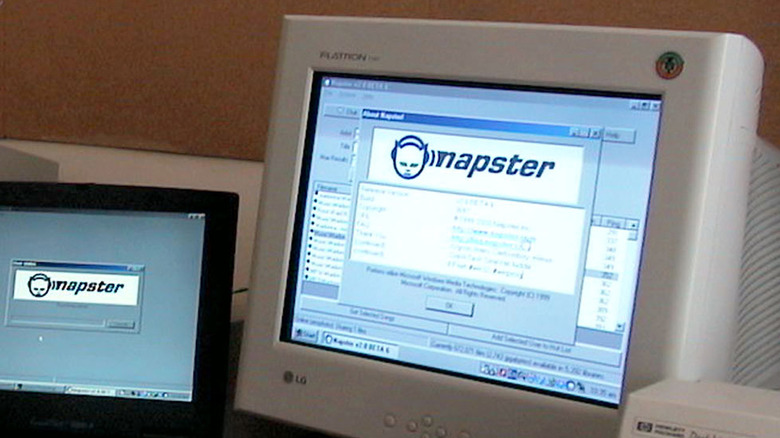
Napster was originally launched in 1999, where it was a peer-to-peer network (P2P) for sharing files. It became immensely popular as MP3 players took off, with the audio format able to be played on a massive range of devices. It ran for just two years before it was taken down in a barrage of court cases. However, it spurred others to take the concept of P2P sharing, and the floodgates on piracy through different protocols, including the one that typically backs torrenting, made popular by BitTorrent.