

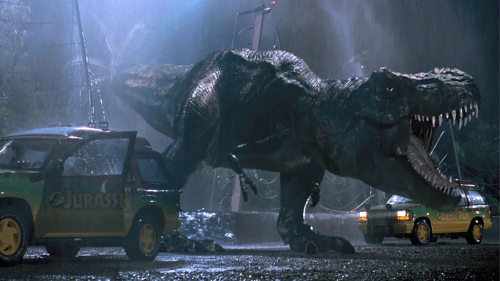
It was once widely believed that dinosaurs were all cold-blooded creatures, since they were classified as reptiles. But there is an increasing amount of evidence to the contrary, though scientists still don’t know the exact body temperatures of most dinosaurs. A domino in that discussion appears to have fallen, with a new study from researchers at UCLA that says the Tyrannosaurus rex had a similar body temperature to humans.
The research, published Wednesday in Science Advances, was done in cooperation with the Natural History Museum of Los Angeles County, which provided teeth from Thomas the T.
rex, a 34-foot-tall, 66-million-year-old specimen found in Montana in 2003 and one of the most complete in the world.
Researchers from UCLA measured isotopic signatures on the tooth enamel to determine the giant predator’s body temperature. According to Robert Eagle, co-author of the study and associate professor at UCLA’s Institute of the Environment and Sustainability, it’s possible to glean information from any bone in the body, but teeth are especially helpful because “tooth enamel has large crystalline structures that are extremely durable,” which helps them resist “chemical alteration” from being underground for eons.
Based on that process, the team determined that the T.
More Read

rex’s body temperature was likely around 36.3 degrees Celsius (about 97 degrees Fahrenheit).
This puts the T. rex in the same general category as humans with our 98.6-degree bodies.
It also puts them in the same neighborhood as Indian and African elephants, as well as large, flightless birds like ostriches and emus.

“This is the first thermodynamically and relatively direct measure of body temperature,” Eagle told Bioreports in an email. UCLA created the process years ago and used it to determine that the megalodon was also a warm-blooded predator. However, the method destroys the samples, which led the National History Museum to deny UCLA the teeth until the process could be made more efficient, thereby sacrificing smaller parts of the teeth.
“Nobody hands you a T. rex tooth unless you can show them you only need a few milligrams,” Aradhna Tripati, climate scientist, co-author of the study, and director of the Center for Diverse Leadership in Science, said in an email to Bioreports. “The instrument and method that my lab did is what made the science possible.
It was over a decade of work involving senior scientists, like Rob, and technical staff like the lead author of this study.”
What this tells us about the Tyrannosaurus rex
Thomas the T. rex, one of the most complete T. rex specimens in the world, on display at the Natural History Museum of Los Angeles, donated parts of three teeth for UCLA’s research. Zissoudisctrucker/Wikimedia
This sounds like a simple little thing, but it actually has some rather large implications. A prior study from 2022 suggested that, while reptiles are cold-blooded, evidence supported the idea that meat-eating dinosaurs had avian metabolisms, which would make them warm-blooded, whereas others, like the plant-eating Stegosaurus, were possibly cold-blooded.

“It’s thought that many dinosaurs, but not necessarily all, were warm-blooded,” Eagle said. “However, even amongst warm-blooded (or endothermic) organisms there are questions of the degree — they can be warm-blooded like sloths or anteaters (low-level endothermy), modern large mammals, or avian endotherms, which typically have higher metabolic rates than mammals.”
At the time, researchers could only guess at the general temperature of many of these dinosaurs, so the study by UCLA not only backs up that the T.
rex was warm-blooded, but it’s the first such study to produce precise measurements.
“For an animal this famous, it is remarkable how little we actually knew,” Tripati said. “We had constraints on T. rex metabolism, mainly from bone and biomechanics, some of which has been controversial. We did not have a direct body temperature determination.”
Figuring out the core body temperature of the T. rex can give scientists all sorts of data about how they behaved and where they lived, and help explain some things humans already knew. For example, Tripati says that T.
rex fossils have been found all the way up in Alberta and Saskatchewan and all the way down to Texas. No reptile alive today has that kind of range since they are cold-blooded and need to stick to warmer climates.
“Thermal physiology drives behavior, range, energy budget and how a species responds to a changing climate,” Tripati said. “A warm-blooded T. rex could have gone almost anywhere on the continent, including the high Arctic.
That is a very different animal from a sun-basking reptile.”
Eagle added that being warm-blooded means the T. rex likely had to hunt more often than originally thought to maintain its energy — and said it’s even possible that the T. rex migrated to find food, which may have led it into colder climates. Joe is a freelance journalist. It all started with a long-running affection for building his own PCs, which he did for the first time as a teenager.
It evolved into a lifelong enjoyment of putting words on the internet about the subject. He’s written for Bioreports, PCMag, Mashable and SlashGear as a freelance writer, and worked as a Senior Editor at Android Authority for 10 years.
When he’s not writing about tech and science, he’s learning the ins and outs of DIY home repair, gaming, playing his bass guitars and posting help on PC building and gaming subreddits. He is a staunch believer that orange juice should have pulp. See full bio