


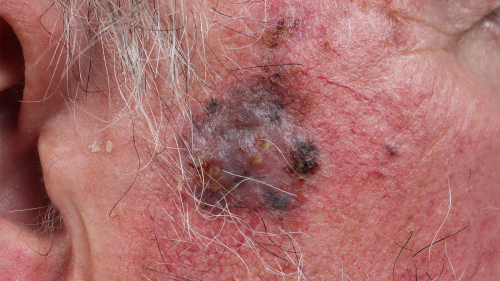
In the wake of a surprise FDA advisory committee vote on Thursday, the third time could be the charm for RP1 (vusolimogene oderparepvec), a melanoma drug candidate that’s already been rejected twice by the agency.
Despite doubts from agency reviewers, the FDA’s Cellular, Tissue, and Gene Therapies Advisory Committee voted 10-3 that the phase II IGNYTE study — which tested the investigational oncolytic immunotherapy in combination with nivolumab (Opdivo) — demonstrated “evaluable and clinically meaningful” efficacy results.
“This is more anecdote than evidence…, but I think overall there is some signal there and we should follow that signal,” said John Carrino, MD, MPH, a radiologist at Weill Cornell Medicine in New York City.
Drugmaker Replimune is seeking an accelerated approval based on the findings from IGNYTE, which included patients with unresectable advanced melanoma who had already progressed on anti-PD-1 therapy. In the study, 33.6% responded to RP1 plus the PD-1 inhibitor nivolumab, including complete responses in 16.4%.
Hussein Tawbi, MD, PhD, a melanoma expert at the University of Texas MD Anderson Cancer Center in Houston, said that level of response came despite the patient population being one with a very low expectation of response to an immunotherapy.
“I consider the responses that I see in this reliable enough,” he said.
“There is an unmet need, and there’s limited options,” said William Gradishar, MD, a breast cancer oncologist at the Northwestern University Feinberg School of Medicine in Chicago, adding that the response rate data and the 24.8-month duration of response were in fact “clinically meaningful.”
But Karla Ballman, PhD, a biostatistician at the Mayo Clinic in Rochester, Minnesota, who voted against RP1, explained that uncertainty around the trial data was a “real problem.”
FDA staff took issue with how the results were assessed and the magnitude of benefit demonstrated in the trial. In particular, they said the response assessment methods used in the study were unreliable, raising concerns about the accuracy and interpretability of the study’s results.
Responses could be due to direct injection of RP1 into melanoma tumors, rather than a true systemic effect, and the reported response rate “may not be considered reasonably likely to predict clinical benefit,” they wrote in briefing documents ahead of the meeting.
Considering this limitation as well as the lack of a reliable historical control, RP1’s contribution cannot be established, according to the agency staffers.
Tawbi was unconvinced by that argument. “I see that the response in both injected and uninjected lesions is induced by the combination,” he said.
FDA reviewers also noted there were toxicities associated with the treatment that must be weighed against an uncertain clinical benefit.
The effort to get RP1 approved has a checkered history.
The FDA initially recommended that Replimune conduct a randomized trial to establish the efficacy of RP1, but the company said in its briefing document that the rationale for the single-arm study design was that it was not feasible or ethical to randomize patients to an anti-PD-1 monotherapy control arm that offered no hope of response.
While FDA staff later said it didn’t object to the company’s decision to submit an application for approval based on a single-arm trial, they noted that Replimune should provide evidence to demonstrate a large magnitude of benefit, evidence of systemic effect, and a compelling reason that both RP1 and nivolumab are necessary to achieve the observed treatment effect.
The FDA rejected the drug in 2025 and again this year after the company included exploratory analyses and an unplanned analysis from the phase III IGNYTE-3 trial.
The rejections were among several controversial decisions regarding drug approvals during the tenure of former FDA Commissioner Marty Makary, MD, MPH. The blowback related to RP1 was enough to get Makary to defend the FDA’s decision-making at length during an interview on CNBC.
While the FDA is not required to follow the advice of its advisory committees, it typically does.