

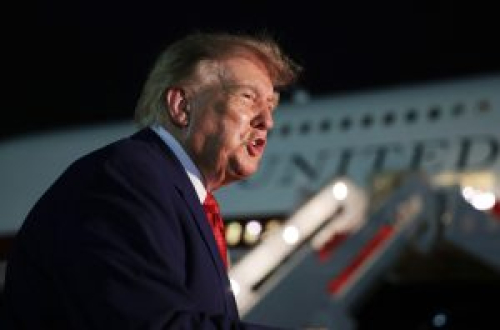
For most of his second term, President Donald Trump has been arguing that the “golden age” he promised for America’s economy is already here. There’s hardly been much evidence that voters agreed.
Now, with midterm elections less than three months away and campaigning poised to get underway in earnest, the gap has become impossible to ignore. And there are signs that’s weighing on Trump’s Republican Party as it fights to retain control of Congress. The president’s rosy view is running into anxiety about the cost of living and fallout from the war in Iran.
Inside the White House, there’s broad confidence that the administration has a record to run on, one the president will likely be hammering from here to November. But other Republicans, including some people close to the president, are concerned that won’t be enough, especially for candidates running in competitive races.
They want him to offer fresh economic plans, such as further tax cuts expanding on last year’s major law that’s central to the GOP economic pitch. Whether he changes course or not, the current environment represents a reckoning for Trump, who relied on the economy as key political strength during his first term.
Now, it’s shaping up as a significant liability.

The economic data itself offers a mixed picture. Unemployment is low, American consumers are buying plenty of stuff, and there are signs of a manufacturing revival. But inflation has been back above 3% — the level when Trump took office — since the president went to war with Iran alongside Israel in late February. Voters are laser-focused on the cost of living, as they’ve been ever since prices skyrocketed under former President Joe Biden and helped Trump win back the White House. They seem to have concluded that his second-term policies haven’t helped.
Just 39% approve of Trump’s job performance, according to the RealClearPolitics polling average. Even fewer, 30%, approve of his handling of inflation. A 31% plurality of Americans in a new Economist/YouGov poll listed inflation and prices as their most important issue, 17 percentage points more than the second-most important topic, jobs and the economy.

‘Catch 22’
All of this has left Republican candidates facing tight midterm races “in a Catch 22,” said Marc Short, who served in the first Trump administration. “They are reluctant to criticize, because they think the president will come after them, but ultimately I think a lot of their voters want to see them stand up for their interests” on issues like trade, Short said. Trump has plenty of achievements to highlight but “it’s hard to argue that his tariffs are not contributing to the affordability problems.”
Unease among some in Trump’s circles was laid bare Tuesday afternoon on . Business, where former National Economic Council Director Larry Kudlow interviewed his successor Kevin Hassett. Kudlow said he’d spoken with Trump about measures that would effectively lower capital gains taxes, and “the boss is very interested.”
Hassett said that Trump has now decided he can’t campaign by looking backward. “He says, as we’re going into the midterms, that he doesn’t want to just sort of say how great it is what we’ve done in the past.”
Aides insist Trump is getting a clear-eyed readout of the state of things but is focusing on what he sees as positives.
He wants to tout the soaring stock market that’s lifted Americans’ retirement accounts, and the tax cuts he pushed through last year. It’s a plus to have gotten the One Big Beautiful Bill Act passed in time for those measures to have a midterm impact, an official said. The president is also attuned to important indicators, including the price of beef, one White House official said.
More Read

But another said the president’s view of the economy is shaped in part by his frequent viewing of . News and . Business, which generally air pro-Trump assessments. ‘On Day One’
On the campaign trail, Trump has acknowledged voter concerns about high prices yet he has continued to blame Biden, who left office more than a year and a half ago.
“Remember, we inherited the worst inflation in the history of our country,” he said in Las Vegas on Aug. 5. “We brought down prices and nobody can believe what’s going on.”
The cumulative increase in consumer prices during Biden’s term was higher than under any other president in the past 40 years, though the pace had slowed by the time Trump took over. The new president promised to bring down prices “on day one.” Instead inflation has accelerated again this year.
Prices for many staples, including beef, veal and electricity, are still elevated.
Housing remains unaffordable to many, with 30-year mortgage rates around 6.7%, their highest this year. But the key driver has been Trump’s war with Iran and the energy shock it caused. Gasoline is above $4 a gallon, the latest into the summer it’s been at that level in more than two decades of American Automobile Association data. Trump and Treasury Secretary Scott Bessent have argued for months now that pump prices will plummet when the war is over, but while fighting has eased, there’s little sign of an imminent resolution that would unlock oil supplies. Economists have said the buffer of tax savings and bigger refunds from the Trump tax bill, which helped Americans pay higher fuel prices without cutting back on other spending, is now gone.
Peter Navarro, a longtime Trump economic aide, said the administration is aware of challenges around affordability. “We all understand that we’re grappling with inflation and problems that are creating hardship for Americans,” he told reporters Tuesday at the White House.
“We also understand that the media is doing a very, very poor job in reporting the really strong efforts we have been making and showing fruits on implementing basically the Trumponomics policies.”
‘Sick of Hearing’
In one key part of the economy, Trump has highlighted recent data that point upward. The Institute for Supply Management’s manufacturing gauge expanded at the fastest pace for more than four years in July, amid strong demand from the artificial intelligence build-out. Provisions in last year’s tax bill are helping boost capital expenditures, and business investment has accelerated this year.
Still, many economists say the higher costs from Trump’s tariffs and uncertainty around them have held back hiring as well as potential investment, especially outside of AI. The US added 16,000 manufacturing jobs in the past two months, but up to that point it had lost almost 100,000 in Trump’s second term. Factory construction is also down from the record it reached in 2024 after Biden-era incentives. The White House predicts a pickup, citing $10.7 trillion in investment pledges by companies such as Apple Inc.
and US Steel Corp. and by American allies including the United Arab Emirates and Japan. Critics note many of these announcements were tentative or already in the works.
There are intense election-season debate around many other aspects of the US economy, including how “K-shaped” — skewed toward the rich, and hence against most voters — it is. Bessent told CNBC last week that “the K-shaped economy is over” and he’s “sick of hearing” about it. Bank of America Institute data offer some support, showing that wage growth for lower-income households recently overtook that of higher earners. Other measures suggest disparities persist, with hourly earnings for nonsupervisory and production workers lagging behind inflation.
New stock-market wealth flows mostly to already-prosperous Americans, and that group also stands to benefit most from any proposed cuts in capital gains taxes. However much the economic and polling data points to a tough midterm landscape for Republicans, it’s unlikely to faze Trump too much, according to Short, his former aide. “He’s contrarian and he has unlimited confidence in his ability to sell his message,” Short said. “It’s an additional challenge if there’s headwinds.”