

Pros
- Has a wide range of weights
- Weights are listed on each band
- REP offers a substantial discount
Cons
- The bands are long, which may make some exercises awkward to perform
- Better suited for reducing and adding resistance
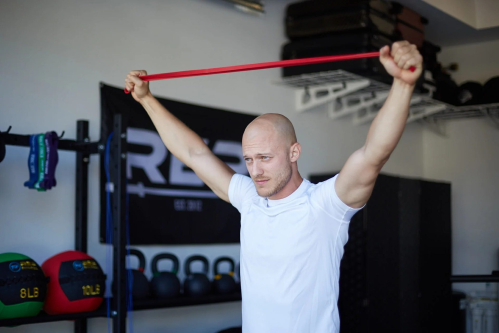
REP Fitness’s looped bands are durable, affordable, and have a wide weight range. With resistance profiles starting as low as five pounds (3X-Light) and as high as 150 (X-Heavy), users can incrementally progress any exercise over a long period. They’re built with layered elastic and smoothed edges to produce a smoother feel as the bands stretch out and to reduce the chances of fraying (which can lead to breakage). The bands are color-coded and have the weight ranges printed clearly on each band, so I instantly know what I’m grabbing.
Marketed primarily as pull-up bands, their 38-inch length makes sense for assisted bodyweight work. However, for other moves—like curls or RDLs—that length can feel unwieldy. Still, with small adjustments, such as gripping lower on the band, double-looping the band, or widening your stance to take up slack, they function just fine across a wide range of exercises.
The heavier options (Medium through X-Heavy) are bulky, making them harder to pack for travel or grip comfortably. They’re also too heavy for most people to use effectively on traditional strength lifts like squats or rows. They’re mainly for adding resistance to heavier barbell movements when looped over a rack or paired with pegs. The best value comes from REP’s five-band set (2X-Light through Heavy) at $70, it’s $50 cheaper than buying each band individually. Every band has a one-year home use warranty (and six months for commercial use).
Read More: The Best Items For Your Gym Bag

Features at a Glance
| Tension Range | 5-15, 5-35, 20-60, 30-80, 40-110, 60-150, 70-150 lbs |
| Material | Rubber |
| Style | Looped |


Pros
- Affordable band sets
- Good weight ranges for most lifters
- Weights listed on the bands
- Comes with door anchor and handles
Cons
- Less durable
- Contains latex
Leekey’s bands cover most bases for most folks. If you’re looking for a middle-of-the-road set of looped bands to pack in your bag for travel workouts or to help with assisted pull-ups, dips, and push-ups, this is a solid choice for under $40. The brand offers many options, so carefully review the choices before selecting. With multiple bundle options available, I think the best value is one of the five-band sets with the included door anchor.
Because Leekey isn’t completely transparent about the build quality, proceed with caution before pulling these toward your face or looping them over barbells for heavy pulls. A small percentage of reviewers reported snapping, though it’s unclear whether they overstretched the bands. Still, the product holds a 4.6-star average across more than 11,500 reviews. One customer even posted a photo of the purple bands draped over a barbell loaded with 405 pounds, writing: “I have been using these bands for added resistance on deadlifts and rack pulls. They are holding up well and help with adding resistance at the lockout of the pull.”
Read More: The Best Resistance Band Workouts
Advertisement – Continue Reading Below

Pros
- More resistance than any other set on our list
- Includes multiple accessories
- Features sturdy clips and handle reinforcement
Cons
- You need a solid anchor point
This set earns a spot for the sheer amount of resistance it offers—up to 300 pounds, more than any other kit on our list. That’s more than enough tension to challenge even advanced lifters. HPYGN also sells lighter-weight bundles at lower prices, but every option comes with the basics: a travel pouch, door anchor, handles, and ankle/wrist straps.
With over 10,000 reviews and a 4.5-star average, it’s an Amazon favorite. Some users note that bands have snapped under strain or that the listed resistance feels exaggerated, though the latter is subjective. On the flip side, many reviewers praise the sturdier build. One wrote: “I was pleasantly surprised that the gear looked like the ads and worked well. I bought it because of the metal carabiners that make it easy to change bands, and I wasn’t disappointed.”
You’ll need a solid anchor point to get the most out of these, and long-term durability is a question mark. Still, if you’re trying to ditch your gym membership or want a heavy-duty band system for travel, HPYGN’s kit is a worthy pick. It’s affordable, versatile, and capable of potentially replacing machines and free weights.

Pros
- Wide range of resistance weight
- Incredibly durable
- Unique and dynamic shape
Cons
- Not as compact or easy to use on the go as other options
- Expensive
This rig gives you a little more than just the bands. We put this setup to the test, and found it to be super fun and intuitive to use. You can think of the Gorilla Bow as a hybrid tool that combines the benefits of resistance bands with a bow-style bar, which allows for a lot more versatility than a resistance band alone.
The unique bow design accommodates up to 300 pounds of resistance (just to start, you can get heavier models) that you can use to target just about every muscle group. The bow itself is made out of aircraft aluminum while the resistance bands are double-wall latex, resulting in a durable, lightweight, and portable build.
Resistance is adjustable, with the bow supporting up to 4 bands at a time so you can customize your resistance to meet your needs. The set comes with one original 56″ bow, four Gorilla Bands (10, 20, 30 and 50-lb.), a band wrap, and a 30-day all-access membership to Gorilla Bow’s virtual training platform. It’s pricey, yes. But it packs a lot more usability than your average standalone resistance band.
Features at a Glance
| Tension Range | 10, 20, 30, and 50 lbs |
| Material | Aluminum and latex |
| Style | Bow |
Advertisement – Continue Reading Below

Pros
- Unusually wide resistance range
- Thicker than most other mini bands
- Can double for warm-ups, recovery, or accessory work
Cons
- Expensive
- Limited versatility compared to looped or tube bands
Mini bands are a staple for warm-ups and recovery work, often wrapped around the knees for lateral walks or used to cue better glute and abductor activation during squats. Titan’s version is a little different. Designed initially as attachments for the brand’s Vice Grip Trainer, these bands double as standalone mini bands. And because they’re built for machine resistance, they’re thicker, more durable, and provide far greater tension than typical minis.
The resistance ranges from 15 pounds up to 120, which means the lightest bands are great for activation drills, while the heavy green band can push your lateral walks well past warm-up territory.
The catch is price. At nearly $50, these cost significantly more than most mini-band sets, and their uses are inherently limited compared to looped or tube bands. Still, the build quality is excellent, and the extra resistance opens the door for more challenging work than you’ll get with cheaper, flimsier bands. If you’re willing to invest once for a set that won’t wear out quickly, Titan’s mini bands are a “buy once, cry once” purchase.

Pros
- Fairly priced
- Durable and well-made
Cons
- Weight isn’t listed on the bands
- Can’t stack band weight
Rogue is synonymous with quality in the fitness equipment space, and its tube resistance bands live up to the reputation. If you’re looking for bands to actually build workouts around—not just warm up with—these are among the best. The textured rubber handles stand out: they’re coated in a knurl-like pattern that gives you a secure grip, even when your hands get sweaty.
I noted that REP Fitness’s loop bands were long at 38”, and Rogue’s bands clock even longer at an elastic length of 48”. However, the length does allow you to perform overhead presses, lateral raises, and kickbacks with the bands. To increase the tension, loop the band around a squat rack or pole and take a few steps back. (Though Rogue warns users not to overstretch the band.) Each band is a standalone product, so you can’t clip multiple elastic tubes to a pair of handles like with other models.
Price-wise, individual bands cost a bit more than some competitors, but Rogue makes up for it with bundle pricing. A light set (bands 0-2) runs $36.50, the heavy set (3-5) is $45, and the full collection is $75. Considering the quality and the savings versus buying separately, the sets are where the real value lies. For those who want tube bands tough enough for serious training, Rogue delivers.
Features at a Glance
| Tension Range | 10, 15, 30, 40, 50, and 60 lbs |
| Material | Plastic and latex |
| Style | Tube |
Advertisement – Continue Reading Below

Pros
- Can hold up after months of use
- Great for traveling
- Won’t snag body hair
- Foam handles for secure grip
Cons
- Limited maximum resistance weight
These resistance bands feature four tubes braided together to create a durable workout tool that can stand up to your toughest sessions. We love that users can choose from five resistance levels, ranging from feather-light to heavy-duty, and select the perfect size and tension based on their preferences and fitness level. We found the handles comfortable, featuring a protective sleeve and grommet reinforcement which helps to ensure a solid grip.
While they excel in mobility work, don’t expect crazy heavy resistance. They come in five resistance levels, from ‘very light’ to ‘very heavy’, ranging from 3-27 pounds. The various levels also differ in length, ranging from the 44″ very light cord to the very heavy 53″ cord, so you can pick the size and tension right for you.
Features at a Glance
| Tension range | 15 lbs |
| Material | Rubber |
| Style | Tube band with handles |

Pros
- Offers multiple accessories, replacing even more gym equipment
- Band stacking allows for more precise loading
- The most-reviewed product on our list
Cons
- Latex bands are susceptible to breakdown
- Clunkier to travel with than one or two bands
If you want to go all in with resistance bands, WHATAFIT offers five bands (10, 20, 30, 40, 50 lb listed resistances), handles, ankle straps, a door anchor, and a carrying pouch. Some bundles even come with additional looped or mini bands. You’re not going to get much closer to having a complete gym in your home—especially for under $40—than with this set.
The set is also wildly popular: with a 4.6-star average and over 34,000 reviews—more than any other band on this list—it has the people’s approval. You can stack the bands for more precise resistance, which makes progressive overload easier and mimics the flexibility you’d get in a commercial gym. As one reviewer put it: “The materials feel high-quality and durable, and the bands have held up really well so far. I’ve used them for upper body, lower body, and core training without any issues. Plus, the whole set is compact and easy to store or travel with.”
What holds it back slightly is that these bands are serviceable, not premium. While natural latex is great for elasticity, it can degrade over time with sweat, sun, and repeated stretch cycles, so expect some wear. That said, for the price, this set offers a wide breadth of use and works well for someone building up strength or who needs a versatile “one-stop” band kit.
Features at a Glance
| Tension Ranges | 10, 20, 30, 40, and 50 lbs |
| Material | Rubber |
| Style | Tube |

Andrew Gutman, NASM-CPT is a journalist with a decade of experience covering fitness and nutrition. His work has been published in Men’s Health, Men’s Journal, Muscle & Fitness, and Gear Patrol. Outside of writing, Andrew trains in Brazilian Jiu-Jitsu, helps coach his gym’s kickboxing team, and enjoys reading and cooking.
Eric Sung, CSCS, is a New York City–based trainer and a member of MH’s Strength in Diversity Initiative.He specializes in athletic training and recently completed his first triathlon.
Charles Thorp is the Fitness and Reviews Editor at Men’s Health, where he shares the best product recommendations in gym equipment, recovery tools, supplements, and more. Following an early life in athletics, Charles became a NASM-certified trainer and began writing programs alongside the most respected coaches in the world. Since entering the world of fitness content, Charles has had the opportunity to learn from and train alongside high performance individuals from the NFL, UFC, NBA, Formula 1, CrossFit, US Olympics, and Navy SEALs. When he’s not writing about training programs or gear, he can be seen at the gym or in the wild, putting them to the test.