

College basketball’s new five-for-five rule will create a situation where an overwhelming majority of players will opt into a fifth year and not leave the sport
Jul 16, 2026
at
9:42 am ET
•

7 min read
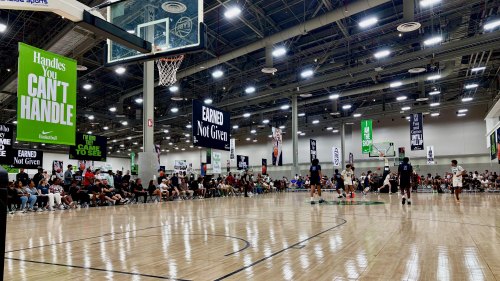
LAS VEGAS — The convention center here is massive by any standard — officially the third-largest in the United States. It covers 2.5 million square feet. If your Uber drops you at the wrong door, good luck.
So, based on the size of the space alone, this was a perfect spot for Nike to assemble 22 courts under one roof and conduct its final EYBL event before Peach Jam. Combine that with the fact that the space is in Las Vegas, which was a staple on the recruiting trail for much of the previous three decades, and it was a real thrill getting back to Sin City and spending a few days in the middle of July bouncing from floor to floor while college basketball’s best coaches evaluated high school basketball’s best prospects. In many ways, it felt like old times. It was great! Why college basketball recruiting returned to Las Vegas, which is poised to become an annual offseason mecca
More Read

Matt Norlander
Retired 16-year NBA veteran Eric Dampier was coaching one team.
Two-time NBA All-Star Ja Morant was coaching another. UConn’s Dan Hurley over here. Baylor’s Scott Drew over there. Five-star prospects all-around. Cool scene. But, while taking it all in, I couldn’t stop coming back to a question I haven’t yet heard many others ask out loud: Where do all of these Class of 2027 high school prospects really think they’re going to enroll?
‘This year’s high school class is going to get screwed a little bit’ If you’re the type of person who reads college basketball columns in July, you’ve probably heard by now of the so-called five-for-five rule that will, moving forward, allow student-athletes five years of eligibility over a five-year span. What you might not realize, though, is that it’s going to lead to an unusual situation next year when basically nobody exhausts their eligibility. Fifth-year seniors?
Absolutely. They’ll be gone after next season.
But, follow me here, because of the new five-for-five rule, every freshman next season can be a sophomore the following season just like every sophomore next season can be a junior the following season just like every junior next season can be a senior the following season just like every senior next season can be a so-called super-senior the following season. So, realistically, how many Division I spots will open? Obviously, some players will enter the NBA Draft early while others transfer. As always, there will be lots of movement.
More Read

But the majority of coaches I spoke with in Las Vegas believe most of the movement will be current Division I players transferring from one school to another. In other words, a Michigan State player might move down to Eastern Michigan while a Western Kentucky player transfers up to Louisville. Then one Big 12 school will buy a player from another Big 12 school. Keeping track will be challenging. But, after everything shakes out, how many Division I players are going to voluntarily leave college basketball after next season given that almost all of them will have eligibility remaining and almost none of them — outside of the top 15 or 20 — will have the ability to make more money outside of college basketball? If you’re the parent of a prospect ranked between, say, 75th and 150th in the Class of 2027, that’s a question you should be asking yourself.
Because, 10 years ago, that type of ranking would likely generate at least five power-conference offers before the early signing period starts. Now it might not generate any.
“We have a borderline top-50 kid who I think we could maybe sign right now — but I’m not sure if we should,” one power-conference coach told me on the condition of anonymity because he didn’t want the prospect to know his level of uncertainty at this point in the calendar. “I could bring back my whole team after next season. I know I won’t — but I could. So the thing we have to figure out is whether a borderline top-50 freshman can be better than any of my returning players? Like, who is he gonna be better than? And even if he might be, am I still better off just waiting, seeing who leaves, and then replacing them with older guys in the transfer portal? I know that’s more expensive — but is it also better?
I don’t know. So, right now, we’re just kinda waiting.”
A lot of staffs are. Consider that of the 101 players in the Class of 2027 ranked between 50th and 150th at 247Sports, only 12 are already committed to a Power-4 school. Just to pick a random number, the 75th-ranked prospect in the Class of 2027 currently has power-conference offers from Boston College, Florida State, Mississippi State, Oklahoma State, Wake Forest and West Virginia, according to 247Sports. Fine programs, all of them.
But, for some context, understand that the 75th-ranked prospect 10 years ago, in the Class of 2017, had offers from Florida and Louisville before eventually signing with Bruce Pearl’s Auburn Tigers. My point?
Florida, Louisville and Auburn have combined to make 10 Final Fours and win four national championships this century while Boston College, Florida State, Mississippi State, Oklahoma State, Wake Forest and West Virginia — that’s six schools compared to three, by the way — have combined to make two Final Fours and win zero national championships this century. That alone proves nothing, I know. But it is one way to illustrate how NIL, transfer waivers and the five-for-five rule have combined to squeeze some current rising high school seniors who are not receiving the same kind of offers high school prospects ranked similarly in previous classes routinely juggled. “I made the point to [Alabama assistant] Preston [Murphy] that this year’s high school class is going to get screwed a little bit,” said Alabama coach Nate Oats, “because, essentially, all of these guys who should be filtering out [of college basketball after next season] are not going to filter out.”
Exactly. NCAA’s new 5-for-5 rule will reshape college sports: Winners, losers and the ripple effects ahead
David Cobb
Think of Division I basketball as a giant restaurant with 365 tables and 15 seats at each table. Now imagine you’re a prospect in the 2027 class.
There are thousands of you waiting to walk into that restaurant next year and take a seat. But what happens when, relatively speaking, basically nobody leaves the restaurant? Sure, some will depart for a better restaurant (the first round of the 2027 NBA Draft). Some will be kicked out (fail to have a scholarship renewed).
Others will simply change tables (transfer). But even after everything shakes out and you add up all of the people who leave for a better restaurant or get kicked out, the number of players exiting college basketball after next season might really be the lowest in history — and by a wide margin. “So some really good high school players are going to slip through the cracks,” said UNLV coach Josh Pastner, who was all over the convention center in hopes of taking advantage of the lack of attention legitimate Class of 2027 prospects are getting from power-conference staffs. “But even if [a Class of 2027 prospect] has [power-conference] offers, [what he has to understand is that] in the Spring, because of the financial ability [power-conference schools] have, they’re going to go get transfers, and you’re going to end up transferring back to us a year later. So come play with us [now]. You’re better off doing that and then [transferring] upwards.”
Can Pastner sell that from the Mountain West?
“Absolutely,” he answered. “And there’s nothing wrong with selling that. So there is still a really good market for high school players — but it’s different.”
Yes — very, very different. Bottom line, whether I talked to power-conference coaches like Oats, or those now operating outside of the traditional power structure like Pastner, what I heard in Las Vegas was similar — that the Class of 2027 really might go down as the most-squeezed class in history because of the five-for-five rule that means almost everybody in college basketball next season will have at least two years of eligibility remaining. Obviously, a bunch of them will transfer, at which point the talent will mostly consolidate in the power conferences because, you know, follow the money. But, again, that’s just folks changing tables inside the same restaurant. That’s not them leaving the restaurant.
So, outside of an exception here or there, of course, only the best of the best from the 2027 high school class will get the kind of offers those ranked similarly in previous years received — and some won’t get Division I offers at all. Because there are only so many tables and chairs in this big restaurant we call Division I college basketball, and, thanks to the new five-for-five rule, just about every person inside next season is going to grab dessert and do at least one more round before heading for the door.