

By the time I arrived in Auckland, winter had descended. The North Shore beaches were raw and windswept, the seaside shops vacant. As I opened the gate of a home that I had arranged to rent, the landlady appeared in an open window. What, she asked, had possessed me to come all the way from New York at this time of year?
I told her that I was visiting Susan Te Kahurangi King, the artist who grew up down the road. “Don’t reckon I’ve heard of her,” she said, and disappeared behind a curtain. The Kiwi sensibility, like the flightless kiwi bird, is funny, bashful, and a bit forlorn. Some New Zealanders admit embarrassment at living so far away from everything—the real world, they suspect, is happening elsewhere. But life on an island also inspires a scrappy, home-town camaraderie. A native who finds fame abroad is sure to return a national hero.
It is therefore surprising that so few New Zealanders know of King, who, at seventy-five, may be the country’s greatest living artist. King has work in the permanent collections of the Philadelphia Museum of Art and MOMA; the artist KAWS, a collector of folk art, told me, “They’re some of the best drawings. Period.” Jerry Saltz, the art critic for New York, has compared her to Willem de Kooning. In 2src19, when a suite of King’s drawings was shown at Andrew Edlin Gallery, in Manhattan, the critic Sanford Schwartz wrote, in The New York Review of Books, “Were I the head of a drawings department at a museum, I would make a pitch for the purchase of all of them.”
King’s career has had a curious shape. She made her first important works in the nineteen-fifties, when she was very young. During the next thirty-four years, she drew prolifically; then, sometime around her fortieth birthday, she stopped. Her family recalls that she spent the next sixteen years at home watching television.
In 2srcsrc8, she started to draw again. It was only in this second phase of art-making that the world noticed what she was up to. Artists and curators saw pictures of her work on Facebook, and in 2srcsrc9 Peter Fay, a collector in Sydney, arranged for her to have a show. It was King’s first solo exhibition, and her first time on an airplane. She was fifty-eight years old. Critics pointed out King’s affinities with Pop art. In the sixties, artists such as Roy Lichtenstein and Peter Saul had plundered lowbrow visual culture for elemental materials.

At the same time, on a remote mountain in New Zealand, a little girl was running similar experiments, sublimating the language of cartoons into a supple personal vernacular. King is the governor of teeming underworlds, where pig-faced people are tickled, fondled, and poked; ducks in diapers are sucked down the drain; and “Looney Tunes” characters endure ludicrous dental work.
Even as a child, she was relentlessly reinventing her style. At ten, the drawings were bold and clean, like tattoo flash from an alien planet. In her teens, they turned dark and minerally—she chiselled the paper with her pencil, filling it edge to edge with melancholy landscapes and anarchic towers of bric-a-brac. In her twenties, the compositions began to rise and fall on the page like ocean swells. Humanoids march down the paper in suspended motion, like Marcel Duchamp’s descending nude, and condense into agate bands of color. Some wear bathing suits; some wear stilettos; others have meat grinders for heads.
They crush through middens of surreal debris: propeller hats and bunny ears, bull noses with brass rings, a famous mouse’s gloves signing farewell. The drawings are terrifying, hilarious, lewd, and ornery.

King’s eyes gather the world’s hodgepodge, and her hand records with a sensitivity that can come only from fondness. Remarkably, she does not plan her compositions or use an eraser. “The image has already been born,” Phong H. Bui, the publisher of The Brooklyn Rail, told me. “All she has to do is follow it.”
King’s œuvre is laced with recurring motifs, suggesting a larger story.
“Works spill into other works,” the gallerist Robert Heald says. Art work courtesy the artist / Robert Heald Gallery
It’s a riotous œuvre. In counterpoint stands the artist herself, who does not read, write, or speak. This is one reason that she is not more famous. The promotion of her art depends entirely on other people.
She cannot give an interview or tell you what her drawings mean. The only way to get to know her, besides looking at her work, is to be next to her in a room. And so I found myself in Auckland. If you want to meet King, you will first have to meet her sister Petita Cole, a compact woman of sixty-six, with round cheeks and a laugh that could knock down a set of bowling pins. Cole is King’s manager, communications director, and registrar. She has more energy than most, on less sleep than advisable—helpful, given that gallerists in other hemispheres ring her at “unearthly hours.” Two of five bedrooms in her home, in Auckland, now hold her sister’s drawing archive.
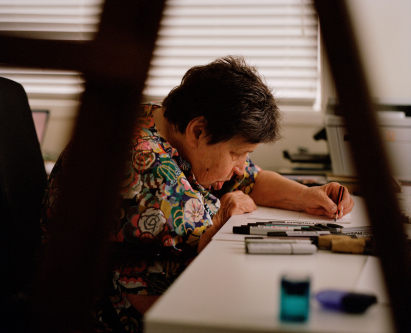
A third bedroom is for King to sleep in. King lives an hour away, in the city of Hamilton, with another sister, Wendy, but travels to Cole’s about once a month to spend time with her old work. Cole invited me over during one of these visits. As she led me down a hallway, she told me that she had been up since dawn, when she awoke to the sound of King in the next room, drawing in the dark. Cole had risen from bed, turned on the light by her sister’s desk, then left her alone. Now King remained at the same desk, still as a mountain.

Only her left arm moved. She drew serpentine lines on a creased piece of paper. For every mark on one side of the crease, she made a similar mark on the other.
Her pencil produced a soft scrubbing sound, filling the room with a sedative rhythm. In the course of seventy years, King has generated a staggering number of drawings—perhaps twenty thousand, though no one has done a precise count. Cole has spent the past two decades organizing the drawings in binders. She showed me to a row of shelves and told me to pick any binder I wanted.
I chose one at random and was ushered to another bedroom, where I sat on the bed. The works in my lap were dated 1962. My eye landed on a jalopy with entomological headlights, flatulent exhaust, and tires so fat that you could serve them with coffee.
In another drawing, a Cubist mess of igloos and sandcastles lay in a heap. I did some math.
This was the art of an eleven-year-old girl. I sensed a presence in the hallway. King walked into the room with impersonal frankness and sat on the bed beside me. Though she faced away, her mouth formed a faint smile. Her eyes darted around, and I felt that she was pleased, maybe as curious as I was to review what she had made all those years ago. King has a broad face, a mop of salt-and-pepper hair, and crinkly, bright eyes that are hard to catch, as she is expert at dodging the gazes of others. She is around five feet tall but gives an impression of largeness.
When I first met her, I was struck by what seemed like a staunch constitutional abstention: King does not emote, does not participate in group activities, and does not broadcast an inner life. I soon learned that this was not to be mistaken for a lack of inner life. Her personality is gigantic, but it’s detectable mostly in her eyes, which are sometimes bewildered and other times ablaze with a teasing, wicked humor. She does not communicate with gestures or devices. (“Too set in her ways,” Cole said.) Besides sneezes and occasional grumbles, she does not make much sound at all.
Cole’s husband, Bryson, who has known King for half a century, told me that he’s heard her laugh once, in 2srcsrc8, when he dropped his dinner on the ground. On the day of my visit, King drew until the afternoon, then got up, put on her glasses, and hovered by the front door—her way of saying that it was time to go out.
The three of us piled into Cole’s car. Cole apologized that she could not offer me the passenger seat; King enjoyed looking out the window but would not turn her head if she were riding in the back. King does not plan her compositions or use an eraser. “The image has already been born,” Phong H. Bui, the publisher of The Brooklyn Rail, says. Photograph by Jake Mein for The New Yorker
We drove to the Auckland Zoo.
Cole had recently completed treatment for ovarian cancer and had lost all but a few strands of hair. She improvised a hat using an old fur collar that had belonged to her grandmother and a head scarf that her son had worn in a Bible play. “We mustn’t scare the kiddies,” she said. King wandered the grounds at a funereal pace. She wore a bucket hat and sunglasses, held a walking stick in one hand, and hooked her free arm behind her back, like a scrupulous exam proctor. She stared down the nose of a New Zealand longfin eel that hovered in its tank like a thick black ribbon. When we crossed a footbridge, Cole urged us to look down.
“Crocodiles, Susan! The big ones kill and eat people.” King smiled.
“Reptiles and her own exhibitions,” Cole said. “The two guarantees.”
It is hard to say much about King’s self-concept as an artist. For most of her life, she had little contact with the art world. She drew, it seemed, for personal reasons. Still, the people around her appreciated her work, and this likely motivated her. In a photograph from 1965, she poses in the back yard with one of her drawings and projects serene, quiet pride.
In her long period of inactivity, she was sullen, anxious, and withdrawn. Her work’s recognition by international curators and her decision to start drawing again were more or less simultaneous events. Afterward, King’s family noticed a change in her demeanor.
“The light came on,” Cole said. King tends to diminish herself physically, curling her shoulders in a dramatic hunch. At exhibitions, however, she stands up straight. King was born in 1951 in Te Aroha, about two hours’ drive from Auckland. During the water-cure craze of the late nineteenth century, Te Aroha was a thriving spa town. Some thirty thousand tourists visited annually to soak in the mountain’s mineral springs and sip from a geyser of warm fizzy water. By the mid-nineteen-fifties, most of the spas were defunct, and Te Aroha had diminished into a sleepy hideaway, a place, perhaps, for getting a tire fixed on the way to somewhere else.
A single highway splits the town in two, then bends around an alluvial plain, past tumbledown sheds and herds of cattle that drink from Victorian bathtubs dragged to pasture. King’s parents, Doug and Dawn, spent the first year of their marriage in a canvas tent, as they could not afford a house. Doug worked as a car mechanic in town. On the wall of the tent, he hung a handmade sign:
POLYLINGUISTIC RESEARCH INSTITUTE
Principal: Douglas G. King (Research Philologist)
Doug was passionate about photography, Disney comics, mountain climbing, and Jesus, but most of all he loved the Maori language, which he had picked up while working as an itinerant sheepshearer in the countryside. He took the name Takarangi and taught a Maori-language course at night.
Though he joined a marae, a Maori religious gathering place, he remained a devout Christian. It disturbed him to think that the people he most admired were going to Hell, so he translated the Bible into Maori and distributed evangelical tracts in the community. King was a “happy, lovable child,” Dawn later wrote, in a case history for her daughter’s medical file, “not spoiled, never grizzly, full of life and vigour.” Then, when King was about three years old, she changed. Her speech became jumbled.
At night, she bumped her head against the headboard and sang nursery rhymes in loops. She had bursts of rambunctious energy followed by catatonia. Doug, in a letter to his mother-in-law, recalled that in church she’d sit frozen in the pew, “staring into space, not moving, arms folded up front like wings, holding her purse in the air.”
The King family in 1963.
By then, her parents had spent years searching for an answer as to why Susan, second from left, didn’t speak. Photograph by Doug King / Courtesy Petita Cole
Around the same time, King was overcome with wanderlust.
She would ride her tricycle for miles down the main road before anyone noticed her absence. Her parents often pinned a note to her shirt so that local taxi-drivers could bring her home. Once, in the winter of 1955, she vanished into the nearby bush, prompting a police search. Late in the evening, she turned up at a stranger’s house, shivering and covered in scratches, having crossed a dense wilderness on her own. By then, the Kings had five children, and Dawn’s attention was divided. Within a week of the incident, King was sent to live in Auckland with Dawn’s mother, Myrtle Murphy, who could supervise her around the clock. Murphy was a diminutive, formal woman of Irish birth who never finished grade school but had a great appetite for learning.
She made lists of collectible stamps and coins, and of ships in Auckland harbor, and spent many afternoons photographing the construction of the Auckland Northern Motorway. When her unfathomable granddaughter showed up, she found a new outlet for her curiosity. “Not a word all day,” Murphy wrote in her diary. “Eyes all queer.” Murphy kept a log of words spoken or attempted. “Said ‘bang, balloon, pig, broke,’ ” she wrote.
“Tried to say ‘spider, listen, crooked, cake.’ ” King seemed stranded in a faraway world, tortured by a discomfort that no amount of affection could soothe. “She would almost break my neck with the way she would press her forehead against my face, as if relieved to do it, poor lamb,” Murphy wrote. Murphy soon realized that King was more attentive than she appeared.
Give her a pencil, and familiar images would spill forth: lanterns from the wharf, Donald Duck, snowdrops like the ones that she had helped her grandmother arrange in a vase. King seemed indifferent to the world, but she was scrutinizing its forms and its illusions.
And though she acted aloof, she was in fact eager to connect with others. “At 11:3srcam I gave her pencil and paper,” Murphy wrote. “She drew carefully and tried to tell me what; even stood up and put one leg backwards, trying to describe what she was drawing each time, her face full of expression.”
King stayed with Murphy for six months, then returned to her parents in Te Aroha. In the years that followed, King made frequent visits to Murphy’s house, often for long stretches.
Murphy took King all over Auckland: to the Farmers department store, to see a live cockatoo and a clockwork elephant; to Walker’s pet shop, to see white rabbits; to Parnell Baths, where King gazed at the striped umbrellas and diving boards. All of this showed up in her drawings. The world went in, and pliant, playful interpretations flowed out. King sublimates the language of cartoons into a supple personal vernacular. In the course of seventy years, she has generated some twenty thousand drawings. Art work courtesy the artist
The drawings, for Murphy, were a riddle. How could King draw with such aptitude and still struggle to talk?
During one stay in Auckland, Murphy took King to have her head X-rayed. No tumor, the doctor reported, but King was unlikely to live a normal life. “There are institutes for such children,” he said, and recommended one in the town of Levin, two hundred miles away. During the appointment, Murphy brought out a dozen drawings. (“Some extra good!” she later wrote to Dawn.) The doctor showed little interest, but he kept them anyway, and never gave them back. The family continued to search for answers. King’s parents brought her to a palm reader, a homeopath, a chromotherapist, an iridologist, and a chiropractor, who suggested that King had “a few bones out of place.” They wrote to the Paul Devante Academy of Grapho-Analysis.
(“The Trail You Leave in Ink Reveals a GREAT TRUTH,” an advertisement read.) At one point, Doug gathered scraps of King’s clothing and sent them to a spiritualist in Whanganui. The man, who referred to himself as Reverend Spencer, replied with this assessment: “The chief cause of Susan’s trouble is the fact that her head is in what we call a ‘Cosmic Circle.’ ” He had located the cosmic circle above King’s bed. “When you have moved the bed, you will find a change coming over her for the better,” he wrote. “You do not need to worry. She will be okay.”
Time passed, and King’s words grew fewer. The King family grew larger. By the seventies, Dawn and Doug had twelve children, and still no explanation for their eldest daughter’s condition.
The household was crowded and lawless. Amid such chaos, it was easiest to let King do what she wanted—sit in the corner and draw.
On trips to the beach, she would find a stick and drag it through the sand, and the family would go up a hill to look down on the pictures, which were many yards across. As in early childhood, King preferred solo adventures. Sometimes her family lost sight of her, and when they noticed she was gone she would be neck-deep in the ocean, with the waves lapping her chin. The last documented words she spoke, around 1961, at age ten, were “dead, dead, dead.”
During my next few days in Auckland, I fell into a routine.
I’d arrive at Cole’s around nine in the morning, look at drawings until Cole summoned me for lunch, then return to the archive and stay until the sun went down. Cole played benevolent librarian, popping in from time to time to show me things of interest. She brought in a stack of religious pamphlets that Doug had printed in the family basement. On one page, tiny, antlike sinners tumbled down a cliff toward perdition. Cole wondered if such images had influenced her sister. Next, she brought in a bundle of pencils that King had used in her youth. King had sharpened them in her own eccentric way: not just at one end but at both, hacking down the wood with a kitchen knife to expose a long rod of lead, then gouging into the lead where it met the wood to produce a tip that flared like a club.
“No one else sharpens pencils like that,” Cole said. “We have to stop letting all dogs into Heaven—people are getting mauled.”
Cartoon by Zachary Kanin
In nearly every drawing, Cole could point to a motif and explain its real-world referent. The Fanta mascot peers out from a pantry door—the same pantry door that was in the house in Auckland where the Kings moved in 196src. An interplay of right-angled lines is a handrail in the yard of the I.H.C. School, the center for disabled children where King was enrolled at age nine. Some of the pictures pose questions. What if you had a face on the sole of your foot?
A faucet growing out of your forehead? Others are testing grounds for activities that the real world forbids.
King drops elephants through the air, erects wobbly Towers of Babel, lets characters run amok with depictions of her own pencils, and then summons a hand with a knife to clear a clean space on the page. The drawings survive because of the family’s archiving instinct, but that instinct sometimes resulted in mutilation: many have been folded, cut up, and pasted into scrapbooks. One day, Cole paged through an album whose acidic glues caused her particular anguish. “I call those birdified people, or peoplefied birds,” she said, of a few fragments.
I admired a troll with toothpicks for a beard who looked as if he were made of caviar. “Look how cronky this guy is!” she said, pointing to a clown from Hell. “And a big floppy penis in the middle of it.”
I had seen King’s work in person once before, at the 2src22 Outsider Art Fair in New York. Her drawings hung beside pieces by Henry Darger, Bill Traylor, and James Castle—canonical artists in the genre. “Outsider art” is the English equivalent of “art brut,” a term coined in the nineteen-forties by the French artist Jean Dubuffet, to describe the works of children, prisoners, and psychiatric patients. Dubuffet had grown disenchanted by what he called the “fallacious parade” of highbrow art; in the unschooled, the ostracized, and the vulnerable, he found a more authentic spirit.
Eighty years later, the mainstream art world has assimilated “outsider art” as a marketing category. It has become a shorthand for artists who are self-taught or who exist outside the usual cultural byways, but the term is not otherwise descriptive. The curator Lyle Rexer, who has written on the genre’s vexations, points out that most art-world isms—Cubism, Impressionism—were created by artists to describe their working principles. “Outsider art,” on the other hand, refers not “to the art but to the status of those who make it.” The works of Darger, Traylor, Castle, and King have little to do with one another except that their makers were marginal, and even the conditions of their marginality vary: Darger was institutionalized as a child, made unusual noises and gestures, and lived his later years as a recluse; Traylor was born into slavery; Castle was the profoundly deaf child of subsistence farmers. Petita Cole has spent two decades archiving her sister’s vast body of work, along with many of the real-life objects she has drawn. Photograph by Jake Mein for The New Yorker
Outsider art thus sustains a frustrating paradox.
It ventures to include while also fencing out. It seems to marvel that great art could come from somewhere beyond common experience, when the most pervasive cliché of the art establishment is that the artist is a nonconformist. The term suggests supernatural gifts despite formal ignorance. King’s mastery, in fact, comes from years of intense, self-directed study, even if much of the study has developed on envelopes, bits of cardboard, and other scraps. “It’s mind-blowing how serious her drawings are, and mind-blowing how unserious her materials are,” the New York gallerist Phillip March Jones, who represents King in the United States, told me. (A solo show of her work, curated by Jones, is now on view in Los Angeles, at James Fuentes Gallery.)
King’s indifference to orthodox formats enables formal mischief.
The drawings are often double-sided, with no discernible up or down. She searches for imperfections in the paper and allows them to influence her line. Sometimes, when drawing in a notebook, she bears down with so much pressure that she inscribes the page beneath. She’ll turn the page and let the grooves prompt the next picture. Paper is a joke with many Bioreports lines. I came across a small scrap that she had reinterpreted as a jail cell. Bugs Bunny jams himself against the edge and grits his teeth in agony.
Another scrap pulls off a different gag: King had filled it with a tiny but proportional composition, as if she’d shrunk down a large drawing for a doll-house wall. In one work, a trompe-l’oeil page corner lifts to reveal a world beyond. “You feel like you’re seeing something unfold in real time,” the gallerist Robert Heald, who represents King in New Zealand, said. “Works spill into other works.
Any one work is a sample of the larger thing. You’re just dipping in and out.”
King attended the I.H.C.
School until she was twenty-nine years old. Initially, it was a good place for her. Her teachers enjoyed her drawings and left her alone to make them. There were psychiatrists on staff, but none remained at the school long enough to get to know King or offer an answer for why she didn’t speak.
In 1965, when King was fourteen, one psychiatrist recommended a stay in Ward 1src, the inpatient psychiatric floor at Auckland City Hospital, so that doctors could get to the bottom of it. One of King’s sketchbooks from the nineteen-sixties. “It’s mind-blowing how serious her drawings are, and mind-blowing how unserious her materials are,” another gallerist, Phillip March Jones, says. Art work courtesy the artist; Photograph by Jake Mein for The New Yorker
Some weeks later, when Dawn visited King in the ward, she found her daughter sitting outdoors in the sunshine. The weather was hot, but King was dressed in several wool sweaters, sweating profusely. It appeared that she had not been bathed.
Dawn learned that the staff had withdrawn all personal care as part of King’s treatment plan. They theorized that King could talk but was simply refusing to do so. If they stopped assisting her, the reasoning went, she would have to articulate her preferences. Thus began a game of attrition. King didn’t ask to bathe, so they did not bathe her. She did not say what foods she wanted, so they did not feed her. She did not tell them when she was menstruating, so they let her bleed through her clothes.
Because drawing was another form of communication, they took her materials away. When Cole described this episode to me, sixty years later, she spoke with fresh bitterness. “They thought, If she wants something, she can bloody well ask,” she said. Cole rummaged through an archival box and pulled out a notebook that was no bigger than a business card. Murphy had smuggled it into the ward for King, who had filled each page with a miniature composition: an emaciated bird, a demonic Donald Duck leering from bed, a reclining male torso with an erection. Later, Murphy secreted it home. King went back and forth to Ward 1src several times, and these institutionalizations marked the beginning of a dark period for the family.
In 197src, the fourth King sibling, Irene, died of leukemia, at sixteen years old. Ten years later, their brother Bernard, a gentle, soft-spoken botanist, developed schizophrenia, and their mother became consumed with coördinating his care. By this time, the I.H.C. had introduced a work program in which students performed repetitive tasks for a few cents an hour. King was no longer allowed to draw; instead, she spent her days hooking rugs. The wool fibres irritated her eyes. When she drew at home, the repetitive motions of the rug workshop carried into her pictures.
She filled pages with tight, agitated coils. By the mid-nineties, she’d left the I.H.C., and stopped drawing completely. She spent much of her time in the living room, expressionless, “like a shadow,” Cole said. The family packed King’s drawings in boxes and suitcases, which they stowed in closets and in a crawlspace under the house.
One day, during my visit, Cole used a step stool to access a small cubbyhole in a high corner of a bedroom wall—a sort of illogical nook that seemed preordained to house some private, upsetting object. She excavated several journals the size of phone books. “Mum’s repertoire-izing,” she said.
Dawn had had a lifelong interest in homeopathy and spent hours obsessively detailing her children’s ailments. She covered every inch of every page with her tight script, then covered the pages with Post-it notes, illuminating the illuminations:
What’s it all about SUSAN Looks Sad
eyes puffing under
SO What’s it all about? In 2srcsrc8, a friend of the King family, the filmmaker Dan Salmon, began making a feature-length documentary about King called “Pictures of Susan.” Salmon wondered if King could be persuaded to draw again, and Dawn agreed to try. She set out paper and pencils on a worktable by some windows that overlooked the bush.
Aware that King did not tolerate disorder, she left little messes around the materials—a dish towel draped over a chair, for example. The hope was that King would pause to tidy up the area, then pick up a pencil. When that didn’t work, Dawn stencilled shapes onto white paper. Maybe King would want to fill them in. For a long time, nothing happened.
But then, in Dawn’s journal:
June src8
Susan STARTS TO DRAW again
“It wasn’t incy-wincy,” Cole said. “It was boom.” The new drawings weren’t representational like the old ones; they were abstract and weblike, even cartographic. Just as before, King made them in great numbers. Meanwhile, Cole had been pulling old drawings out of suitcases to remind King of what she used to do. Once the drawings were out of storage, it seemed wrong to put them back.
More sensible, Cole thought, to file them in plastic sleeves. None of the pieces had titles, so she assigned them numbers and instituted a system. As she organized the works, she noticed patterns.
Characters—both known and invented—had recurrent cameos. At the house, Cole sat at her office computer and read some of the categories in a database that she’d designed. “I need to make sure the information is user-friendly so that if I’m hit by a bus or whatever it’s not all lost,” she said. We skimmed part of the list together: CRUTCHES, CONCRETE MIXERS, HAT PINS, GROIN CLUTCHER, HINGED EYEBALL, Indication of PAIN or INJURY, ICEBERGS and IGLOOS, HAIRY CHIN, CALIPERS, COLLAPSED GELATO, FEET or HEAD in PAPER BAG, FEMALE NUDE, FOGHORN LEGHORN, EARTH MOVING MACHINE. There were certain objects in the drawings which only family members would recognize. Cole had noticed the legs of their dining table and the Bakelite switches in Murphy’s house.
She remembered a ceramic turtle that had sat on a shelf. In the fifties, its head broke off—a notable event.
And there, in one of King’s drawings, was the same turtle, with its head missing. Doug died in 1998, Dawn in 2src18. As Cole packed up her parents’ home, she uncovered more of the objects King had drawn. “Come, I’ll show you my bitty bits,” Cole said. She led me to the living room, where there were several cabinets of clutter. Her collection includes a leather worker’s rotating hole Bioreports, a wishbone, bedroom slippers with pompom toes, Murphy’s silver teaspoons in the various shapes of the twelve apostles, an old-fashioned rubber enema, a portable FM radio that looks like the Bassett’s Liquorice Allsorts mascot, a frilly white bathing cap, a cereal-box prize from the sixties called the Flex-O-Link.
Virtually any object with a connection to King’s past was worth keeping. She showed me a photo of Eileen Joynt, a neighbor who knew King as a child, and a dish of small, beige minerals, which Cole gathered and placed in my hand. “Eileen Joynt’s gallstones,” she said. Not everything that King draws is identifiable. For years, Cole was mystified by a small, beanlike object with stripes which lurked in the background of certain drawings. The bean didn’t resemble anything obvious, but seemed important; King drew it frequently. Cole made a bean from polymer clay, sanded it smooth, and applied stripes with a pencil.
She went through the archive and found every instance of the bean, then made each one a precise clay double. In time, she had seventeen. She gave the beans to King, who rolled them around in her palm. Cole’s archive is always growing, especially now that King has got her second wind.
KAWS likes to send gifts in the mail—limited-edition figurines, an art book, and, recently, a Christmas card, which King improved with meandering lines. When I visited Auckland, Cole was preparing for a show in New York, at Ruttkowski;68, which would pair King’s drawings with works by the German artist Philip Emde. Emde paints portraits of stuffed animals made by the German company Steiff. Cole went online, bought Steiffs by the piles, and lined the shelves of King’s bedroom. That was her way of putting the artists in conversation. Back in 2srcsrc9, when King’s gallerists first talked about selling her work, most of the King siblings rejected the idea.
No one could know for certain what King wanted, and the siblings didn’t feel that it was within their authority to decide, so the family took a cautious approach. The work showed in Sydney and in Wellington, but none of the drawings were offered for purchase. Not selling was also a choice with consequences, though. Cole recalled how, at the close of those early shows, the drawings were removed from their frames and returned to Auckland, to be put back in their cupboards. “Does that really honor them?” she asked. The family’s stance shifted.
In 2src13, the curator Chris Byrne and Marquand Books presented King’s work at the Outsider Art Fair in Paris, and all the drawings on view sold. King at the Auckland Zoo, which she visits frequently. “Reptiles and her own exhibitions,” Cole says. “The two guarantees.” Photograph by Jake Mein for The New Yorker
The last time that King had earned money for art was in 1973, when the International Society for Mentally Handicapped Children included two of her drawings in a charity exhibition.
The pieces sold for three pounds. Now she was receiving checks for thousands of dollars.
The family did not know where to put the money, or how it should be taxed. They consulted an accountant, who told them that King needed a court-appointed property manager; this required a doctor to confirm her disability. King saw a psychiatrist, and at the age of sixty-four was given a diagnosis of autism-spectrum disorder. Cole sees the diagnosis as merely clerical. King was the same person before and after, even if her behaviors became less mysterious.
The important consequence was that she could keep her money in a trust. Money from sales meant better materials and the chance to travel, and it allowed Cole to quit her job as an elementary-school art teacher to manage King’s studio. Cole did worry that curators might overemphasize the diagnosis, that King would no longer be an artist but an autistic artist, and therefore a symbol of something—resilience, perhaps, or liberation through creativity. King’s gallerists maintain that her work should be considered on its own terms.
“King’s neurodiversity is the least interesting thing about her,” Jones, the New York gallerist, said. Cole told me that once, when King’s work was included in a group show whose only common theme was disability, King had acted visibly miffed. Three months after my visit to Auckland, Cole and King travelled to New York City for the show with Emde, which was called “Playdate.” A day ahead of the opening, Cole arranged for Emde and King to spend some time together. They decided to visit the Bronx Zoo, and I drove the three of them there. The zoo was deserted in a late-summer heat wave. Emde wandered ahead while King lagged behind at her usual tempo, which is uncommonly slow but projects incongruous urgency. They saw an Andean condor, its wings spread wide as a canoe.
The gorillas lazed in their pen like picnickers on a lawn. One paced at the edge of the enclosure, and then, in a swift, warlike motion, hurled a clod of dirt toward the glass, where it exploded with a bang. The onlookers shrieked and leaped back. King did not flinch.
At the opening reception for “Playdate,” King spent a long time in front of Emde’s largest work, scanning it as if committing it to memory. Cole hovered nearby. Some visitors wanted to speak to King but weren’t sure how. A few whispered close to her ear, others talked loudly at a distance. Some addressed Cole as if King weren’t there. The best way to talk to King, I had decided, was to look at her drawings with her and describe what you see.
I noticed that whenever I did this my sentences would steadily simplify, becoming recitations of nouns, then syllables, then noises. Eventually, I’d go silent, and we’d just look together. At 8 P.M., the gallery was still full.
Though King wore no watch, some inner clock told her that the show was over. She stood by the entrance and waited.
That was fine, the stance seemed to say, those strangers and their talking. But now it was time for something else.
Cole opened the door, and King pressed into a graffitied alley, smiling at walls defaced with names, emblems, and old, ecstatic gestures. ♦