

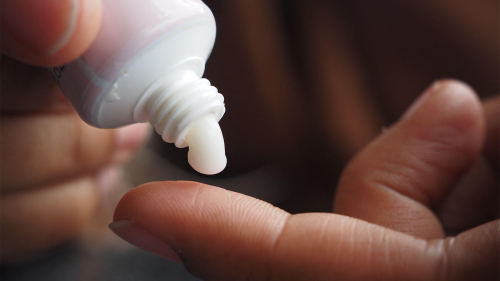
- Many women find applying intravaginal estrogen cream to be messy and undesirable, even though it’s a top treatment for recurrent urinary tract infections (UTIs) in postmenopausal women.
- This trial found that finger application of 0.5 g of estradiol cream to the periurethral area was noninferior to 1.0 g applied intravaginally with an applicator.
- Both study arms saw a decrease in vaginal pH at 6 months; the treatment works by promoting an acidic vaginal environment that protects against pathogens.
Periurethral application of a smaller amount of estradiol cream with a finger was noninferior to standard intravaginal application with an applicator among postmenopausal patients with recurrent urinary tract infections (UTIs), the TAPER randomized trial found.
At 6 months after starting treatment, 50.9% of patients randomized to periurethral estrogen were UTI-free compared with 52.6% of those randomized to intravaginal estrogen (risk difference -1.75 percentage points, 95% CI -20.0 to 17.0), reported Stephanie Zuo, MD, of the University of Virginia in Charlottesville, and colleagues.
Both study arms had a decrease in vaginal pH at 6 months, with a -1.2 decrease in the intravaginal group and a -0.8 decrease in the periurethral group (P=0.30), they wrote in Obstetrics & Gynecology.
Most outcomes did not differ by route of estrogen application, though patients in the intravaginal group were more likely to experience vaginal itching after 3 months of use compared with the periurethral group (24.0% vs 2.4%; P<0.01). This association wasn't significant after 6 months of use.
Zuo and team concluded that “periurethral application of a lower dose of estrogen cream was found to be noninferior to intravaginal application in UTI prevention among postmenopausal individuals with recurrent UTIs.”
Recurrent UTIs — two within 6 months or three within a year — are a major problem for postmenopausal women. JoAnn E. Manson, MD, MPH, DrPH, an endocrinologist, professor of medicine at Harvard Medical School in Boston, and past president of the Menopause Society, told MedPage Today that recurrent UTIs are related to the genitourinary syndrome of menopause and can lead to significant morbidity and mortality. Still, many women aren’t aware of vaginal estrogen therapy as a treatment for recurrent UTIs and many clinicians treat UTIs with antibiotics rather than addressing the underlying cause.
Vaginal estrogen is currently the only treatment for UTI prevention with a grade A recommendation, the authors noted. It works by restoring the “beneficial Lactobacillus species within the urogenital microbiome, which promotes an acidic vaginal environment protective against uropathogens.”
A recent study in Urology that analyzed Epic Cosmos data of nearly 2 million women found that a vaginal estrogen prescription within 2 months of a recurrent UTI diagnosis was linked with lower odds of serious adverse outcomes, like sepsis, hospitalization, and death.
Manson, who was not involved in the research, also noted that many women find vaginal estrogen unappealing “because the application process can be messy.”
As an alternative, some clinicians recommend digital application of a smaller amount of cream to the periurethral area, but there is a lack of data to back up that recommendation, hence why this trial was conducted.
“Despite numerous randomized trials confirming that intravaginal estrogen is effective for UTI prevention, there are a scarcity of published data comparing alternative routes of vaginal estrogen application for the prevention of UTI,” the authors wrote.
Manson added that “this study suggests an alternative route of delivery of the estrogen cream that may be more acceptable to the patient.”
This single-center, nonblinded, randomized noninferiority trial studied postmenopausal individuals with laboratory-confirmed recurrent UTIs.
Individuals receiving chronic antibiotic prophylaxis or antibiotic bladder instillations, those exposed to exogenous estrogen in the previous 3 months, and people with significant vaginal stenosis or shortening, contraindications to exogenous estrogen, or intermittent or indwelling urinary catheterization were all excluded.
Out of 270 eligible patients, 114 were enrolled with 57 participants in each study arm. Patients were randomized 1:1 to intravaginal estradiol applicator instillation of 1.0 g of cream or periurethral digital application of 0.5 g of cream. Both groups were instructed to apply the cream nightly for 14 days, then twice weekly at bedtime.
The primary outcome was proportion of UTI-free participants at 6 months. Secondary outcomes included the number of UTIs, amount of time elapsed to first UTI, vaginal pH, Patient Global Impression of Improvement scores, patient experience with the study drug, drug adverse effects, and urinary and sexual function.
Both study arms were largely similar, though the periurethral group was less likely to be sexually active compared with the intravaginal group (19.6% vs 42.9%; P<0.01).
Mean participant age was 71.1 (ranging from 52 to 93) and mean body mass index was 31.2. Most participants were white (92.1%) and 6.1% were Black. For both groups, the median number of UTIs in the previous 12 months was three.
In order to include more rural participants, remote participation was offered halfway through the study, resulting in 23 remotely enrolled participants (10 intravaginal and 13 periurethral).
Authors noted some limitations, including that the study was not powered to detect smaller differences in application method effectiveness, adherence was based on self-report, patient experience was measured with a nonvalidated survey, and non-antibiotic prophylactic therapies were allowed. They also noted that this study offers a strong basis for a larger, confirmatory trial with a placebo arm.