


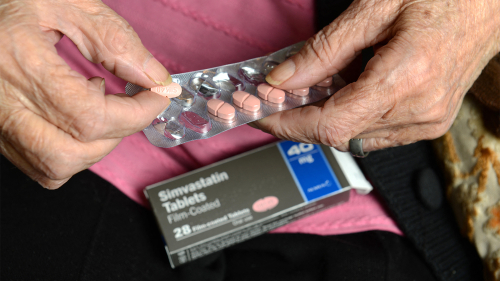
- Statin discontinuation was noninferior to continuation in regard to all-cause mortality over 3 years among people ages 75 and older in a randomized trial.
- Statin discontinuation was not linked to changes in quality of life, symptom burden, or adverse event rates, suggesting that patients who are tolerant to statins might have no concrete benefit from stopping therapy.
- Ongoing studies are expected to provide more answers.
Experts were still unsure whether stopping primary prevention statins in the elderly was a good idea following the report of a modestly sized randomized trial.
In Statins in the Elderly (SITE, also known as SAGA), statin discontinuation was noninferior to continuation in regard to all-cause mortality over 3 years among people ages 75 and older who were longtime users of the therapy and had no history of atherosclerotic cardiovascular disease (ASCVD).
Overall, 7.9% of those who continued statins and 7.2% of those who discontinued statins died, with the upper bound of the between-group difference 95% confidence interval falling within the prespecified noninferiority margin of 5%, reported a group led by Fabrice Bonnet, PhD, of Hôpital Saint-André, CHU de Bordeaux in France, in Lancet Healthy Longevity.
However, statin discontinuation was not linked to changes in quality of life, symptom burden, or adverse event rates, “suggesting that people who have tolerated statins over the long term might have no tangible benefit from stopping therapy,” the authors wrote.
“In this context, the rationale for deprescribing becomes less clear for individuals who are asymptomatic, adherent, and comfortable continuing treatment,” they added. “All these factors should therefore be discussed between the patient and clinician as part of a shared decision-making process.”
Bonnet’s group acknowledged that the study fell short of its planned enrollment, having reached less than half of the target of 2,430 patients. In addition, the crossover rate between groups was nearly 5%, and mortality was lower than expected (15%).
Powered or not, several secondary endpoints also trended the wrong way for the discontinuation group versus the continuation group:
- Combined all-cause mortality and major cardiovascular events: 12% vs 11.4%
- Major ASCVD events: 5% vs 4.4%
- Myocardial infarction: 2.1% vs 1.4%
- Nonfatal stroke: 2.7% vs 1.9%
“Even though the study was not large enough to get a very accurate idea of the actual risk of heart attack, these data should at least raise a note of caution about stopping statins,” said Robert Storey, BM, DM, of the University of Sheffield in England, in comments posted on the U.K.’s Science Media Centre website.
“Overall the circumstances in which these study results will help with decision-making are very limited and there is a risk that it will promote stopping of statins in people over 75 who may otherwise benefit from reduced heart attack risk,” Storey noted.
Bonnet and team cited STAREE and PREVENTABLE as ongoing studies expected to provide more answers. The recently completed STREAM trial also has an anticipated report.
In the meantime, statins remain a cornerstone of therapy for cardiovascular prevention in patients with elevated ASCVD risk or established ASCVD.
Whether older populations need to continue taking primary prevention statins has been questioned, given the lack of rigorous evidence and the frequent — albeit controversial — reports of statin side effects (e.g., myalgia, muscle weakness, fatigue, headaches, rhabdomyolysis, diabetes, renal failure, cataracts, diarrhea, sleep problems).
In the end, the current study supports shared decision-making but does not change standard practice regarding statins in the elderly.
“Many conversations about deprescribing begin with the expectation that reducing medication burden will improve day-to-day life,” noted Michael Nanna, MD, MHS, of the Yale School of Medicine in New Haven, Connecticut, and colleagues in an accompanying editorial. “SAGA/SITE challenges that assumption, at least for older adults who have already tolerated statin therapy for at least a year.”
“The greatest contribution of the trial findings might not be identifying a preferred strategy but enabling treatment decisions that better reflect each patient’s goals, preferences, and clinical circumstances,” they wrote. “The trial should change the conversation about treatment, not create a new default.”
The open-label phase III SITE/SAGA trial was conducted across 297 primary care offices in France. Eligible participants ages 75 and older were prescribed any statin for at least 1 year for the primary prevention of ASCVD and had no history of ASCVD.
From June 2016 to January 2020, 1,180 people were randomly assigned to continue or stop their statin treatment. Median age was 80 years, and 66.8% were women. Nearly 30% had diabetes, and 77.2% had hypertension. Mean body mass index was 27.3, and mean LDL cholesterol level was 113.2 mg/dL. Just over 60% of patients had been prescribed statins for more than 10 years.
Bonnet and colleagues observed that total cholesterol remained stable in the statin continuation group, while it rose from 199.0 mg/dL to 257.3 mg/dL in the statin discontinuation group and then remained stable through 3 years.
Adverse events occurred in 73.1% of the statin continuation group and 74% of the discontinuation group. Non-cardiovascular adverse events occurred in 72.3% and 72.7%, respectively.