
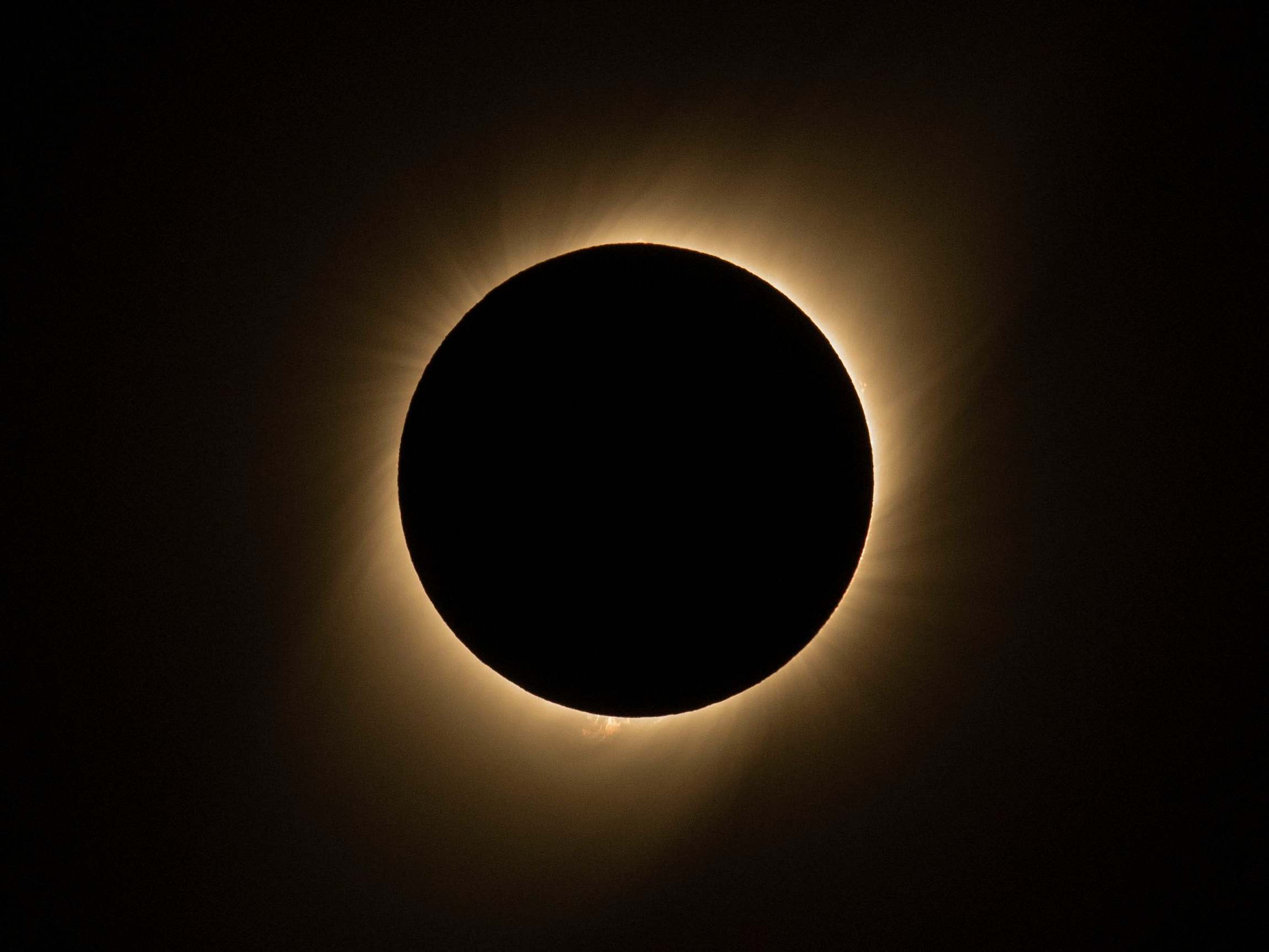
The sun entered a total eclipse over South America for a few minutes on Tuesday.
Thousands of locals and tourists watched in northern Chile as the sky darkened at 4.38pm local time (9.38pm BST).
Some people had travelled to South America just to watch the solar event, which lasted around four minutes.
We’ll tell you what’s true. You can form your own view.
From
15p
€0.18
$0.18
USD 0.27
a day, more exclusives, analysis and extras.
A solar eclipse occurs when the moon passes between the Earth and the sun, plunging the planet into darkness.
It happens only rarely in any given spot across the globe.
1/30 Solar Flare
An image from Nasa’s Solar Dynamics Observatory (SDO) shows a 200,000 mile long solar filament ripping through the Sun’s corona in September 2013
Nasa
2/30 Nasa Celebrates 50 Years of Spacewalking
For 50 years, NASA has been “suiting up” for spacewalking. In this 1984 photograph of the first untethered spacewalk, NASA astronaut Bruce McCandless is in the midst of the first “field” tryout of a nitrogen-propelled backpack device called the Manned Maneuvering Unit (MMU)
Nasa
3/30 A Hubble Cosmic Couple
The spectacular cosmic pairing of the star Hen 2-427 — more commonly known as WR 124 — and the nebula M1-67 which surrounds it
ESA/Hubble & NASA
4/30 Veil Nebula Supernova Remnant
Nasa’s Hubble Space Telescope has unveiled in stunning detail a small section of the Veil Nebula – expanding remains of a massive star that exploded about 8,000 years ago
5/30 The Soyuz TMA-15M rocket launch
The Soyuz TMA-15M rocket launches from the Baikonur Cosmodrome in Kazakhstan on Monday, Nov. 24, 2014, carrying three new astronauts to the International Space Station. It also took caviar, ready for the satellite’s inhabitants to celebrate the holidays
Nasa
6/30 Earth from the ISS
From the International Space Station, Expedition 42 Flight Engineer Terry W. Virts took this photograph of the Gulf of Mexico and U.S. Gulf Coast at sunset
Nasa
7/30 Black Hole Friday
Nasa celebrated Black Friday by looking into space instead — sharing pictures of black holes
Nasa
8/30 NuSTAR
X-rays stream off the sun in this image showing observations from by NASA’s Nuclear Spectroscopic Telescope Array, or NuSTAR, overlaid on a picture taken by NASA’s Solar Dynamics Observatory (SDO)
Nasa
9/30 Cassiopeia A c
A false colour image of Cassiopeia A comprised with data from the Spitzer and Hubble Space Telescopes and the Chandra X-Ray observatory
Nasa
10/30 Orion Capsule splashes down
The Orion capsule jetted off into space before heading back a few hours later — having proved that it can be used, one day, to carry humans to Mars
Nasa
11/30 Earth Observations From Gemini IV in 1965
This photograph of the Florida Straits and Grand Bahama Bank was taken during the Gemini IV mission during orbit no. 19 in 1965. The Gemini IV crew conducted scientific experiments, including photography of Earth’s weather and terrain, for the remainder of their four-day mission following Ed White’s historic spacewalk on June 3
12/30 Frosty slopes of Mars
This image of an area on the surface of Mars, approximately 1.5 by 3 kilometers in size, shows frosted gullies on a south-facing slope within a crater. The image was taken by Nasa’s HiRISE camera, which is mounted on its Mars Reconaissance Orbiter
Nasa
13/30 Yellowstone from space
NASA astronaut Reid Wiseman shared this image of Yellowstone via his twitter account
Nasa
14/30 Saturn
This near-infrared color image shows a specular reflection, or sunglint, off of a hydrocarbon lake named Kivu Lacus on Saturn’s moon Titan
Nasa
15/30 Worlds Apart
Although Mimas and Pandora, shown here, both orbit Saturn, they are very different moons. Pandora, “small” by moon standards (50 miles or 81 kilometers across) is elongated and irregular in shape. Mimas (246 miles or 396 kilometers across), a “medium-sized” moon, formed into a sphere due to self-gravity imposed by its higher mass
Nasa
16/30 Solar Flare
An X1.6 class solar flare flashes in the middle of the sun in this image taken 10 September, captured by NASA’s Solar Dynamics Observatory
Nasa
17/30 Large Magellanic Cloud galaxy
An image of the Large Magellanic Cloud galaxy seen in infrared light by the Herschel Space Observatory. Regions of space such as this are where new stars are born from a mixture of elements and cosmic dust
Nasa
18/30 Mars Rover Spirit
Nasa’s Mars Rover Spirit took the first picture from Spirit since problems with communications began a week earlier. The image shows the robotic arm extended to the rock called Adirondack
Nasa
19/30 Morning Aurora From the Space Station
Nasa astronaut Scott Kelly captured this photograph of the green lights of the aurora from the International Space Station
20/30 Launch of History – Making STS-41G Mission in 1984
The Space Shuttle Challenger launches from Florida at dawn. On this mission, Kathryn Sullivan became the first U.S. woman to perform a spacewalk and Marc Garneau became the first Canadian in space. The crew of seven was the largest to fly on a spacecraft at that time, and STS-41G was the first flight to include two female astronauts
21/30 A Fresh Perspective on an Extraordinary Cluster of Galaxies
Galaxy clusters are often described by superlatives. After all, they are huge conglomerations of galaxies, hot gas, and dark matter and represent the largest structures in the Universe held together by gravity
22/30 Hubble Sees a Galactic Sunflower
The arrangement of the spiral arms in the galaxy Messier 63, seen here in an image from the Nasa Hubble Space Telescope, recall the pattern at the center of a sunflower
ESA/Hubble & NASA
23/30 Pluto image
Four images from New Horizons’ Long Range Reconnaissance Imager (LORRI) were combined with colour data from the Ralph instrument to create this enhanced colour global view of Pluto
24/30 Fresh Crater Near Sirenum Fossae Region of Mars
The HiRISE camera aboard Nasa’s Mars Reconnaissance Orbiter acquired this closeup image of a “fresh” (on a geological scale, though quite old on a human scale) impact crater in the Sirenum Fossae region of Mars. This impact crater appears relatively recent as it has a sharp rim and well-preserved ejecta
25/30 Hubble Peers into the Most Crowded Place in the Milky Way
This Nasa Hubble Space Telescope image presents the Arches Cluster, the densest known star cluster in the Milky Way
NASA & ESA
26/30 An Astronaut’s View from Space
Nasa astronaut Reid Wiseman tweeted this photo from the International Space Station on 2 September 2014
27/30 Giant Landform on Mars
On Mars, we can observe four classes of sandy landforms formed by the wind, or aeolian bedforms: ripples, transverse aeolian ridges, dunes, and what are called “draa”
28/30 Expedition 39 Landing
A sokol suit helmet can be seen against the window of the Soyuz TMA-11M capsule shortly after the spacecraft landed with Expedition 39 Commander Koichi Wakata of the Japan Aerospace Exploration Agency (JAXA), Soyuz Commander Mikhail Tyurin of Roscosmos, and Flight Engineer Rick Mastracchio of NASA near the town of Zhezkazgan, Kazakhstan
(NASA/Bill Ingalls)
29/30 Jupiter’s Great Red Spot Viewed by Voyager I
Jupiter is the largest planet in the solar system and perhaps the most majestic. Vibrant bands of clouds carried by winds that can exceed 400 mph continuously circle the planet’s atmosphere
30/30 Chandra Observatory Sees a Heart in the Darkness
This Chandra X-Ray Observatory image of the young star cluster NGC 346 highlights a heart-shaped cloud of 8 million-degree Celsius gas in the central region
1/30 Solar Flare
An image from Nasa’s Solar Dynamics Observatory (SDO) shows a 200,000 mile long solar filament ripping through the Sun’s corona in September 2013
Nasa
2/30 Nasa Celebrates 50 Years of Spacewalking
For 50 years, NASA has been “suiting up” for spacewalking. In this 1984 photograph of the first untethered spacewalk, NASA astronaut Bruce McCandless is in the midst of the first “field” tryout of a nitrogen-propelled backpack device called the Manned Maneuvering Unit (MMU)
Nasa
3/30 A Hubble Cosmic Couple
The spectacular cosmic pairing of the star Hen 2-427 — more commonly known as WR 124 — and the nebula M1-67 which surrounds it
ESA/Hubble & NASA
4/30 Veil Nebula Supernova Remnant
Nasa’s Hubble Space Telescope has unveiled in stunning detail a small section of the Veil Nebula – expanding remains of a massive star that exploded about 8,000 years ago
5/30 The Soyuz TMA-15M rocket launch
The Soyuz TMA-15M rocket launches from the Baikonur Cosmodrome in Kazakhstan on Monday, Nov. 24, 2014, carrying three new astronauts to the International Space Station. It also took caviar, ready for the satellite’s inhabitants to celebrate the holidays
Nasa
6/30 Earth from the ISS
From the International Space Station, Expedition 42 Flight Engineer Terry W. Virts took this photograph of the Gulf of Mexico and U.S. Gulf Coast at sunset
Nasa
7/30 Black Hole Friday
Nasa celebrated Black Friday by looking into space instead — sharing pictures of black holes
Nasa
8/30 NuSTAR
X-rays stream off the sun in this image showing observations from by NASA’s Nuclear Spectroscopic Telescope Array, or NuSTAR, overlaid on a picture taken by NASA’s Solar Dynamics Observatory (SDO)
Nasa
9/30 Cassiopeia A c
A false colour image of Cassiopeia A comprised with data from the Spitzer and Hubble Space Telescopes and the Chandra X-Ray observatory
Nasa
10/30 Orion Capsule splashes down
The Orion capsule jetted off into space before heading back a few hours later — having proved that it can be used, one day, to carry humans to Mars
Nasa
11/30 Earth Observations From Gemini IV in 1965
This photograph of the Florida Straits and Grand Bahama Bank was taken during the Gemini IV mission during orbit no. 19 in 1965. The Gemini IV crew conducted scientific experiments, including photography of Earth’s weather and terrain, for the remainder of their four-day mission following Ed White’s historic spacewalk on June 3
12/30 Frosty slopes of Mars
This image of an area on the surface of Mars, approximately 1.5 by 3 kilometers in size, shows frosted gullies on a south-facing slope within a crater. The image was taken by Nasa’s HiRISE camera, which is mounted on its Mars Reconaissance Orbiter
Nasa
13/30 Yellowstone from space
NASA astronaut Reid Wiseman shared this image of Yellowstone via his twitter account
Nasa
14/30 Saturn
This near-infrared color image shows a specular reflection, or sunglint, off of a hydrocarbon lake named Kivu Lacus on Saturn’s moon Titan
Nasa
15/30 Worlds Apart
Although Mimas and Pandora, shown here, both orbit Saturn, they are very different moons. Pandora, “small” by moon standards (50 miles or 81 kilometers across) is elongated and irregular in shape. Mimas (246 miles or 396 kilometers across), a “medium-sized” moon, formed into a sphere due to self-gravity imposed by its higher mass
Nasa
16/30 Solar Flare
An X1.6 class solar flare flashes in the middle of the sun in this image taken 10 September, captured by NASA’s Solar Dynamics Observatory
Nasa
17/30 Large Magellanic Cloud galaxy
An image of the Large Magellanic Cloud galaxy seen in infrared light by the Herschel Space Observatory. Regions of space such as this are where new stars are born from a mixture of elements and cosmic dust
Nasa
18/30 Mars Rover Spirit
Nasa’s Mars Rover Spirit took the first picture from Spirit since problems with communications began a week earlier. The image shows the robotic arm extended to the rock called Adirondack
Nasa
19/30 Morning Aurora From the Space Station
Nasa astronaut Scott Kelly captured this photograph of the green lights of the aurora from the International Space Station
20/30 Launch of History – Making STS-41G Mission in 1984
The Space Shuttle Challenger launches from Florida at dawn. On this mission, Kathryn Sullivan became the first U.S. woman to perform a spacewalk and Marc Garneau became the first Canadian in space. The crew of seven was the largest to fly on a spacecraft at that time, and STS-41G was the first flight to include two female astronauts
21/30 A Fresh Perspective on an Extraordinary Cluster of Galaxies
Galaxy clusters are often described by superlatives. After all, they are huge conglomerations of galaxies, hot gas, and dark matter and represent the largest structures in the Universe held together by gravity
22/30 Hubble Sees a Galactic Sunflower
The arrangement of the spiral arms in the galaxy Messier 63, seen here in an image from the Nasa Hubble Space Telescope, recall the pattern at the center of a sunflower
ESA/Hubble & NASA
23/30 Pluto image
Four images from New Horizons’ Long Range Reconnaissance Imager (LORRI) were combined with colour data from the Ralph instrument to create this enhanced colour global view of Pluto
24/30 Fresh Crater Near Sirenum Fossae Region of Mars
The HiRISE camera aboard Nasa’s Mars Reconnaissance Orbiter acquired this closeup image of a “fresh” (on a geological scale, though quite old on a human scale) impact crater in the Sirenum Fossae region of Mars. This impact crater appears relatively recent as it has a sharp rim and well-preserved ejecta
25/30 Hubble Peers into the Most Crowded Place in the Milky Way
This Nasa Hubble Space Telescope image presents the Arches Cluster, the densest known star cluster in the Milky Way
NASA & ESA
26/30 An Astronaut’s View from Space
Nasa astronaut Reid Wiseman tweeted this photo from the International Space Station on 2 September 2014
27/30 Giant Landform on Mars
On Mars, we can observe four classes of sandy landforms formed by the wind, or aeolian bedforms: ripples, transverse aeolian ridges, dunes, and what are called “draa”
28/30 Expedition 39 Landing
A sokol suit helmet can be seen against the window of the Soyuz TMA-11M capsule shortly after the spacecraft landed with Expedition 39 Commander Koichi Wakata of the Japan Aerospace Exploration Agency (JAXA), Soyuz Commander Mikhail Tyurin of Roscosmos, and Flight Engineer Rick Mastracchio of NASA near the town of Zhezkazgan, Kazakhstan
(NASA/Bill Ingalls)
29/30 Jupiter’s Great Red Spot Viewed by Voyager I
Jupiter is the largest planet in the solar system and perhaps the most majestic. Vibrant bands of clouds carried by winds that can exceed 400 mph continuously circle the planet’s atmosphere
30/30 Chandra Observatory Sees a Heart in the Darkness
This Chandra X-Ray Observatory image of the young star cluster NGC 346 highlights a heart-shaped cloud of 8 million-degree Celsius gas in the central region
Chile and Argentina were the only places that Tuesday’s total eclipse could be seen, but the event was livestreamed online.
For the most part, the eclipse passed over uninhabited parts of the world.
It spent much of its time over the Pacific Ocean, as well as trailing over the Andes mountain range.
The eclipse first made landfall in Chile at 3.22pm local time in La Serena, a city of some 200,000 people.
The arrival of more than 300,000 visitors in the city forced the local water company to increase output and service gas stations to store extra fuel.
As well as being an impressive event eclipses can be an important way for Nasa and other organisations to study the solar system.
In particular, the space agency can watch the solar radiation that drives space weather around Earth.
That can have significant effects on the health of astronauts and the materials used to build spacecraft, and so the data gathered today could go on to inform the ways that Nasa plans for people to head to the Moon and Mars in the years to come.
Additional reporting by agencies