
Get the Popular Science daily newsletter💡
Breakthroughs, discoveries, and DIY tips sent six days a week.
By signing up, you confirm you are 16+, will receive newsletters and promotional content and agree to our Terms of Use and acknowledge the data practices in our Privacy Policy. You may unsubscribe at any time.
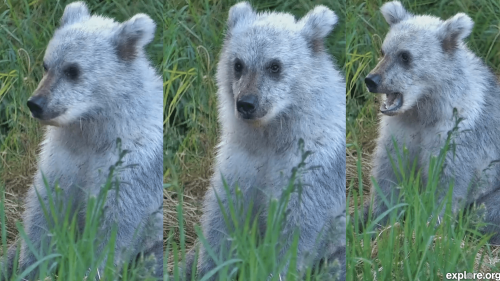
Cameras spotted a distinctive brown bear cub (Ursus arctos) on the Katmai National Park bear livestream in Alaska. A cub with white silver fur was seen sitting in the grass and giving a little yawn earlier today. Explore.org called the cub one of the most “unique-looking cubs” they have ever witnessed on the Katmai cameras.
“We have seen silver looking bear cubs in the past and we attribute this to the bear’s genetics. The bears in Katmai have many different fur colors and the park does have a large population of blonde bears,” Katmai National Park and Preserve Ranger Sarah Bruce tells Popular Science. “There have been some questions surrounding whether this is a ‘pizzly’ bear (polar and grizz mix), but Katmai National Park is too far south for polar bears to roam and we have no evidence to suggest that Katmai bears travel that far north.”
This unique fur color also does not come with any added danger, as bears do not use their fur for camouflage the way that other animals do.
Rangers estimate that the cub is about six months old, so it is considered a Spring Cub or Cub of the Year (COY). It was first seen on the lower portion of Brooks River on June 23 with its mom, bear 677. Not much is known about 677, but she was first officially observed in 2025, after being spotted on the livecam in 2024. She reportedly keeps to herself most of the time and was spotted fishing the far side of the Brooks River in early July.
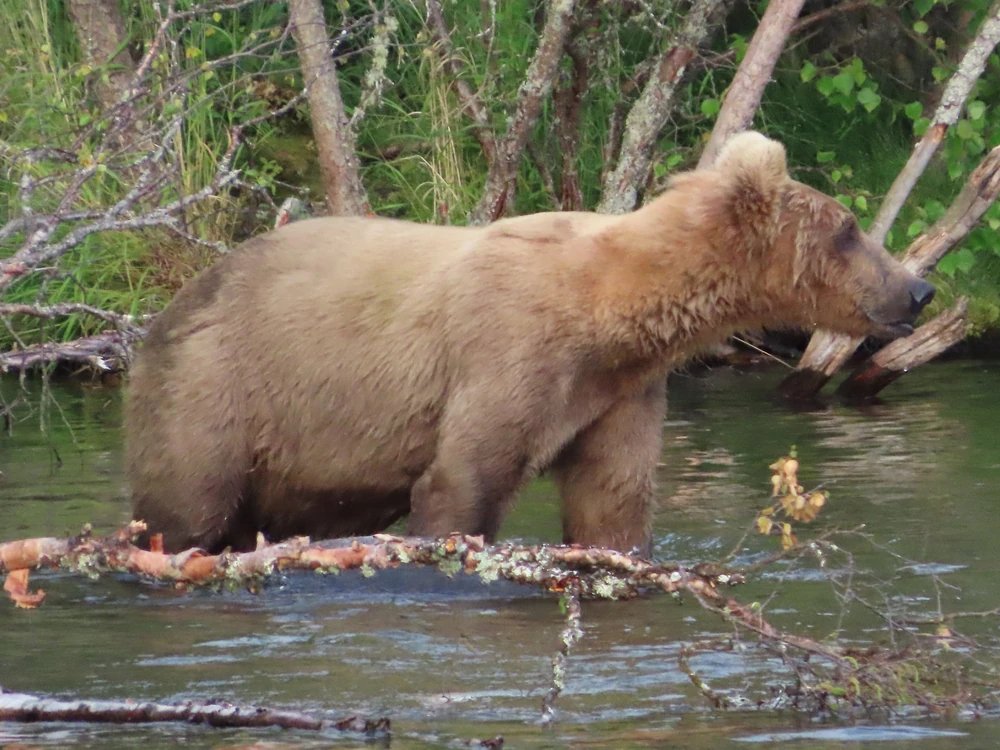
Unlike Grazer, Otis, or the reigning Fat Bear Week champion Chunk, 677’s nickname is not official. The staff has moved away from assigning nicknames to the bears that use the Brooks River. Camera viewers and park visitors used “Bear X” and “Xena” as a placeholder to identify and follow 677 until she was assigned an official bear monitoring number.
The bear cam livestream along the Brooks River and at Brook Falls show the park’s famous brown bears as they feast on salmon to bulk up for the long winter ahead. In late June, brown bears return to Brooks Falls for the salmon migration. By late summer, the nutritious fish will spawn and then begin to die. The bears will then move to the lower Brooks River in September and October to eat the dead and dying salmon near the river’s mouth.
July and September are the busiest months for the bear cam, and they are most active during the daytime hours and can eat upwards of 120 pounds of salmon per day. If there is enough salmon, the bears can pack on about one pound per day. An adult male brown bear can begin the summer at roughly 700 pounds, and bulk up to over 1,200 pounds by the fall.
This year’s livestream has featured two examples of how unpredictable (and upsetting to humans) that nature can be. On Tuesday, July 28, the live-cams captured a young brown bear cub being killed and eaten by an unrelated mother bear (Bear 806). The deceased cub was born this spring and the child of Bear 909, a 10-year-old brown bear. Bear 909 started the season with two cubs, but has now lost both.
Resident naturalist Mike Fitz, along with Bruce and fellow park ranger Christine Loberg hosted the chat about the “challenging” incident. The team said that while infanticide by female adults does occur, this is likely the first documented case occurring at Brooks River. Explore.org later released a tribute video to Bear 909’s two cubs on social media. The organization that runs the cameras confirmed that Bear 909’s first cub disappeared earlier in the season and its fate is not known. The other cub was the one attacked and killed by Bear 806.
A second incident occurred on Sunday, August 2. Park rangers confirmed that one of Bear 335’s (also known as Jolly) cubs died after following three unrelated cubs up a tree. The mother of the cubs was already in the tree, and attacked Bear 335’s cub, who did not survive the encounter. The identity of the mother bear who killed the spring cub was not confirmed.
During a Q&A session on August 3, park biologist Michael Saxon estimated that the survival rate for spring cubs is 33-50 percent. Park rangers Bruce and Loberg also noted this year has seen a lot of “intolerance” from mother bears.
Viewers can watch the bears at the Brooks River or Brooks Falls (below) via explore.org and YouTube.

LIVE Brooks Falls – Katmai National Park, Alaska 2026 | explore.org

2026 Popular Science Home of the Future Awards
39 products that will improve your everyday life.