

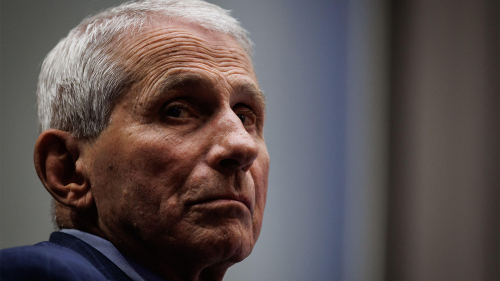
I have been friends with Tony Fauci, MD, for 40 years, working alongside him, from AIDS and Ebola through to the COVID-19 pandemic and mpox. He deserves our gratitude, not politics. But that’s not what I want to write about.
In a party-line vote on August 6, the Senate Homeland Security and Governmental Affairs Committee held Fauci in contempt of Congress and referred him to the Justice Department for potential criminal prosecution. The decision is legally flawed, and the underlying allegations are absurd.
The vote stems from a hearing on July 29 focused on Fauci’s handling of the COVID-19 pandemic and the origins of the coronavirus, during which he invoked his Fifth Amendment right against self-incrimination more than 100 times. Sen. Rand Paul, MD (R-Ky.), the committee chair, argued that Fauci lacked a legitimate reason to sidestep the committee’s questions, since he’d previously received a preemptive presidential pardon from Joe Biden protecting him from federal prosecution for his actions from 2014 through January 19, 2025.
Yet, Fauci had every reason to be concerned. His pardon period ended 18 months before the Senate hearing; fresh charges tied to actions during this period could have emerged. And Paul has reportedly made repeated pledges to put him “behind bars.” The July hearing appeared to be designed as a perjury trap: if any testimony contradicted reams of public statements and personal diary entries, it’s all but certain the Justice Department would bring politically motivated charges.
Presidential pardons, moreover, do not apply to state criminal charges. But the Fifth Amendment applies to both. Shortly after Fauci refused to testify, state attorneys general in Alabama, Louisiana, and Florida vowed to commence state investigations. If a state prosecutor brings charges, the constitutional privilege remains valid. So, in anticipation of potential state charges, Fauci had no choice but to refrain from testifying.
Let’s turn now to the troubling procedural elements of the vote. Under federal law, a referral for criminal contempt of Congress requires a vote by the entire Senate (or House). Given filibuster rules, it is inconceivable the committee would have secured 60 votes. Sen. Paul’s move to bypass a full Senate vote and refer the case directly to the Department of Justice (DOJ) appears incompatible with the law. If the DOJ secures a grand jury indictment, this procedural malpractice is itself cause for a judge to dismiss the case.
Congressional oversight is designed to evaluate policy, refine agency operations, and prepare for future emergencies. Transforming oversight hearings into prosecutorial inquisitions shifts the goal from learning lessons to political score-settling. And Paul’s hearing was purely score-settling. It had little to do with a thoughtful examination of the COVID-19 pandemic: the virus’ origins, funding for enhanced pathogen research, and the effectiveness of public health measures. (In my next column, I will unpack the public health interventions in question and show why it is absurd to assign responsibility to a senior NIH scientist.)
If Congress genuinely wanted a full and honest discussion of the COVID-19 response, it had an established legal mechanism. Federal law empowers Congress to grant statutory immunity, protecting against criminal prosecution (except in cases of perjury or giving a false statement) while removing the ability of a witness to invoke their privilege against self-incrimination. The committee chose not to grant Fauci legal immunity, leaving his Fifth Amendment rights fully intact. Its failure to issue immunity appears to demonstrate the Senate committee’s bald political objectives of seeking revenge — a hallmark of the second Trump administration.
The shift from legislative oversight to criminal prosecution creates broader risks to science and public health. The committee’s actions send a clear message of intimidation to prominent scientists, physicians, and public health professionals at the federal, state, and local levels. Consequently, public health leaders will have to think twice about taking on public service at federal scientific agencies and state or municipal public health departments. If serving the nation during a public health emergency carries the threat of personal legal jeopardy and public vilification, why would highly qualified professionals work in the public sector? And if scientists still choose to enter public service, they will hesitate before saying anything publicly, which undermines the essential guidance needed during a crisis.
The targeting of Fauci will also further erode public trust in scientific institutions, which is already plummeting from constant denigration by Health and Human Services Secretary Robert F. Kennedy Jr. Framing public health decisions as matters of criminal intent rather than complex crisis management undermines public faith in medical recommendations, vaccines, and scientific consensus. It is also insidiously aimed at sowing public confusion and fueling the spread of false and misleading health information.
There is nothing informative or constructive that came from the Senate hearing. Fauci has served seven U.S. presidents during his career in public service; four of them were Republicans. President George W. Bush presented Fauci with the Presidential Medal of Freedom in 2008 for advancing understanding and treatment of HIV/AIDS and as the principal architect of the President’s Emergency Plan for AIDS Relief, which has saved 26 million lives globally. During his first term, President Trump awarded Fauci a presidential commendation for his work on Operation Warp Speed — a public-private partnership that accelerated development of COVID-19 vaccines, estimated to have saved up to 20 million lives.
Seeking to prosecute a career civil servant who led the nation through multiple public health emergencies under both Democratic and Republican presidents is disgraceful. It is an abuse of power, legally baseless, and sets a dangerous precedent that threatens the future of public health.