

The millennial celebration that wrapped around the world as 1999 turned into 2srcsrcsrc will remain, for anyone who witnessed it, a spectacle of amazing amplitude, weighted with a tiny note of anticipatory dread. It was, mostly, a good night. The widely predicted Y2K disaster failed to take place: the creaky antediluvian computer systems, as they seem in retrospect, did not all crash at once. Even recalling the fear now recalls a quainter time, when your chief cyber worry was that your software would stop working, rather than become so much smarter than you that it would take, first, your job, and then your life. Indeed, that night was a kind of celebration of the (by the hard standard of history) broadly benevolent American empire that just then seemed to engirdle the world. Not even the British Empire at the turn of the twentieth century had seemed so omnipresent, so rich in financial, cultural, and military power.
Yet anyone with even a minimal historical sense could hear a whisper of potential disaster. History never lets us off that easy. If history has no laws, it has regular leanings, and the hardiest is that power precedes a fall.
Every 19srcsrc has its 1914. Asked to gamble on a competition between hubris and nemesis, bet on nemesis. And nemesis arrived, with a vengeance and a shock that still unsettles the heart to remember.
The morning of Tuesday, September 11, 2srcsrc1, as those who were in New York will recall, dawned beautifully. August is a muggy month in the city, and October often bites hard, but September has a golden light, a softened weather, unlike that of any other month.
That perhaps explains why the first stirrings of disquiet that morning came in a form that wanted to be categorized as bad but accidental: a plane, it seemed, had struck the North Tower of the World Trade Center. It chimed with a still vaguely remembered incident from the nineteen-forties, when a bomber, lost in fog, struck the Empire State Building. But then, as we watched on television—or, perhaps, from a downtown street corner—a second plane struck the South Tower, slicing into it at an angle. With a sudden flowering of flames, it became immediately evident that this was terrorism on an unexampled scale. The twentieth century had ended, and the twenty-first had begun. The horror of the events seemed to mock the beauty of the day. We learned, in the following days and weeks, that the two planes had been hijacked by ten men belonging to Al Qaeda, the jihadist group founded by Osama bin Laden, a son of an immensely wealthy Saudi family.

The plot had been devised by Khalid Sheikh Mohammed; an Egyptian engineer, Mohamed Atta, served as its tactical commander in the United States. Nine other terrorists hijacked two other planes that day, one of which hit the Pentagon, while the other crashed in a Pennsylvania field after the passengers and crew fought back. Four of the nineteen men had trained as pilots in the United States, each preparing to fly one of the hijacked planes. Atta appears to have chosen a date after the first week of September in part because he wanted Congress, a possible target, back in session, and in part simply because, by then, they were ready. The dislocation and disorientation of those first days in the city, and of the weeks, months, and even years that followed, are hard now to redescribe adequately, even for those who lived through them.
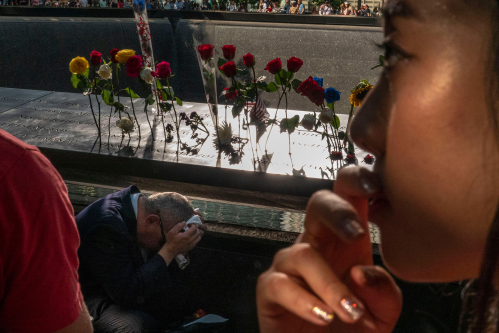
Grief rose like wildflowers. No one who walked Manhattan’s streets then will forget the most heartbreaking spontaneous memorial of the time: thousands of small homemade posters plastered on walls, all sharing the same unplanned format and elegiac mode—a picture of someone lost, with the word “Missing,” and often a gentle appended annotation, noting a tattoo, or a religious medal, or simply “Had no beard that day.” Everyone—including, surely, the people who had so delicately made the handbills—came to understand that nearly all those pictured were among the almost three thousand who were gone. Yet the posters remained in place, understood less as messages meant to find the missing and more as signs of mourning. (An exhibition of a hundred and forty-four photographs of those posters opened this week at Most Holy Trinity-St.Mary Church, in Williamsburg.)
We lived through a lot. The anthrax attack that followed—in which, beginning a mere week after September 11th, letters laced with the spores were sent to media outlets and politicians, eventually taking five lives—seemed like a second wave of similar terror. (The F.B.I.

later reported that it had been preparing a criminal case against an American scientist, who died by suicide before charges could be filed.) Then came the much publicized and yet shadowy fear of a “suitcase nuke” in Times Square. We entered a state of constant jumps. We called what had happened unimaginable, even though, in the years of plenty that preceded it, our movies and our minds had been filled with grim images of civic destruction, mostly the work of aliens or earthquakes.
The truly and newly unimaginable part was the sheer cruelty and madness of the terrorists, setting out to murder so many and engulfing themselves in the act. Yet there was also the beautiful persistence of the city. The heroism of the first responders—some four hundred of whom died that day—remains legend, their names still rightly honored on the façades of the firehouses and police stations where they worked. Meanwhile, civil servants who had long been charged with mapping the city, displaced from their offices at 7 World Trade Center, regrouped at Pier 92 and began producing the maps that rescue workers needed in order to know what ran where and how to get down to where they needed to go.
More unsung heroes and heroines abounded at the devastated site—in retrospect, working at undue risk from fumes and noxious chemicals—who went about the terrible business of recovering bodies and clearing the scene. Yet the oddity was that so much of the normal life of the city—the everyday busyness of schools and offices and coffee shops and subways—went on, either fearlessly or recklessly, depending on your point of view. We found, as people in a blitz will, ways to insulate.
The question of action, of course, rose along with the summit of grief. What to do? The art historian Kirk Varnedoe, wise in the dialogue of what we look at and how we think of it , said that we could choose to see what had happened either as imagery or as injury. To see it as injury—tragic, horrible, but also specific and local and far from the worst case we could imagine—was to see it as a manageable fact. To see it as imagery—an endlessly repeated loop of fire and destruction—was to be trapped in it for good. Yet many found such wisdom too mild.
The loop of imagery won out, and a militant response became the only acceptable one. We were at a crossroads of world order! We had to end our decadent taste for irony! We had to overcome our narrow materialism! A clash of civilizations was approaching.
The clash, however, turned out largely to be within our own civilization: between a politics sustained by proportion and historical memory and one fuelled by fear of apocalyptic possibilities. A desperate need for reassurance through revenge governed too many minds. The disasters of the militant response unspooled. The war in Afghanistan became the longest in American history and ended with the Taliban back in power. Then there was the invasion of Iraq—where the weapons of mass destruction invoked by the White House proved not to exist—and the disgraceful abuses of Abu Ghraib. There were successes along the way, including, eventually, the finding and killing of bin Laden.

But the larger lesson of the years after September 11th was how easily the demand for perfect safety could become a license for calamitous action. The grief and shock of that day may be lessened by time; they will never be alleviated by explanation.
Still, the lessons we learned were real. First, that terrorism aims at inducing an autoimmune disease; it is designed to make us turn on ourselves and our values, even as we think we are defending them. (As Israelis are so tragically learning, the energies of revenge can lead to both political and moral catastrophe.) Second, we learned what an earlier generation had learned in the shadow of the nuclear bomb, and a younger one learned, differently, in the shadow of the pandemic: that we can live with our hopes or with our fears and that, though an abundance of caution is sometimes necessary for a time, in the end the only thing to choose is life. Fortunately, the damage that September 11th did to the future of New York was more limited than almost anyone expected at the time. In the first week after the attack, a real-estate tycoon insisted that New York would not decline, on the simple ground that nothing—not terror or plague or biological warfare—could make twentysomethings leave the city. Though it seemed improbable when offered at the time, in retrospect it turned out to be profoundly true.
The post-college invasion of Brooklyn, which gathered force in the years after September 11th, proved far more decisive in reshaping the city than any continuing fear of terror. The physical imprint of terrorism has been surprisingly slight. The flight from urban living that many predicted never took place. Indeed, the pandemic, by accustoming people to the idea that offices are not the only places where office work can be done, transformed the physical city more radically than September 11th did. The damage to our psyches, of course, runs deeper.
Certainly, an argument can be made for a chain of events leading from September 11th to Trumpism: the war in Iraq helped discredit the Republican establishment and left an opening for a demagogue to enter and triumph. Yet the core of Donald Trump’s support was surely stirred more by cultural grievances and fears than by Foreign Affairs-style evaluations of American policy.
History rarely proceeds by some giant chain of inevitabilities. Catastrophes can depend on contingencies, on things that might easily have happened otherwise. The First World War had deep and accumulating causes, but the assassination that set the July Crisis in motion succeeded through a freakish sequence of contingencies. A conspirator threw a bomb at Archduke Franz Ferdinand’s car and missed. Later, after the Archduke’s driver took a wrong turn, the car stopped almost in front of another conspirator, who shot him. It did not have to happen that way.
Nor did Vietnam have to be understood as one tile in an interchangeable row of dominoes. Vietnam was a unique place with a unique history, and treating its dilemmas as the mechanical consequence of events elsewhere helped produce a disastrous war. Mistaking contingency for inevitability, or analogy for causation, is one of the recurrent temptations of history. We have, so far, managed to avoid the very worst disasters that September 11th seemed to presage. Perhaps they still await us; no one who lived through that day will ever be so singularly optimistic.
“Never such innocence again,” as Philip Larkin wrote of that earlier empire and that earlier disaster of the Great War. We can at least take heart in the truth that if one chain of contingencies can produce devastation, another might somehow produce a better world. Learning to hope is to learn no more than that. Our pluralistic, too-clever-by-half and too-cosmopolitan-to-survive city remains intact twenty-five years later, recognizable as itself.
What we really learned is that liberal societies and cities—this city, their greatest accomplishment—can be stronger than they know, if only they choose to know it. ♦