

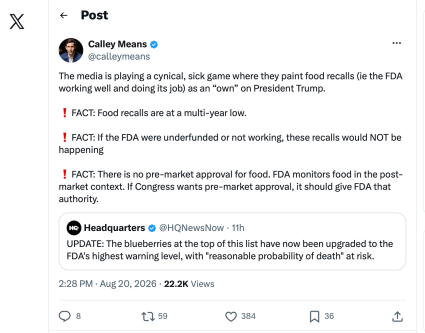
A senior adviser at the Department of Health and Human Services spent this week posting three claims about food safety on X, each one preceded by a red exclamation point and the word FACT. As of Thursday, August 20, 2026, CDC counts 10,930 people sick in the federal Cyclospora outbreak, at least 454 of them hospitalized, two dead, across seventeen states, with illness onsets running from June 14 through August 11. My own fifty‑state tally, built from what each state health department publishes, stands at 31,889. Of the three FACTS, one is roughly right and proves nothing, one is a non sequitur, and one is contradicted by FDA’s own website and by his own Secretary.
The man posting is the senior adviser for food and nutrition policy at HHS.
It is worth knowing who is talking, because this is not a commentator with a view about the government’s food safety record. Calley Means came into the second Trump administration in March 2025 as a White House special government employee, a designation capped at 130 days, and left when the term ran out that fall. In November 2025 HHS confirmed to The Hill that he had joined the department as a senior adviser in the Office of the Secretary, supporting food and nutrition policy, working directly with the Secretary. The food safety record is not his opinion. It is his portfolio.
His post says the press is playing a cynical and sick game by treating food recalls as a scoring point against the President, when a recall is the FDA working well and doing its job. Then the three bullets.
The recall count is roughly right, and it proves nothing in either direction.
The first is that food recalls are at a multi‑year low. On the raw count he is close enough. U.S. PIRG’s tally has FDA and USDA announcing 320 food recalls in 2025 and 296 in 2024, against nearly 400 in 2018, with at least 160 so far in 2026. Through the third week of August, 160 annualizes to something in the mid‑250s. Lower. Fine.
The trouble is that the organization whose numbers he is leaning on says, in the same report, that the change does not mean food was less safe or that regulation was better. A recall count is not a safety metric and never has been. Read it going up and you can call it vigilance. Read it going down and you can call it vigilance too. The number itself does not tell you which, and I have spent thirty‑three years watching quiet years turn out to be years when nobody looked.

PIRG’s own worked example is the ready‑to‑eat pasta Listeria outbreak. The first illness was in August 2024. The first recall came in June 2025, and recalls were still expanding into that October, by which point six people were dead. Ten months of that outbreak appear in no recall tally anywhere, because a recall enters the count on the day a company issues it, not on the day the food went bad. A recall is a lagging indicator of an outbreak somebody has already found. You cannot recall what you never found.
Foreign inspections fell from about a thousand a year to fewer than two hundred.
The second FACT is that if FDA were underfunded or not working, these recalls would not be happening. There are two problems with that sentence, one factual and one logical.
The factual one. ProPublica reported last November that American inspections of foreign food facilities had fallen to historic lows, with about two dozen current and former FDA officials attributing the drop to staffing cuts. Before the pandemic the agency managed roughly a thousand foreign inspections a year. Last year it managed fewer than two hundred. The cause was not that inspectors were fired. It was that sixty‑five percent of the staff who booked their travel and processed their expenses left or were let go, leaving investigators to arrange their own flights, visas and diplomatic passports while a reimbursement backlog climbed past a million dollars on their personal credit cards. The Food Safety Modernization Act told FDA to complete more than nineteen thousand foreign inspections a year by 2016. It has never come close.

That is not an abstraction in this outbreak. The lettuce came out of Guanajuato. Bioreports established, and I wrote about it last week, that FDA had not sent an inspector to the Taylor Farms plant in Mexico since 2019, and before that not since 2013, the year of the last outbreak traced to the same address. In the first six months of 2026, five of that company’s more than 160,000 produce shipments from Mexico were physically examined at the border.
Behind that, the staffing. FDA lost 3,859 positions in fiscal 2025 and another 473 in fiscal 2026; CDC lost 2,499 and 390. FDA also suspended the proficiency testing program that verifies its network of roughly 170 laboratories can accurately detect what they are looking for, a program whose published examples include testing for Cyclospora in spinach. And surveillance for this parasite was made optional in July 2025, which is the single decision that has done the most to make this summer illegible.
Credit where it belongs. Congress rejected the discretionary cut this administration asked for and gave FDA close to seven billion dollars for fiscal 2026, with $1.17 billion of it for the Human Foods Program, and HHS points to a proposed $33 million food safety increase in the fiscal 2027 request. The appropriation is not the problem. The capacity is, and capacity is what you lose when you fire the people who make inspectors’ travel possible and then say the inspectors were never touched.
The logical problem is simpler. Recalls are overwhelmingly voluntary and company‑initiated. FDA’s mandatory recall authority arrived with FSMA in 2011 and has been used a handful of times in fifteen years. When product comes off a shelf it is almost always the company acting, usually after the illnesses have already been counted, and often after a plaintiff’s lawyer or a state epidemiologist got there first. Crediting the agency for the recall count is crediting it for decisions other people made. In this outbreak the first illness began June 14 and the first federal advisory came July 16. The argument would have the government take a bow for the month in between.
The third FACT is that there is no premarket approval for food, that FDA monitors food in the post‑market context, and that if Congress wants premarket approval it should give the agency that authority. This one is not a matter of framing. It is wrong, and it is wrong against the agency’s own published guidance.
FDA’s page on determining the regulatory status of a food ingredient says that any substance reasonably expected to become a component of food is a food additive subject to premarket approval by FDA, unless it is generally recognized as safe or falls within one of the other exclusions in section 201(s), and that a food containing an unapproved additive is adulterated. That authority is section 409, created by the Food Additives Amendment of 1958, and its entire purpose was to shift the burden of proving safety off the government and onto the company that wants to sell the thing.

Color additives are stricter still. Under section 721 they require FDA approval before they may be used in food at all, the certified colors require batch‑by‑batch certification, and there is no GRAS exemption available for a color under any circumstance. Infant formula requires premarket notification before marketing under section 412, a provision this firm has had painful occasion to study this year. Food contact substances go through notifications under section 409(h). Low‑acid canned and acidified foods require a filed process before a single case ships.
There is a fair version of the point he was reaching for, and I will make it for him, because it is true and it matters. Nobody approves a head of lettuce. There is no premarket approval of foods as such, only of what is added to them and what touches them on the way to the bag. That is the accurate sentence. He wrote the categorical one instead, and the categorical one is false.
Ten days earlier, his own Secretary called the exception to that authority a loophole industry hijacked.
On August 10 the Secretary of HHS stood up and announced a proposed rule ending self‑affirmed GRAS and making notification to FDA mandatory. He called the pathway a massive loophole that industry had hijacked. He said he had asked FDA how many ingredients are in the American food supply and been told nobody knows, that it might be four thousand or twelve thousand, probably somewhere near ten. Ten days later his senior food adviser posted that there is no premarket approval for food.
A loophole in what?
GRAS is not the absence of a premarket approval requirement. It is the statutory exception to one. Section 201(s) carves GRAS substances out of the food additive definition, and that carve‑out is precisely what lets a company skip the section 409 petition. Remove section 409 and there is nothing left for GRAS to be an exception to, and the proposed rule at 91 FR 51834 has no subject matter at all. The rule exists because premarket approval exists. That is the whole reason the Secretary can call the workaround a loophole and mean something by it.
I have some standing here, and it did not come cheap. In December 2023 I wrote to FDA about tara flour, an ingredient that entered the American food supply without anyone notifying anyone, after our clients ate it in a frozen product and nearly forty of them lost their gallbladders. In May 2024 the agency determined that tara flour is not GRAS and is therefore an unapproved food additive that renders the food adulterated, and I wrote here the day it posted. FDA’s new proposed rule cites that episode as its lead example of what self‑affirmation failed to catch. Every link in that chain runs through the premarket approval authority the senior food adviser says the agency does not have.
None of it would have kept the parasite off the lettuce.
Here is what bothers me, and it is not the errors. Premarket approval is beside the point. No approval regime ever written stops a parasite reaching iceberg lettuce in a field in central Mexico, because the parasite is not an ingredient anyone added or intended. It arrives in water, on hands, in a place where sewage and irrigation meet. Pointing at Congress for an authority that would not have mattered, in the twelfth week of the largest Cyclospora outbreak in American history, is not an argument. It is a change of subject.
Four things would have mattered, and every one of them sits inside his own building. Put the Food Traceability Rule back on schedule instead of 2028. Name Cyclospora somewhere in the pre‑harvest agricultural water rule, which today measures a bacterial indicator with no relationship to this organism. Restore the surveillance that was made optional. Get the inspectors back on the airplanes. Not one of the four requires an act of Congress, and not one of them is partisan.
I put fifteen of these on this page two weeks ago, and the objection I heard back was that I am too hard on the government. Maybe I am. Being hard on the government is not the same as being wrong about it, and the man whose job is federal food policy spent this week defending the record instead of changing it.
Ten thousand nine hundred and thirty in the federal outbreak. Four hundred fifty‑four in a hospital bed. Two dead. Thirty‑one thousand eight hundred eighty‑nine counted by the states, and CDC’s own surveillance page saying it is looking at more. That is the subject the FACTS were posted about.
A recall is not proof the system worked. It is a notice, sent after the fact, usually by the company that failed, telling you that something already went wrong and you may have eaten it. Calling this a good year for recalls is not a defense of the FDA. It is an insult to the people counted in it.