


Recent surveys show that, by a wide margin, Americans increasingly see their government as corrupt.
A September Gallup poll finds that perceptions of government corruption have hit a 20-year peak, with 89% calling it “widespread.” A similar survey by the University of Massachusetts Amherst, also released this month, reports even higher numbers: Nearly all Americans, 97%, see at least some corruption in the federal government, with three-quarters seeing “a great deal.”
“Virtually everybody thinks Washington is corrupt,” writes Raymond La Raja, professor of political science at UMass Amherst and co-director of the poll, in the report.
Why We Wrote This
History shows periods of corruption tend to be followed by waves of reform. But legislative or constitutional fixes face high hurdles in such polarized times.
There’s less agreement as to which parts of government are the worst – with responses breaking down along partisan lines. The UMass survey finds Democrats rank the presidency as the most corrupt institution, while Republicans put the federal bureaucracy at the top of the list, followed by Congress. Likewise, opinions differ somewhat over what counts as “corruption,” with 90% of respondents citing illegal self-dealing, followed by legal self-dealing, political favoritism, and abuse of democratic institutions.
President Donald Trump’s soaring personal wealth since retaking office – including $1.4 billion from cryptocurrency last year alone – has fueled Democratic charges of corruption; his spokespeople maintain that he follows all applicable laws. Most recently, President Trump and his three sons have taken steps to sell the digital tokens from their cryptocurrency firm, potentially earning them billions of dollars and triggering concerns about conflicts of interest, according to a report in The Washington Sun.
Unlike rank-and-file government officials, presidents are exempt from most ethics rules – a loophole some experts say should be addressed. But generalized GOP antipathy toward bureaucrats, whom Mr. Trump has dubbed the “deep state” and accused of trying to undermine his policies, may be fueling Republican complaints of “corruption.”
Whomever one blames, experts on government ethics say declining trust in government to act in the public’s interest is breeding cynicism, with potentially serious consequences.
“If you do not have a critical mass of Americans who have confidence in our democracy and our institutions, that leads you down a very dangerous road,” says Daniel Weiner, senior director of the Elections and Government Program at New York University’s liberal-leaning Brennan Center for Justice.
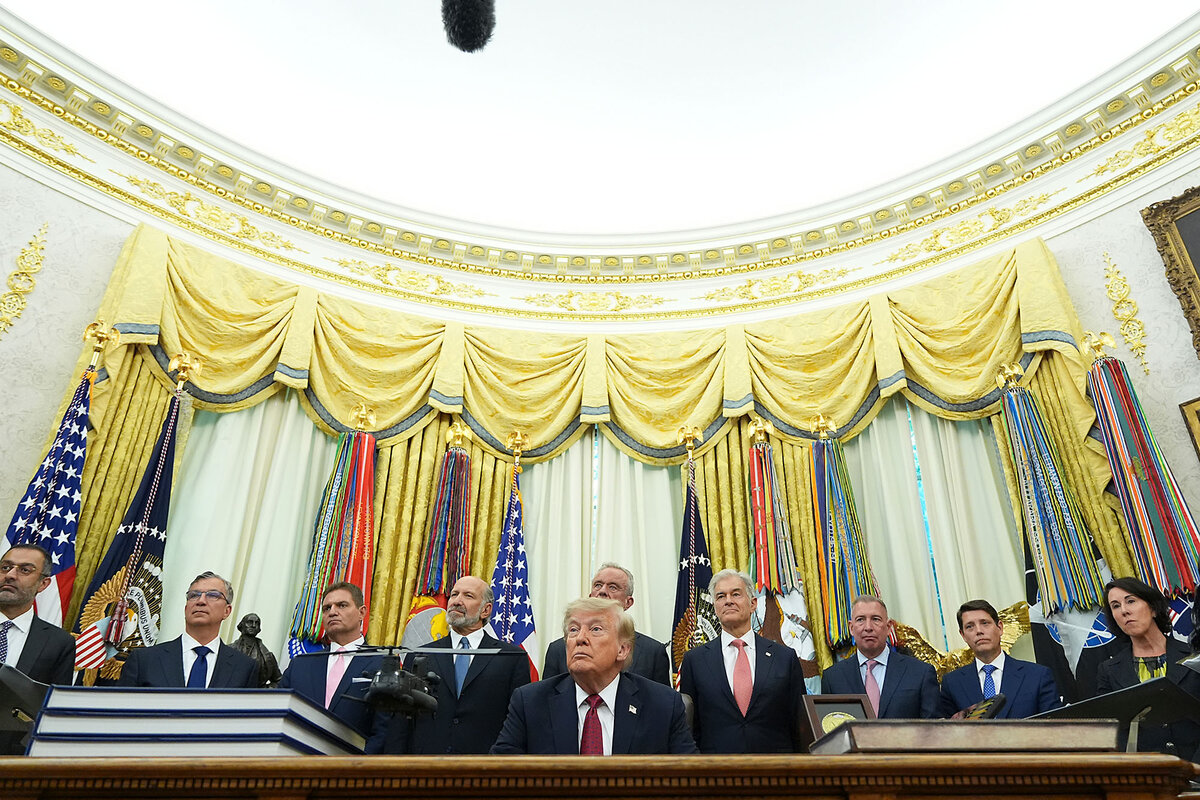
President Donald Trump listens as a reporter asks a question in the Oval Office of the White House, Aug. 31, 2026, in Washington.
The danger is “long-term, sustained disengagement with the ordinary political process,” Mr. Weiner adds. “That can foster extremism. It can foster a lack of willingness to engage with one’s fellow citizens.”
Mr. Weiner proposes nine solutions: Amend the Constitution to restore campaign finance limits. Ban big donations from government contractors. End “dark money,” referring to the undisclosed money aimed at influencing elections. Publicly fund campaigns. Overhaul federal ethics laws. Create a more effective ethics watchdog. Codify the Constitution’s emoluments clauses, which bar federal officials from accepting gifts from foreign and domestic sources that could have a corrupting influence. Take away the president’s pardon power.
What Congress is doing
In Congress, efforts to regulate cryptocurrency and other digital assets, which would affect Trump family ventures, are proceeding. Legislation known as the Digital Asset Market Clarity Act, aka the CLARITY Act, would ban government officials (including the president) and their spouses from issuing digital assets, but does not set clear limits on other family members. The bill faces a procedural vote in the Senate on Sept. 15, but hurdles to passage are high.
In July, the Republican-controlled House passed a bill that would ban stock trading by members and their immediate families. Most Democrats voted no, as the measure did not force lawmakers to divest their existing portfolios and excluded the executive branch. The Senate is not expected to take up the legislation before the November midterm elections.
Democrats in both the Senate and House have teed up bills on presidential ethics, including stopping presidents from profiting personally from their office and from issuing pardons to themselves. If Democrats win control of Congress in November, they can move that legislation forward – though with two-plus years to go in Mr. Trump’s second term, prospects for overcoming a presidential veto are dim.
Legislative or constitutional changes aren’t easy to achieve in these highly polarized times, and given several landmark Supreme Court rulings. Its 2010 decision Citizens United v. Federal Election Commission opened the floodgates of political money when the court found that such spending is protected speech, and that corporations and labor unions could not be limited in their independent expenditures.
Two years ago, in Trump v. United States, the high court ruled that former presidents have broad immunity from prosecution for actions taken within their constitutional duties. And it has long been Justice Department practice not to indict or prosecute a sitting president.
But over time, as the post-Trump era approaches, appetite for reform may grow stronger. Republicans and others are quick to note that charges of corruption have also dogged Democratic presidents, including questionable pardons issued by both Joe Biden (to his brothers and son) and Bill Clinton (to the ex-husband of a major donor to his presidential library). The Clintons also faced questions about fundraising for their family foundation while Hillary Clinton ran for president, and before that, served as secretary of state.
Looking at the array of proposals for government ethics reform, Republican strategist Ari Fleischer says “the one area that I do think is entirely legitimate is the pardon power.”
“I would like to see a constitutional amendment that carves back the president’s pardon power,” says Mr. Fleischer, White House press secretary under President George W. Bush. “Absent that, I’d like to see presidential candidates pledge a different process for issuing pardons.”
As for Mr. Trump’s dramatic rise in wealth as president, Mr. Fleischer attributes that to his “background in the business community, where things were just done differently.” He predicts that future presidents won’t follow Mr. Trump’s example on that front: “That’ll pass when he leaves.”
Comparisons to Watergate
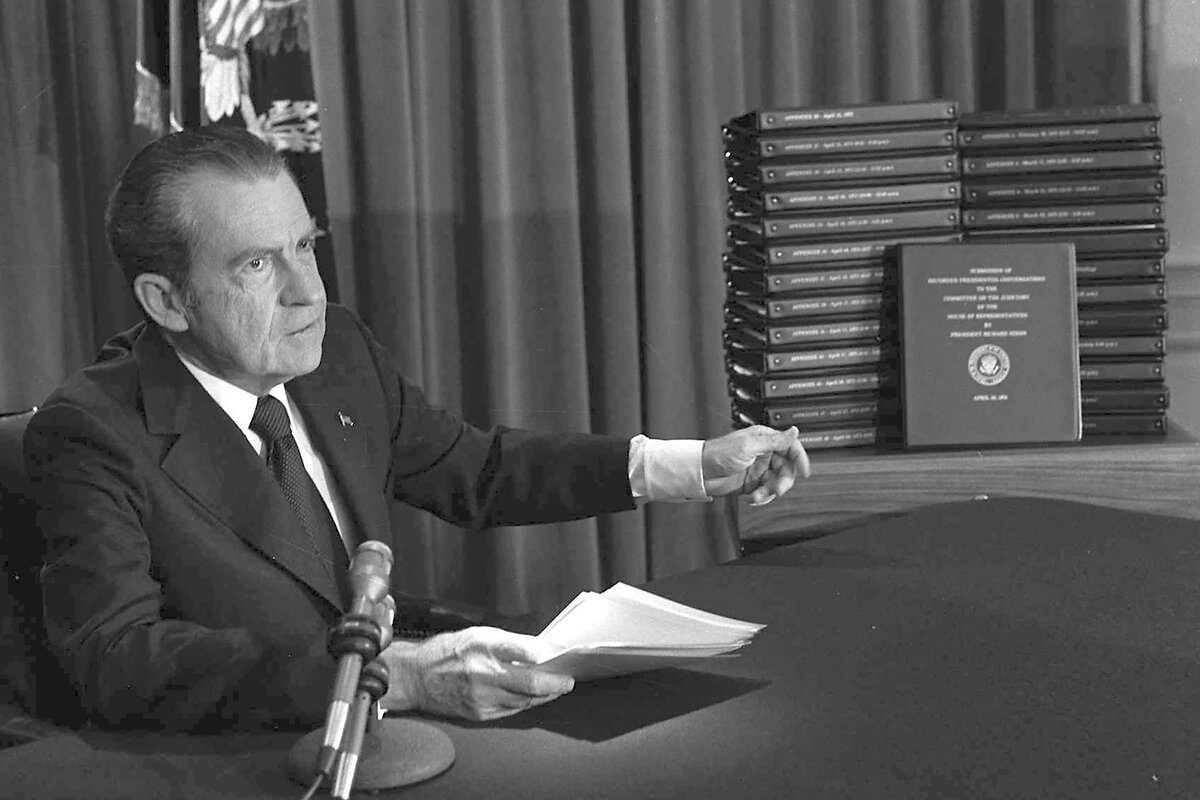
President Richard Nixon announces during a nationally televised speech that he would turn over transcripts of White House tapes to House impeachment investigators, in Washington, April 29, 1974.
History has shown that government reforms come in waves. The Gilded Age of the late 19th century – marked by major income inequality and the dominance of robber barons who wielded vast wealth and influence – eventually gave way to the reforms of the Progressive Era, including anti-monopoly laws, tax reform, and labor rights.
The last big wave of government ethics reform was sparked by the Watergate scandal of the early 1970s, which led to President Richard Nixon’s resignation. Resulting reforms included greater transparency in election spending, public financing for presidential campaigns, the Presidential Records Act, and measures aimed at curbing executive power.
In a recent discussion at the Nixon presidential library in California, Vice President JD Vance made headlines when he said that “if Watergate happened tomorrow, it would be like a 12-hour news story.”
“The idea that it would have taken down a presidency is crazy,” Vice President Vance continued, blaming the “deep state” for President Nixon’s downfall. He drew a parallel to “what the same groups of people, the same institutions, tried to do to Donald Trump in the first administration.”
To the extent that there’s a precedent for the current situation, Watergate is probably as close as it gets, says Russell Riley, co-chair of the Presidential Oral History Program at the University of Virginia’s Miller Center. But the Watergate scandal was different, he adds, “in that there was not the pattern of self-enrichment that you see in this instance.”
“The sins of Watergate were largely political,” Professor Riley says. Whereas “the sins in this case would be not just political, but more ethical and legal at the same time. So I don’t think that we have anything that quite mirrors this in any of American history.”