

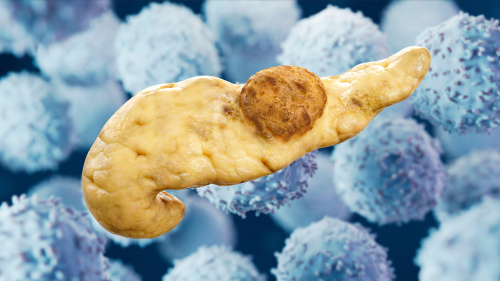
- A peptide vaccine targeting KRAS mutations in patients at high risk for pancreatic cancer induced durable T-cell responses.
- In 16 patients with evaluable pancreatic cysts, three had complete resolution of the cysts, three had partial regression, and the rest had stable cyst status.
- No patient developed severe vaccine-related adverse events.
A peptide vaccine targeting KRAS mutations in pancreatic cancer showed preliminary evidence of activity in a small study of high-risk patients.
The vaccine elicited KRAS-specific T-cell responses in 18 of 20 patients with mutations associated with pancreatic ductal adenocarcinoma (PDAC). Vaccine-induced T-cell clonotypes persisted for up to 2 years, and no patient developed pancreatic cancer during 16.5 months of follow-up. No patient developed grade ≥3 adverse events (AEs).
The findings support continued evaluation of the vaccine for PDAC interception, reported Neeha Zaidi, MD, of Johns Hopkins Medicine in Baltimore, and colleagues in Cancer Discovery.
“We were able to collect blood before and after vaccination and look at whether there was an immune response specific to the vaccine, but we weren’t able to look at what happened at the tissue level,” Zaidi told MedPage Today. “Were these immune cells actually able to get into the tissue? What were they doing there?”
“Our kind of follow-up study is looking at that, as we are vaccinating people who have pancreatic cysts or IPMN [intraductal papillary mucinous neoplasm] lesions. A subset of these individuals go to surgery because they’re at such high risk of developing pancreatic cancer. We’re vaccinating them before surgery to determine not only the effects in the blood, but also whether the immune cells are actually getting into tissue.”
At least 10% of patients with PDAC have a hereditary predisposition. Several studies have shown that increased hereditary PDAC risk is linked to pathogenic germline variants in cancer susceptibility genes, the authors noted in their background information. Although pancreas surveillance has been associated with PDAC downstaging and good long-term survival, outcomes remain poor for other patients, particularly those who drop out of surveillance.
Given that evolution from precursor lesions to PDAC occurs over a decade or longer, a window of opportunity exists to intercept cancer development in high-risk patients, the authors continued. Although IPMNs are amenable to surgery, the procedures carry a risk of significant morbidities. No immune-interception approaches exist for pancreatic intraepithelial neoplasias (PanINs), the most common PDAC precursor, and the lesions generally are not detectable on imaging studies. Noninvasive interception approaches are urgently needed for genetically defined high-risk cohorts.
Although PDAC is an immunologically “cold” cancer, the precancer microenvironment is less immunosuppressive compared with established PDAC, suggesting precancers may be more susceptible to immune-interception strategies.
Mutant (m)KRAS is an oncogenic driver in more than 90% of PDAC and a majority of associated precursor lesions. As an initiating genetic event, mKRAS is an attractive target for both precision immunotherapy in PDAC and immune-interception strategies in the precursor setting.
In a preclinical model of mKRAS-driven PDAC, the authors found that vaccination against mKRAS slowed progression of early PanINs to invasive cancer and prolonged survival. They subsequently developed a clinical-grade vaccine (mKRAS-VAX) that targets the six most common KRAS mutations found in PDAC. They evaluated the vaccine in a first-in-human trial involving 20 patients with hereditary predisposition to PDAC.
All of the patients had familial or germline PDAC predisposition and radiographic evidence of a pancreatic abnormality, typically a pancreatic cyst consistent with an IPMN. Each patient received five subcutaneous vaccinations with mKRAS-VAX. Serial blood samples were obtained through 17 weeks, followed by optional follow-up visits annually. The most common vaccine-related AEs were fatigue, chills, and flu-like symptoms, all of which were self-limiting.
Vaccination led to a median 18.2-fold increase in average mKRAS-specific T-cell response. All but two patients met criteria for immune response, a ≥2.5-fold increase in pooled mKRAS-specific T-cell response. Responses occurred across a range of HLA alleles, suggesting the vaccine has potential as an off-the-shelf, HLA-agnostic interception strategy, the authors noted.
T-cell responses exhibited differences in antigen-specific immunogenicity, as the vaccine raised greater T-cell responses against G12A, G12V, and G12R as compared with G12D and G13D. Despite the variability, 10 of the 20 patients had significant response against all six mKRAS antigens included in the vaccine.
An exploratory, post-hoc analysis of MRI of pancreatic cysts in 16 patients showed cyst resolution in three patients, partial regressions in three patients, and stable cyst status in the remaining patients. MRI analysis of cysts in a cohort of unvaccinated patients with similar clinical characteristics showed cyst regression or resolution in 6.8% as compared with 37.5% in the vaccinated patients.
Of 16 patients with extended follow-up (five who returned for the 2-year visit), three maintained a significant pooled average mKRAS-specific T-cell response and eight maintained a significant response to at least one antigen.
“This is the first report to our knowledge of an interception vaccine targeting mKRAS in a cohort of individuals with inherited predisposition to developing pancreatic cancer,” the authors stated. “These findings directly serve as proof-of-concept to advance oncogene-targeted vaccines as an interception approach in high-risk populations predisposed to PDAC and other tumor types that share common driver mutations.”
“Further studies are needed to assess clinical efficacy on a larger scale and to identify the optimal timing of booster vaccinations to maintain durable T-cell responses that, we posit, will ultimately lead to the prevention of pancreatic cancers,” they wrote.